
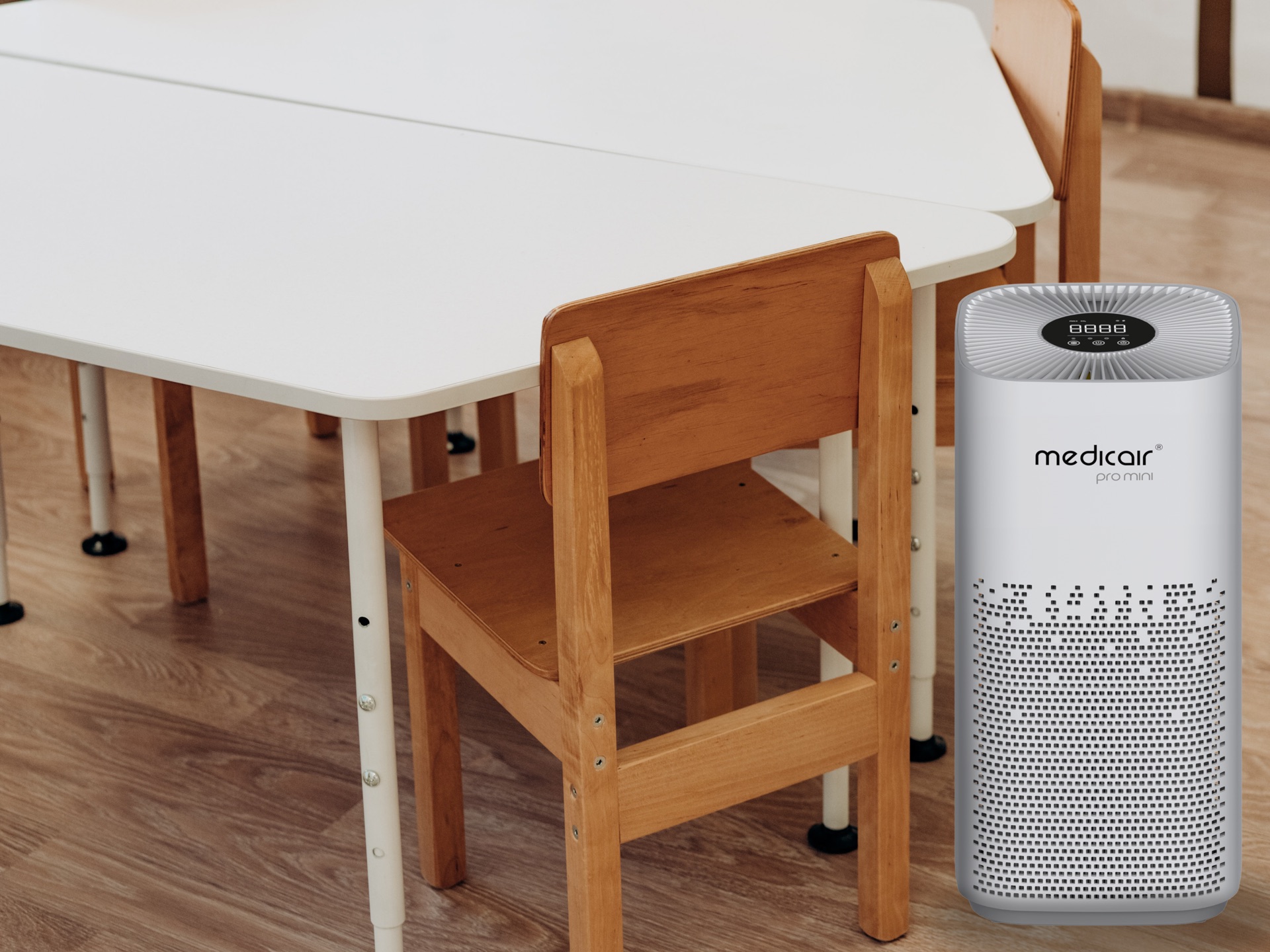
Aim to keep classroom CO₂ below 800 ppm. That is Dubai Municipality’s 8-hour limit for existing buildings and the demand-controlled ventilation set-point that Al Sa’fat applies through the Dubai Building Code. The Code requires CO₂-based demand-controlled ventilation, with an alarm above 1,000 ppm, in spaces over 100 m² designed for 25 or more people per 100 m² (H.4.8.3). On Dubai’s indoor air quality index, 400–600 ppm is Good and 601–1,000 ppm is Moderate.
What CO₂ level is acceptable in a classroom?
| Source | CO₂ value |
|---|---|
| Dubai Municipality guideline, Table 2 | 800 ppm (8-hour average) |
| Al Sa’fat 502.02 | Set-point below 800 ppm; alarm above 1,000 ppm |
| Dubai EIAQI | Good 400–600 ppm; Moderate 601–1,000 ppm |
| WELL v2 A06 (option) | Below 900 ppm (1 point) or 750 ppm (2 points) |
| RESET Air | Acceptable < 1,000 ppm; high performance < 600 ppm |
The Dubai Municipality, Al Sa’fat and EIAQI values apply in Dubai, and WELL and RESET are voluntary building standards. Our guide to indoor air quality requirements in the UAE and Saudi Arabia covers the other emirates.
Why does CO₂ rise during lessons?
People exhale CO₂. A classroom puts many people in a small, closed, air-conditioned room for long periods, so CO₂ climbs whenever the fresh-air supply is lower than the room needs. It often peaks late in a lesson and after breaks, when rooms refill.
Do Dubai schools need continuous monitoring?
Dubai’s EIAQI says buildings with high-risk occupants, “e.g., schools, elderly care homes”, must implement enhanced IAQ monitoring protocols and additional mitigation strategies, “as required by sector-specific IAQ guidelines” (p15). It does not name those guidelines or give a deadline. Continuous monitoring is also the simplest way to find which classrooms are consistently under-ventilated.
Where should a classroom CO₂ sensor go?
At breathing height in the occupied zone, away from windows, doors, supply diffusers and students’ direct breath. A wall position roughly 1–2 metres above the floor and away from the air supply gives readings that represent the room.
How do you lower classroom CO₂?
Increase fresh air: check outdoor air dampers, fan schedules and filters, and use demand-controlled ventilation where the system supports it. Air purifiers do not remove CO₂. They are useful for particles, but CO₂ is fixed by ventilation.
Frequently asked questions
Is 1,200 ppm CO₂ bad in a classroom?
It is above the 1,000 ppm alarm level that Dubai’s building rules set for demand-controlled ventilation, so the room needs more fresh air. Dubai Municipality’s 800 ppm limit applies to the 8-hour average, not to a single reading.
Can a purifier fix high CO₂?
No. Only more ventilation lowers CO₂.
Can parents see classroom air quality?
Yes, where schools share monitor dashboards or display screens.
Sources
- Dubai Municipality, Technical Guidelines for Indoor Air Quality for Healthy Life (DM-HSD-GU119-IAQ, Version 4, December 2024): Table 2 (p33).
- Al Sa’fat – Dubai Green Building System, 2nd edition (January 2023): clause 502.02, which applies Dubai Building Code (2021) H.4.8.3.
- Dubai Municipality, Environmental Indoor Air Quality Index (EIAQI), DM-HSD-GU141-IAQI2, Version 1 (14 February 2025): Table 2 (p10), p15.
- International WELL Building Institute, WELL Building Standard v2 (Q2 2025): feature A06.
- RESET Air Standard for Commercial Interiors v2.0, and v2.1 draft (2023).
This guide explains public standards in plain language. It is not legal advice; check the current version of each document for compliance decisions.