Choosing a purifier
Choosing an air purifier for an office
The most common office complaint, a stuffy meeting room, is not a purifier problem. Purifiers help with dust and fine particles on open-plan floors and in rooms near entrances, loading areas or nearby construction.
Check CO₂ first. If CO₂ climbs through the day in a meeting room, the room needs more fresh air. No purifier lowers CO₂, including the Pro Max, which only displays a reading. Our ventilation and filtration assessment covers that side.
Size by volume. MedicAir’s sizing guidance for offices is about five air changes an hour. Leave headroom below each model’s stated maximum so the units can run at a middle speed through the working day.
Illustrative sizing, not measurements from a HawaQ project. Capacities are MedicAir’s stated maximums at full speed. Five air changes an hour; the Pro’s speeds are from its brochure.| Space | Clean air needed | Starting point |
|---|
| Private office, 12 m² × 3 m (36 m³) | 180 m³/h | 1 × Pro Mini |
|---|
| Meeting room, 30 m² × 3 m (90 m³) | 450 m³/h | 1 × Pro between Medium and High, or 2 × Pro Mini |
|---|
| Open-plan floor, 200 m² × 3 m (600 m³) | 3,000 m³/h | 3 × Pro Max, spread across the floor |
|---|
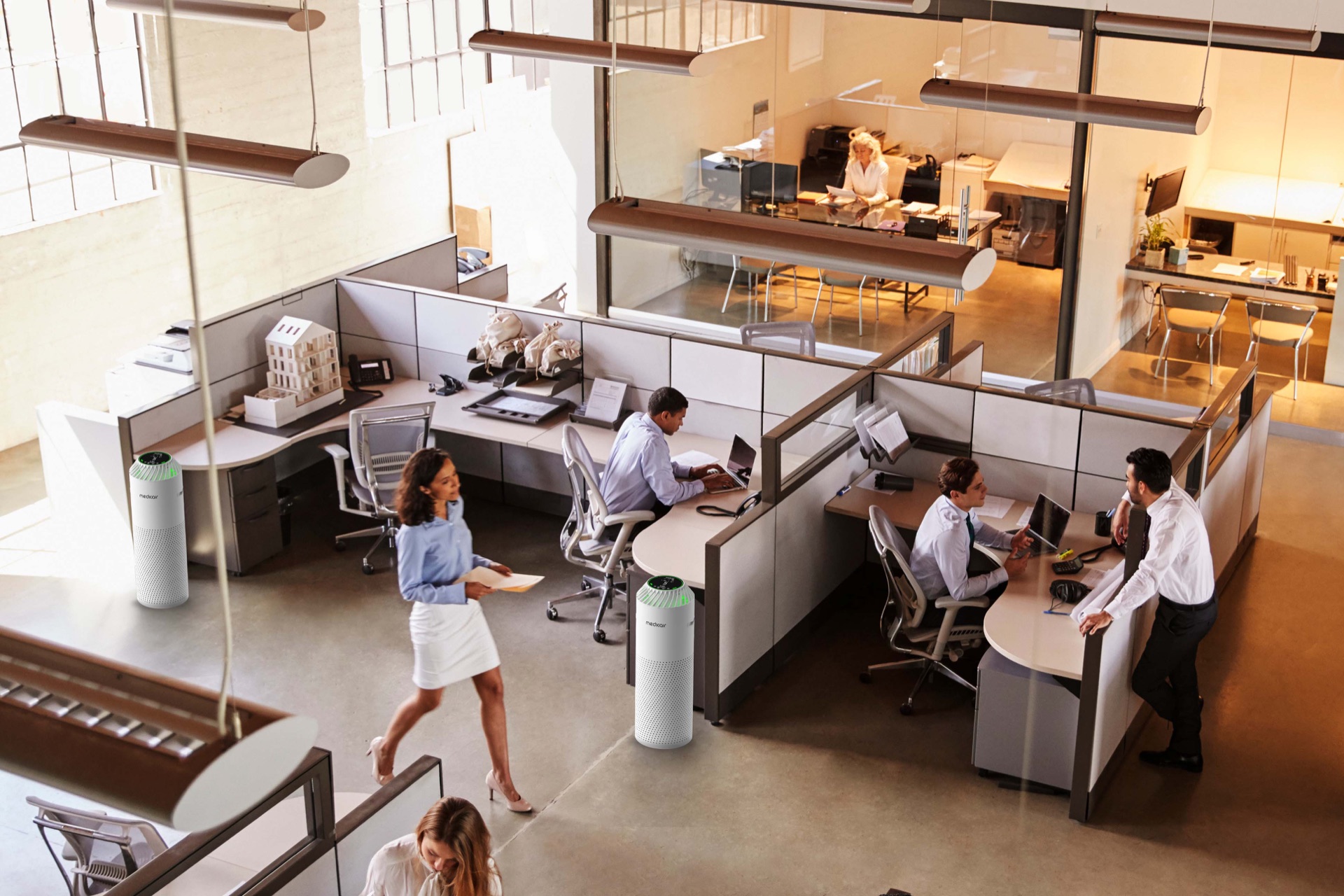
Spread the units out. On a partitioned floor, several units placed apart clean more of the air than one large unit in a corner. Near desks, noise matters: only the Pro has published airflow and noise at each speed, from up to 180 m³/h at 28 dB on Low to 360 m³/h at 45 dB on Medium.
After a fit-out, VOCs from new furniture, paint and carpets fall mainly with ventilation and time; see air quality after an office fit-out.
Compare the three models in our Pro Mini vs Pro vs Pro Max guide. Specifications and prices are on PRO TECHnology’s pages for the Pro Mini, Pro and Pro Max, each with a short enquiry form.