Sectors

Indoor air quality for hospitals and clinics in the UAE

Patients, visitors and staff share the same air for hours. We monitor it room by room and add HEPA and UV-C purification where the data shows it is needed.

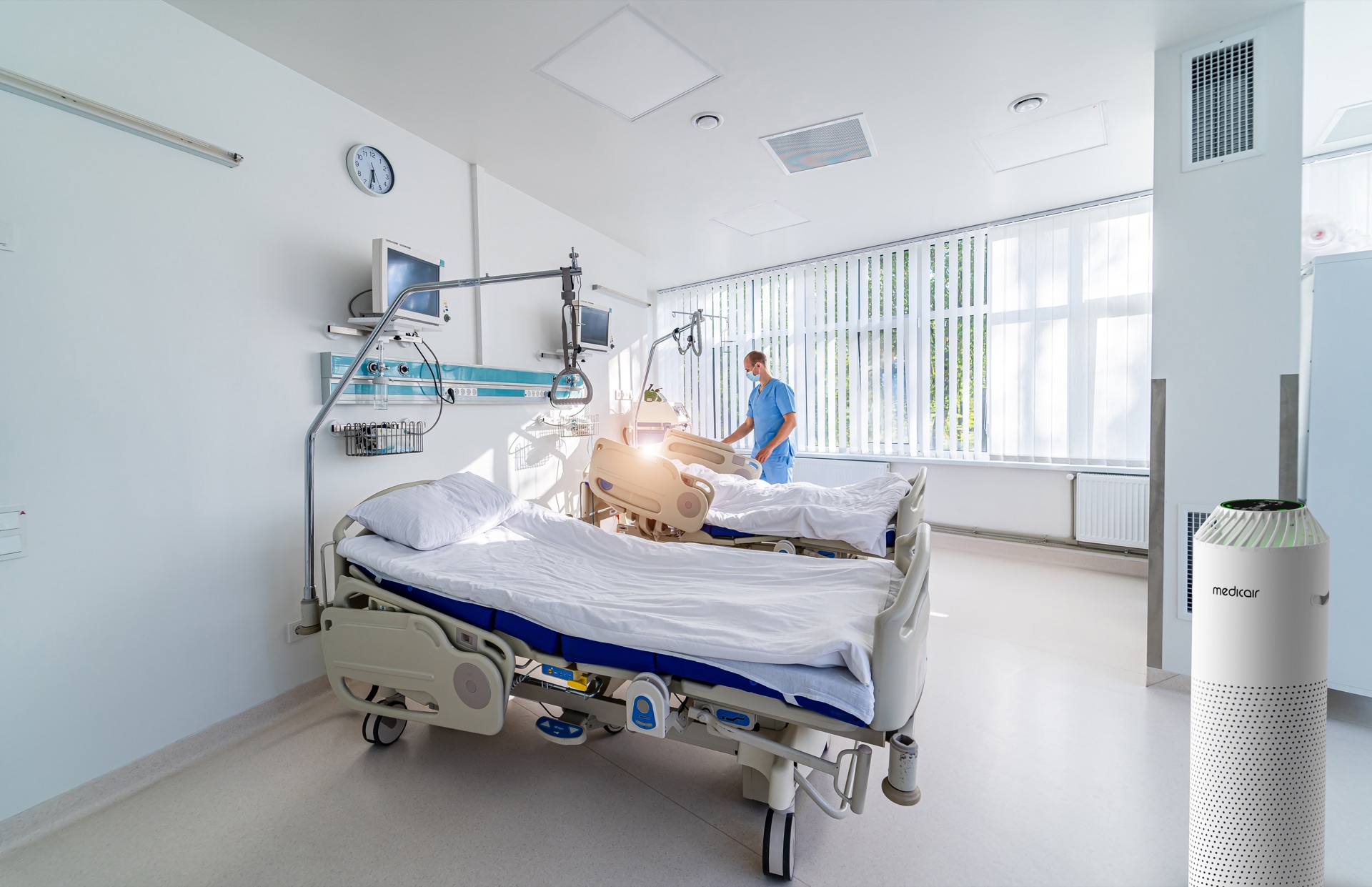
MedicAir Pro air purifier beside two beds in a bright hospital ward with a clinician in blue scrubs
In short

Healthcare buildings need clean, well-ventilated air to protect vulnerable patients and staff. Continuous monitoring of particles, CO₂, humidity and VOCs shows where ventilation falls short, and enclosed HEPA and UV-C purifiers add cleaning in wards, waiting areas and consultation rooms.

Why it matters

Why air quality matters in hospitals & clinics

Waiting areas fill and empty through the day, consultation rooms are small and busy, and wards are occupied around the clock. Each behaves differently, so a single reading tells you little. Continuous data shows when CO₂ climbs, when particles spike and where humidity drifts out of range.

Cleaning chemicals and disinfectants also raise VOC levels, which monitoring makes visible so they can be managed.

What we measure

  • CO₂ in waiting areas
  • PM2.5 and PM10
  • TVOC from disinfectants
  • Humidity
  • Temperature

Solutions

What we recommend

Always after measuring, and sized to the space.

MedicAir Pro Max

For wards and large waiting areas: up to 1,500 m³/h and an H14 HEPA filter as stated by MedicAir, with enclosed UV-C. Ask for an EN 1822 filter certificate before specifying it for patient areas: a 2025 independent test found the supplied Pro Max filters did not achieve an H13 or H14 rating.

MedicAir Pro Mini

For consultation and treatment rooms: compact and quiet, with an H14 HEPA filter as specified by MedicAir and UV-C.

Dinies UV-C

Laboratory UV chambers and UV-C units for HVAC and unoccupied rooms.

SafeTraces veriDART

Verification of airflow and clearance in critical spaces.

Choosing a purifier

Choosing an air purifier for a clinic

Portable HEPA purifiers can add filtered air in waiting areas and consultation rooms. They do not replace the ventilation a licensed facility must have, and they are not medical devices.

Size against a higher target. MedicAir’s guidance for healthcare rooms is about ten air changes an hour, its own suggestion rather than a regulation. At that rate a Pro Mini at its stated maximum serves about 40 m³, a consultation room of roughly 13 m² with a 3 m ceiling. Larger rooms need a Pro or more than one unit.

Illustrative sizing, not measurements from a HawaQ project. Capacities are MedicAir’s stated maximums at full speed. Ten air changes an hour.
SpaceClean air neededStarting point
Consultation room, 12 m² × 3 m (36 m³)360 m³/h1 × Pro between Medium and High, or a Pro Mini close to full speed
Waiting area, 60 m² × 3 m (180 m³)1,800 m³/h1 × Pro Max plus 1 × Pro, or 2 × Pro Max

The building’s ventilation comes first. Licensed healthcare rooms in Dubai follow ASHRAE 170 for the building’s ventilation. A portable unit can raise the equivalent air changes as a supplement, but the minimum outdoor air is still required, and placement should be agreed with the facility’s engineers.

UV-C. The UV-C lamps in MedicAir units are enclosed inside the unit. MedicAir states they work without emitting ozone but does not publish the lamp wavelength, so ask for that data when specifying units for patient areas. See UV-C air purifiers in hospitals and clinics.

PRO TECHnology’s guide for clinics and healthcare covers DHA requirements and the evidence behind MedicAir. Compare the models in our Pro Mini vs Pro vs Pro Max guide. Specifications and prices are on PRO TECHnology’s pages for the Pro Mini, Pro and Pro Max, each with a short enquiry form.

FAQ

Hospitals & Clinics: common questions

Have another question? Ask our team

Are MedicAir purifiers medical devices?

No. They are air purifiers, not medical devices. They support cleaner air alongside ventilation and infection-control procedures.

Which areas of a clinic should be monitored first?

Waiting areas, consultation and treatment rooms, and any space where many people spend long periods. The data then shows where to focus.

Is UV-C safe in patient areas?

Only enclosed UV-C is used in occupied rooms: the lamp sits inside the unit, as in MedicAir and Dinies UVG purifiers, and open UV-C is for empty rooms only. MedicAir states its UV-C works without emitting ozone but does not publish the lamp wavelength, so ask for that data before specifying units for patient areas.

Find out what is in your air

Book an indoor air quality assessment with HawaQ. We measure first, then recommend only what your space needs.