UV-C works best as a supplement to HEPA filtration, not a replacement. The US CDC states that UV germicidal irradiation is not a substitute for HEPA filtration, exhaust or negative pressure. In occupied rooms use only units where the UV-C light is fully enclosed, and choose models stated to be ozone-free.
Do UV-C air purifiers work?
UV-C light at around 254 nm damages the genetic material of microorganisms, but only with enough dose: intensity multiplied by time. Dubai Municipality’s guideline cautions that typical home UVGI units have limited effectiveness and that effective destruction usually needs much higher exposure than a typical home unit provides (Appendix 6, p57). That is why design and airflow matter more than the label.
Are they safe around patients?
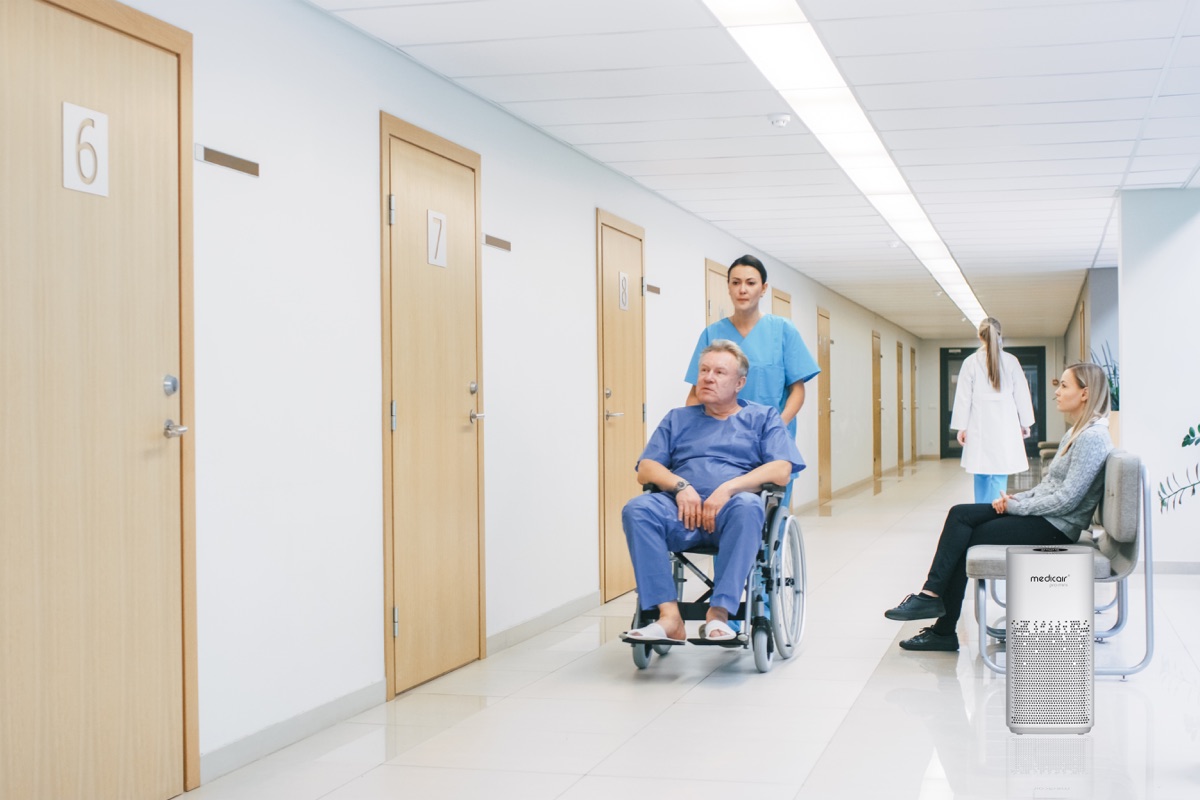
Direct UV-C exposure harms skin and eyes. In occupied rooms, use only purifiers where the lamp is fully enclosed inside the unit, such as MedicAir purifiers and Dinies UVG air purifiers. Open or mobile UV-C, such as Dinies UV-Mobil, is for empty rooms only.
Do UV-C purifiers produce ozone?
Some lamps emit at 185 nm and produce ozone; germicidal 254 nm lamps chosen as ozone-free do not. MedicAir states its UV-C works without emitting ozone, and the Dinies catalogue describes the lamps in its UV-C air purifiers as ozone-free. Dubai Municipality notes that ozone generators are “not always safe and effective” for controlling indoor pollutants (Appendix 6, p55).
UV-C or HEPA: which matters more?
HEPA. The CDC states that UVGI “is also not recommended as a substitute for HEPA filtration, local exhaust of air to the outside, or negative pressure”. A purifier that combines HEPA with enclosed UV-C, as MedicAir does, captures particles first and treats the air stream as well.
How much air should a portable unit clean in a clinic room?
The CDC describes portable HEPA units filtering 300–800 cubic feet per minute and achieving the equivalent of at least 12 air changes per hour in the settings it covers. Size by room volume: a 30 m³ consultation room at 12 ACH needs about 360 m³/h of clean air.
Which HawaQ solutions use enclosed UV-C?
MedicAir Pro Mini, Pro and Pro Max (HEPA, activated carbon and enclosed UV-C), and Dinies enclosed UV-C air purifiers such as the UVG series. MedicAir purifiers are not medical devices; they support, and do not replace, ventilation and infection-control procedures.
Frequently asked questions
Is UV-C safe in a waiting room?
Yes, if the UV-C light is fully enclosed inside the purifier so no one is exposed.
Does UV-C remove dust?
No. UV-C treats microorganisms; particles need filtration such as HEPA.
Does Dubai Municipality’s IAQ guideline cover hospitals?
No. Its scope excludes facilities dedicated to the medical sector, which follow their own requirements.
Sources
- US CDC, Guidelines for Environmental Infection Control in Health-Care Facilities: Air.
- Dubai Municipality, Technical Guidelines for Indoor Air Quality for Healthy Life (DM-HSD-GU119-IAQ, Version 4, December 2024): Scope p7; Appendix 6 p55 and p57.
- MedicAir product information; Dinies Technologies catalogue.
This guide explains public standards in plain language. It is not legal advice; check the current version of each document for compliance decisions.