
Black mould, or black mold, in an air conditioner grows where the unit stays wet: the cooling coil, the drip tray and dusty duct linings. In Dubai, where the AC runs for most of the year in humid air, those parts rarely dry out. Look for a musty smell when the AC starts, dark spots on vents and grilles, and symptoms that ease when you leave home. Fix the water first, have the AC cleaned by a maintenance company approved by Dubai Municipality, keep room humidity below 60%, and check that the mould does not come back.
Why does mould grow inside an AC in Dubai?
An air conditioner dries the air by cooling it over a cold coil. Water condenses on the coil, runs into a drip tray and leaves through a drain line. The US EPA points out that cooling coils are designed to remove water from the air, so they are wet whenever the AC cools. Dust that gets past the filter settles on these wet surfaces and feeds mould.
Dubai Municipality’s indoor air quality guideline lists “microbiological growth in drip pans, humidifiers, ductwork, coils” among the HVAC sources of indoor air problems. It also warns that duct liners with fibrous or rough surfaces hold dirt and moisture that feed mould, and that mould which has grown into fibrous material is difficult to remove.
Three things make it worse in Dubai:
- The AC rarely rests. Units run for most of the year, so coils and trays stay wet most of the time.
- Humid air gets in. Coastal homes take in humid outdoor air through doors, gaps and fresh-air intakes.
- Drains block. A blocked drain line or a tray that does not empty leaves standing water. The EPA calls substantial standing water or debris in the tray a problem that needs immediate attention.
An AC can also cool a room without drying it enough. An oversized unit switches off before it removes much moisture, and a fan that keeps blowing over a wet coil can return moisture to the room. Stadler Form explains how much humidity an AC removes, and what AC dry mode does.
What are the signs of mould in an AC?
- A musty or earthy smell when the AC starts.
- Dark spots on vent grilles and diffusers, or on the ceiling around them.
- Dark growth on the louvres of a split unit, or on the fan you can see behind them.
- Water dripping from the indoor unit, or a drip tray that stays full.
- Mould returning on walls, wardrobes or ceilings near the vents soon after cleaning.
- Symptoms that ease when you leave home. The CDC lists a stuffy nose, sore throat, coughing or wheezing, burning eyes and skin rash among the possible effects of mould.
Is the black stuff on my AC vent mould?
Not always. Dark marks around a ceiling vent can be mould, or dust and dirt carried by the airflow and left on the ceiling. The US EPA notes that a substance may look like mould, but only an expert can confirm it, sometimes with a laboratory test.
“Black mould” describes a colour, not a type you need to identify. The CDC describes Stachybotrys chartarum, the mould usually meant by black mould, as greenish-black, and says it is not necessary to find out which mould is growing: all moulds should be treated the same way for health risk and removal.
Is black mould in an AC dangerous?
It can affect health, and it affects some people far more than others. The CDC says damp and mouldy places may cause a range of health effects, or none at all. For some people mould causes a stuffy nose, sore throat, coughing or wheezing, burning eyes or a skin rash. People with asthma or a mould allergy may react severely, and people with weakened immune systems or chronic lung disease can get lung infections from mould.
The US EPA advises not to run an HVAC system you know or suspect is contaminated with mould, because it could spread mould through the building. In a Dubai summer that is rarely practical for long, which is one more reason to find and fix the source quickly. Anyone with symptoms should see a doctor.
Do you need a mould test?
If you can see mould, you do not need a test to know it is there. The US EPA says that in most cases, if visible mould growth is present, sampling is unnecessary. The CDC does not recommend mould testing, and says you do not need to know the type of mould to remove it.
An inspection is worth it when:
- You can smell mould but cannot find it.
- Mould keeps coming back after the AC or the room has been cleaned.
- People feel unwell at home and better away from it.
- You need evidence for a landlord or building manager.
- A building has to be compared with Dubai Municipality’s guideline value of 500 per m³ for total fungi in existing buildings.
The aim is to find the moisture, not just the mould. A HawaQ mould investigation combines a visual inspection, room-by-room humidity and moisture readings, a check of the AC coils, drip trays, filters and diffusers, continuous monitoring of the air, and air or surface samples analysed by a laboratory where needed. The report says where the mould is, why it grows and what to fix first.
How do you get rid of mould in an AC?
- Stop the water. Make sure the drip tray drains and the drain line flows; the US EPA advises keeping drip pans clean and drain lines unobstructed. Fix any leak near the unit or the ducts, and dry wet materials within 24–48 hours.
- Clean the AC properly. The coil, drip tray, fan and accessible ducts need cleaning, not just the filter. In Dubai, Al Sa’fat requires HVAC equipment to be inspected and cleaned by a specialised maintenance company approved by Dubai Municipality, or by a building operator who can show they are qualified.
- Replace what cannot be cleaned. The EPA says duct insulation that gets wet or mouldy cannot be cleaned effectively and should be removed and replaced.
- Be careful with sprays. The EPA notes that little research supports biocides or ozone inside ducts, and that sealants should never be used to cover actively growing mould. Ask the company to show you any mould it says it has found.
- Clean small patches around the vents. On hard surfaces, scrub with detergent and water and dry completely. Larger areas, over about 1 m² (the EPA’s 10 square feet), need a more careful, professional approach.
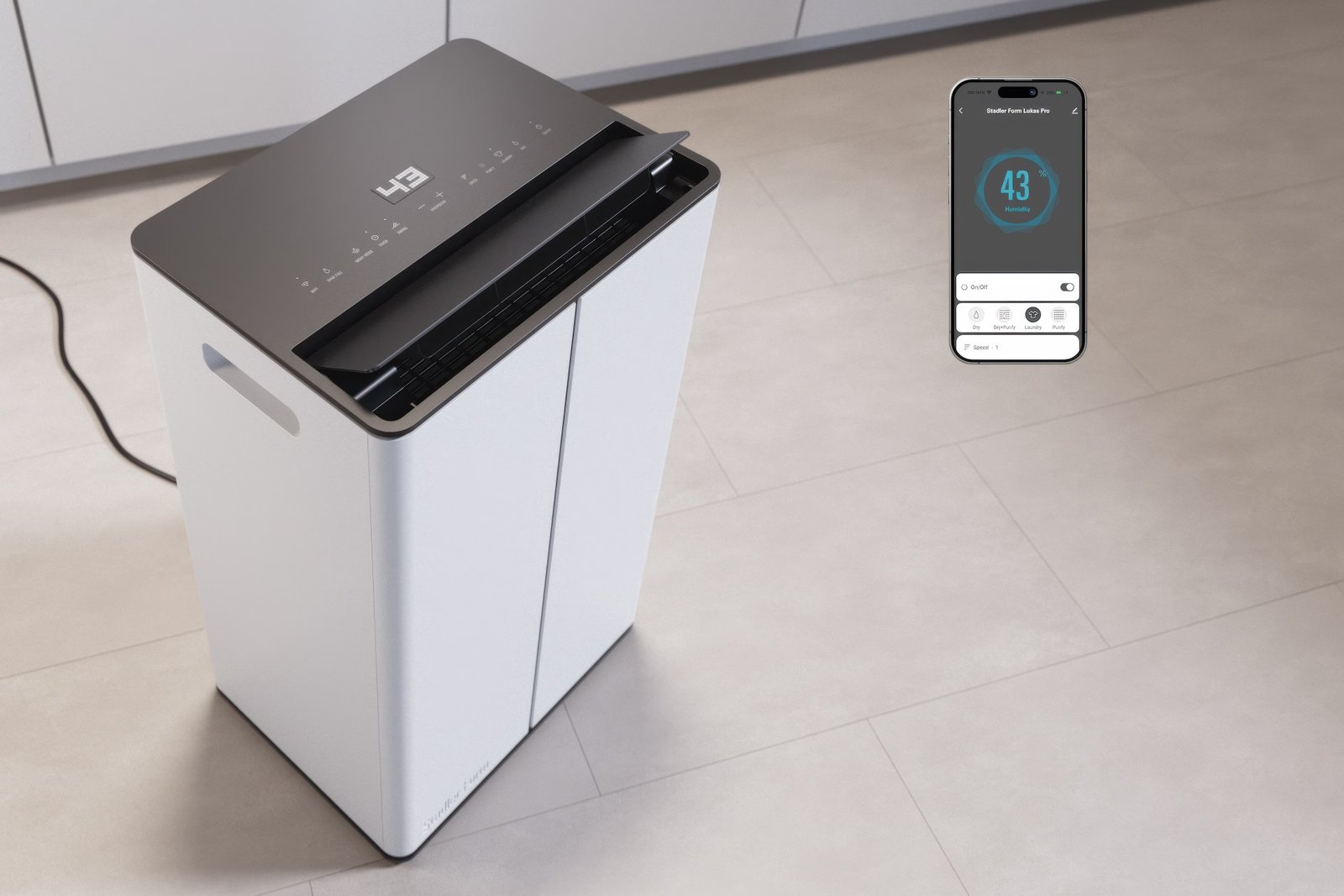
- Dry the rooms. Keep indoor humidity below 60%, ideally 30–50% (US EPA). Where readings stay high, a dehumidifier sized to the room helps: Stadler Form Lukas Pro removes up to 50 litres a day for rooms up to 175 m² and has an H11 particle filter, and Stadler Form Lukas removes up to 20 litres a day for rooms up to 70 m². Stadler Form says these maximums are reached only from about 22 °C and 70% humidity, so a cooler air-conditioned room will see less.
- Check that it worked. Monitor humidity after the clean, and look and smell again after a few weeks of normal use.
How often should an AC be cleaned in Dubai?
Dubai Municipality’s indoor air quality guideline sets a maintenance routine for a building’s HVAC system, and says the schedule should follow the manufacturer’s recommendations. For a split unit at home, follow the manufacturer’s schedule and use these intervals as a benchmark.
| What | Dubai Municipality guideline |
|---|---|
| Building and HVAC inspection | At least every three months |
| Drip trays (water trays) | Cleaned at least every month |
| Cooling coils and condensate pipes | Cleaned at least every six months |
| Fans, dampers and other air-handling unit parts | Cleaned at least every six months |
| Filters | Cleaned or replaced so they never clog |
| Airflow, temperature and humidity | Checked and adjusted at least once a year |
| Maintenance records | Kept for all work |
How do you stop AC mould coming back?
- Keep indoor humidity below 60% and check it room by room, including bedrooms and wardrobes. See the ideal indoor humidity for Dubai homes.
- Keep the drip tray and drain line clear, and have the coils cleaned on schedule.
- Clean or change filters before they clog. Dubai Municipality notes that dirt and dust on damp surfaces is what microbes feed on.
- Avoid fan settings that keep air moving over a wet coil after cooling stops.
- Run a dehumidifier in rooms that stay humid, such as a ground-floor bedroom or a room near the sea.
- Fix leaks and dry wet materials within 24–48 hours.
Mould comes back unless the moisture goes away. The US EPA puts it plainly: if the conditions that caused the mould growth are not corrected, mould growth will recur.
Frequently asked questions
Can black mould in an AC make you sick?
It can. The CDC says mould can cause a stuffy nose, sore throat, coughing or wheezing, burning eyes or a skin rash in some people, and severe reactions in people with asthma or a mould allergy. Anyone with symptoms should see a doctor.
Is the black stuff in my AC vent mould?
It may be mould, or it may be dust and dirt carried by the airflow. The US EPA notes that only an expert can confirm whether something is mould, sometimes with a laboratory test. Either way, a vent with dark marks is worth checking.
Should I turn off an AC that has mould?
The US EPA advises not to run an HVAC system you know or suspect is contaminated with mould, because it could spread mould through the building. In Dubai’s heat, arrange the cleaning quickly rather than running a contaminated unit for weeks.
How often should AC drip trays and coils be cleaned in Dubai?
Dubai Municipality’s indoor air quality guideline says drip trays should be cleaned at least every month, cooling coils and condensate pipes at least every six months, and the building and its HVAC system inspected at least every three months.
Who can clean AC ducts in Dubai?
Al Sa’fat, Dubai’s green building system, requires the HVAC equipment of new and existing buildings to be inspected and cleaned by a specialised maintenance company approved by Dubai Municipality, or by a building operator who can show they are qualified.
Does HawaQ check AC units for mould?
Yes. An AC and HVAC check is part of every HawaQ mould investigation: coils, drip trays, filters and diffusers are inspected alongside room-by-room humidity readings and, where needed, air or surface samples analysed by a laboratory.
Will a dehumidifier stop mould in my AC?
Not inside the AC itself: the cooling coil is wet whenever the AC cools, so the drain, the tray and regular cleaning deal with that. A dehumidifier keeps room humidity below 60%, which helps stop mould growing on walls, furniture and around the vents.
Where can I buy a Stadler Form dehumidifier in the UAE?
Online at stadlerform.ae, the Stadler Form UAE store.
Sources
- US EPA, Should You Have the Air Ducts in Your Home Cleaned?
- US EPA, A Brief Guide to Mold, Moisture and Your Home.
- CDC, Mold and Facts about Stachybotrys chartarum.
- Dubai Municipality, Technical Guidelines for Indoor Air Quality for Healthy Life (DM-HSD-GU119-IAQ, Version 4, issued 11 December 2024): source categories (p15), clause 9-1 items 5, 13, 15 and 16 (p24–25), clause 9-4 (p27–28), Tables 1–2 (p32–33).
- Al Sa’fat – Dubai Green Building System, 2nd edition (January 2023): 401.09 Inspection and Cleaning of HVAC Equipment (p43).
- Stadler Form Lukas and Lukas Pro product data (stadlerform.ae).
This guide explains public guidance in plain language. It is not medical or legal advice. Cover image: Stadler Form Lukas Pro product photograph.