
Before moving into a newly fitted-out office, wait until the works and the final clean are finished, run the HVAC with its full fresh-air supply, then measure. Log TVOC, formaldehyde, particles, CO₂, temperature and humidity in representative rooms, use targeted laboratory testing where readings stay high, fix the source and measure again. Smell cannot tell you the air is acceptable, and no fixed waiting period guarantees it.
What releases VOCs and formaldehyde in a new fit-out?
Emissions from new materials are usually at their highest when the work finishes. Dubai Municipality’s indoor air quality guideline makes this point about new buildings (clause 9-2), and a fit-out packs the same materials into a single floor. The usual sources:
- Joinery and composite wood. Desks, storage, wall panels and counters in MDF, particleboard or plywood, whose resins are a known formaldehyde source.
- Adhesives and sealants. Flooring and panel adhesives, sealants and joint compounds.
- Paint and coatings. Including touch-ups in the days before handover.
- Flooring. Carpet tiles, vinyl and laminate, and the adhesives under them.
- Furniture and fabrics. Chairs, upholstered seating, acoustic panels and partitions.
- Cleaning products. The final clean and the first weeks of routine cleaning add VOCs of their own.
The guideline also lists gypsum board, ceiling tiles and varnishes among formaldehyde sources (Appendix 10-1-5). The US EPA notes that heat speeds up formaldehyde release and that humidity may play a part, which matters in a UAE summer if the cooling was off or turned down during the works.
Why is smell not a reliable test?
A strong smell shows that something is being released. It does not tell you which chemical, how much, or whether the level matters. The reverse is also true: a space with little smell can still give high readings.
People also get used to a smell, so those who work in the space notice it less than a visitor. Fragrance from cleaning products or air fresheners can mask odours without removing anything, and CO₂ and fine particles have no smell at all. If headaches or irritation ease after leaving the office, our guide to sick building syndrome explains how to investigate them.
What should you measure, and what do you do with the result?
Five groups of readings cover most post-fit-out questions. The limits below apply in Dubai; other emirates and GCC countries set their own requirements. Our guide to Dubai Municipality indoor air quality limits covers the full tables.
| Reading | Likely sources after a fit-out | How to assess it | If it is high |
|---|---|---|---|
| TVOC | Paint, adhesives, sealants, flooring, furniture, cleaning products | Sensor trends show when and where levels rise. Limit: 0.6 mg/m³ (8 h) in existing buildings; 300 µg/m³ for new buildings seeking the municipality’s certificate. | Remove or seal the source and increase fresh air. Where a pass or fail matters, test individual VOCs in a laboratory. |
| Formaldehyde (HCHO) | MDF, particleboard, plywood, laminates, adhesives, some boards and ceiling tiles | Sensor trends, then laboratory sampling against the 0.01 ppm (8 h) limit. | Find the joinery or board involved, extend the flush-out, seal or replace the worst items. |
| PM2.5 and PM10 | Cutting, sanding and gypsum dust; dust in ducts and filters | Sensors with the HVAC running and the space in use. Limits: 35 µg/m³ PM2.5 and 150 µg/m³ PM10 (24 h). | Clean again, including grilles and diffusers; check or replace loaded filters. |
| CO₂ | Not a material emission: it rises when fresh air does not keep up with occupancy | Measure in occupied rooms, especially meeting rooms. Limit: 800 ppm (8 h) in existing buildings. | Check fresh-air rates and rebalance after layout changes. Purifiers do not lower CO₂. |
| Temperature and humidity | HVAC settings and control, moisture left from the works | Continuous logging. Humidity range: 20–60% RH. | Correct the HVAC control first. A dehumidifier lowers humidity, not VOCs. |
A pre-move-in checklist
Work through these steps in order. Measuring before the works and the final clean are finished mostly measures the works.
- Completion of works. Painting, sealing, flooring, joinery and furniture installation are finished, including snagging touch-ups, and leftover paint and adhesive containers are out of the office.
- Cleaning. The final clean covers grilles, diffusers and the tops of joinery. Agree low-fragrance products for the first weeks.
- Source inspection. Walk the floor with the materials list, note composite wood, adhesives and coatings, and ask suppliers for emission data where it exists.
- HVAC operation. Run the HVAC on its occupied schedule with the full design fresh air. The municipality’s guideline recommends a flush-out at a higher-than-normal ventilation rate before occupancy, and rebalancing the air distribution after layout changes (clauses 9-2 and 9-3). Check or replace filters loaded during the works; a ventilation and filtration assessment shows how much fresh air each room gets.
- Representative monitoring. Place monitors in open-plan areas, meeting rooms, rooms with the most new joinery and any area on a separate air-handling unit, at breathing height and away from supply diffusers. Log TVOC, formaldehyde, PM2.5, PM10, CO₂, temperature and humidity with the HVAC running as it will after move-in. See how we set up indoor air quality monitoring.
- Targeted testing. Where TVOC or formaldehyde stays high, or a formal result is needed, commission laboratory sampling. Under the guideline, individual VOCs may be measured at a point that fails on TVOC, using US EPA TO methods; if all ten meet their objectives in Table 4 (clause 9-8-6), the point counts as passed for TVOC (clause 9-8-9).
- Corrective action. Remove, seal or replace the source, extend the flush-out, adjust ventilation or clean again, as the data indicates.
- Verification. Measure again in the same places and HVAC conditions, as the guideline also provides after remedial action (clause 9-8-10), and move in when results meet your target limits.
Sensor monitoring or laboratory testing?
They answer different questions. Sensors show how readings move through the day, how fast they fall during a flush-out and which rooms lag behind. Laboratory testing identifies and quantifies specific chemicals and gives a result you can compare with a limit.
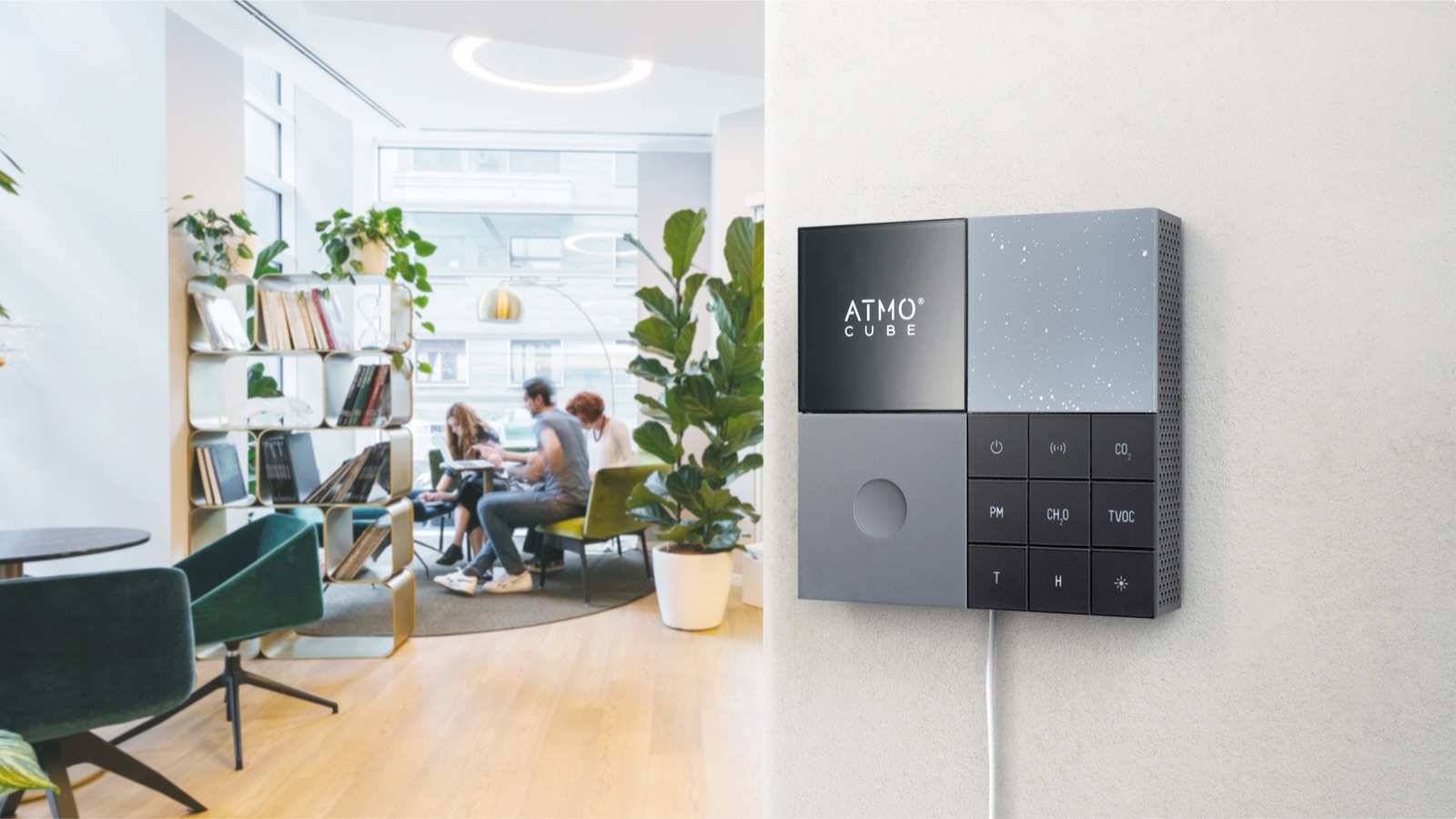
Read sensor data with care. Kaiterra’s Sensedge Go measures TVOC with a metal-oxide sensor, alongside particles, CO₂, temperature and humidity, but not formaldehyde. Atmocube estimates TVOC from a VOC index sensor and measures formaldehyde with a Sensirion SFA30 rated at ±0.02 ppm or ±20%, whichever is larger: good for trends, but a wider margin than the 0.01 ppm limit, so it cannot confirm compliance. A TVOC figure is a total. It does not name the chemicals, and a low number does not prove the air is safe.
Dubai Municipality’s optional certificate for new buildings needs testing before occupancy by an EIAC-accredited company or laboratory with calibrated equipment (clause 9-8-3). Sampling is on an 8-hour basis or four half-hour slots across business hours, 100–200 cm above the floor, with at least one point per 500 m² in areas under 3,000 m² (clause 9-8-7). HawaQ does not issue this certificate; our monitoring helps you find and fix problems before that test.
Match the monitoring period to the question. Our commercial IEQ audit, which covers new fit-outs, logs two weeks of minute-by-minute data so that working days, weekends and HVAC schedules all show up. That is our diagnostic choice, not a regulatory protocol. A check after a fix can be shorter if it covers the same hours and HVAC conditions; a compliance test follows the laboratory’s method.
How long should you wait before moving in?
There is no universal number of days. Emissions depend on the materials and their quantity, the temperature, the fresh-air rate and how long the HVAC has run. The municipality’s guideline asks for occupancy to be delayed until “a reasonable flush-out” is complete, without setting a duration (clause 9-2).
Decide with data instead: move in when readings in representative rooms, under normal HVAC operation, are within your target limits and stable or falling. If the date is fixed, keep fresh air high through the first weeks of occupancy, as the guideline also suggests, and keep measuring.
Where do purifiers and dehumidifiers fit?
Equipment comes after the source and the ventilation, and only where measurements justify it. The guideline lists short-term gas-phase air cleaning among ways to limit emissions, alongside flush-out and delayed occupancy (clause 9-2).
- Air purifiers. HEPA captures particles, not gases or CO₂. MedicAir purifiers add activated carbon, which MedicAir says removes odours, gases and VOCs, but carbon performance varies with the chemical, the amount of carbon and how loaded it is. A 2025 independent test of the Pro Max described its carbon stage as too thin for effective gas capture. We measure before and after rather than assume a purifier fixes formaldehyde or TVOC. Compare models on a clean air delivery rate (CADR) tested to a published standard, not raw fan airflow.
- Dehumidifiers. If humidity stays above 60% after the HVAC has been checked, a Stadler Form dehumidifier can help in a small room. It lowers humidity, not VOCs; see ideal indoor humidity for target ranges.
Frequently asked questions
Is the new-office smell harmful?
Smell alone cannot tell you. It shows that something is being released, not which chemical or how much. Measure, and test specific chemicals if readings stay high. Anyone with symptoms should see a doctor.
How many days should we wait after a fit-out before moving in?
There is no fixed number. It depends on the materials, temperature and ventilation. Measure in representative rooms with the HVAC running normally, and move in when readings meet your target limits and are stable or falling.
Can an air quality monitor show that the office is compliant?
No. Sensors show trends and help find problems. Compliance testing for the Dubai Municipality certificate is done by an EIAC-accredited company or laboratory.
Does HawaQ issue Dubai Municipality indoor air quality certificates?
No. That certificate requires testing by an EIAC-accredited company or laboratory. HawaQ monitors and assesses the space so you can fix problems before that test.
Will an air purifier remove formaldehyde?
Not reliably. HEPA filters capture particles, not gases. Activated carbon can capture some gases, but performance varies with the chemical and the filter’s condition. Remove the source and ventilate first.
Do Dubai’s limits apply elsewhere in the GCC?
No. Dubai Municipality’s guideline applies in Dubai. Other emirates and GCC countries have their own authorities and requirements, so confirm which apply to your building.
Sources
- Dubai Municipality, Technical Guidelines for Indoor Air Quality for Healthy Life (DM-HSD-GU119-IAQ, Version 4, issued 11 December 2024): clauses 9-2 (p25) and 9-3 (p27), clause 9-8-3 and Table 1 (p31–32), Tables 2–3 (p33–34), clause 9-8-6 and Table 4 (p34), clause 9-8-7 (p35), clauses 9-8-9 and 9-8-10 (p37), Appendix 10-1-5 (p44).
- US EPA, Volatile Organic Compounds’ Impact on Indoor Air Quality (updated 23 June 2026).
- US EPA, Protect Against Exposures to Formaldehyde (updated 1 April 2026) and Facts About Formaldehyde (updated 30 March 2026).
- Kaiterra, Sensedge Go (SE-300) specifications.
- Atmocube, Sensor Accuracy and Technical Specifications (ATMO Support Center, 7 September 2026).
- MedicAir, MedicAir Pro product information.
This guide explains public standards in plain language. It is not legal advice; check the current version of each document for compliance decisions. Cover image: Atmocube product photograph, not a HawaQ project.