
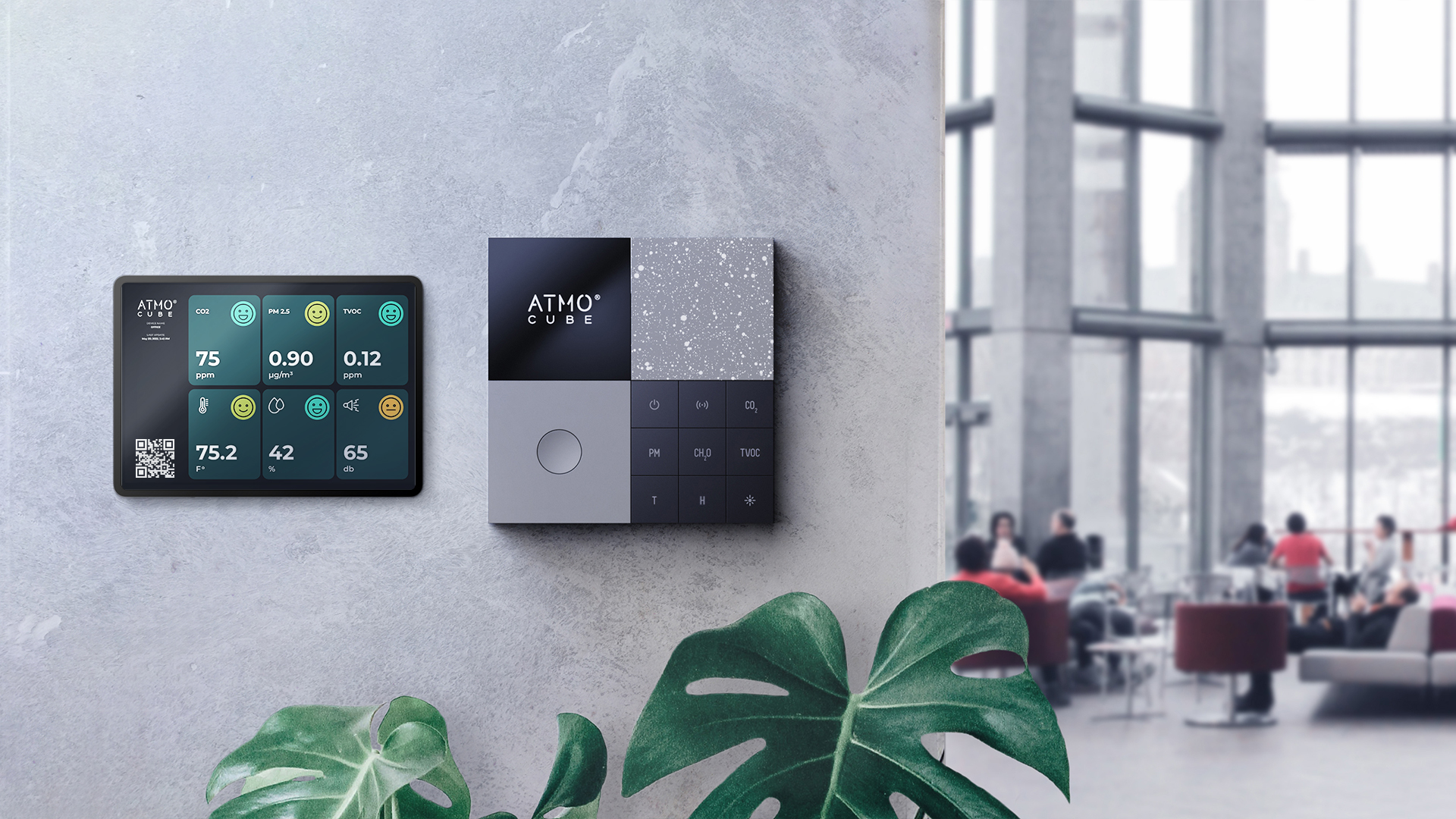
The best office monitor measures at least PM2.5, CO₂, TVOC, temperature and humidity with published accuracy, logs data continuously to a dashboard, and integrates with the building management system. For certification, choose a RESET-accredited model (WELL v2 also accepts RESET Grade B or above), and plan monitor density to the standard: WELL asks for one monitor per 325 m² in projects under 3,250 m².
What should an office air quality monitor measure?
The core set is PM2.5, CO₂, TVOC, temperature and relative humidity: the parameters RESET Air requires. PM10 and formaldehyde add value in dusty locations and after fit-outs. Dubai’s EIAQI also includes CO, NO₂ and ozone.
What does WELL require from monitors?
WELL v2 feature A08 asks for monitors measuring at least three parameters with stated accuracies. Under WELL’s Performance Verification Guidebook (version 2025-03, August 2025), monitors report at intervals of 15 minutes or less, are installed at one per 325 m² in projects under 3,250 m² (one per 500 m² or 1,000 m² in larger projects), and are recalibrated or replaced every three years.
What does a RESET-certified monitor mean?
RESET tests monitor models and lists them by grade. RESET Air projects must use Grade A or B monitors, and Grade B is the only accreditation RESET currently offers. Kaiterra Sensedge, Sensedge Mini and Sensedge Go and Atmocube are listed at Grade B. Check the RESET monitor directory for the current status of any model you consider. Accreditation tells you how a model performed in testing; why air quality monitors give different readings covers what to check on your own units.
Consumer or commercial monitor?
Consumer monitors suit a single room. Commercial monitors add calibration routines, published accuracy, central dashboards, alerts, data export and BMS integration over BACnet, Modbus or MQTT. Those features matter once you manage many rooms or report data.
How many monitors does an office need?
For WELL, one per 325 m² of occupiable space in projects under 3,250 m², with a minimum of two. In practice, add monitors to rooms with very different use, such as meeting rooms, which reach high CO₂ much faster than open-plan areas.
Which monitors does HawaQ install?
We usually recommend Kaiterra Sensedge, Sensedge Mini or Sensedge Go, or Atmocube, depending on whether you need a screen, wireless installation, BMS integration or extra parameters such as formaldehyde, light and noise.
| Kaiterra Sensedge | Kaiterra Sensedge Mini | Atmocube | |
|---|---|---|---|
| Screen | 7" touchscreen | No | No (LED panel) |
| Particles | PM2.5, PM10 | PM2.5, PM10 | PM1, PM2.5, PM10 |
| Gases | CO₂, TVOC | CO₂, TVOC (O₃, NO₂ and CO on AW/PW models) | CO₂, TVOC, formaldehyde |
| Integration | BACnet/IP, Modbus, MQTT, API | BACnet/IP, Modbus, MQTT, API | MQTT, Modbus; BACnet via gateway |
Frequently asked questions
Do office air quality monitors need calibration?
Yes. WELL’s August 2025 guidebook requires recalibration or replacement every three years (earlier editions said annually), and Dubai’s EIAQI expects devices calibrated and certified in accordance with ISO 17025. Follow the manufacturer if it sets a shorter interval.
Can monitors control ventilation?
Yes, when integrated with the BMS, so fresh air follows real occupancy and CO₂.
What CO₂ level should an office stay below?
In Dubai, Dubai Municipality’s guideline sets 800 ppm as an 8-hour average for existing buildings, and Al Sa’fat applies the same limit to the existing building types it lists. Other emirates and GCC countries set their own requirements.
Sources
- International WELL Building Institute, WELL Building Standard v2 (Q2 2025): feature A08; WELL Performance Verification Guidebook, version 2025-03 (13 August 2025). RESET monitor directory (RM-003, RM-020, RM-035, RM-056).
- RESET Air Standard for Commercial Interiors v2.0, and v2.1 draft (2023).
- Dubai Municipality, Environmental Indoor Air Quality Index (EIAQI), DM-HSD-GU141-IAQI2, Version 1 (14 February 2025): Appendix 1.
- Kaiterra datasheets SE-100, SE-200, SE-300; Atmocube datasheet.
This guide explains public standards in plain language. It is not legal advice; check the current version of each document for compliance decisions.