
Choose the model by how each space is used: Sensedge where people should see the readings, Sensedge Mini for wired floors, Sensedge Go where cabling is not practical. Place monitors in the breathing zone at the density your standard asks for, connect them to the BMS over BACnet/IP or Modbus, set ventilation to Dubai’s CO₂ set-points where they apply, and replace sensor modules on time. In the UAE, Kaiterra monitors are supplied by PRO TECHnology, an authorised Kaiterra distributor, and installed by HawaQ.
Which Kaiterra monitor goes where?
Start from the room, not the catalogue: who looks at the readings, whether there is power and network at the wall, and whether the building is occupied during installation.
| Space | Model that usually fits | Why |
|---|---|---|
| Reception, lobby, classroom or meeting room used every day | Sensedge (SE-100) | Its 7-inch touchscreen shows live readings to the people in the room |
| Open-plan floors and rows of offices in a new build or fit-out | Sensedge Mini, PoE version (SE-200P) | One network cable carries power and data, and BACnet/IP feeds the BMS |
| Hotels, offices and heritage interiors already in use | Sensedge Go (SE-300) | Battery powered with peel-and-stick mounting; reports by radio to a Kaiterra gateway |
| WELL projects that need ozone, nitrogen dioxide and carbon monoxide | Sensedge Mini for WELL (SE-200AW or SE-200PW) or Sensedge Go for WELL (SE-300W) | These versions add the three gases to the standard set |
A wired floor of Sensedge Mini monitors can be upgraded for WELL later: Kaiterra’s gas module fits units already on the wall. Specifications for each model are on our Kaiterra page; SKUs, licences and quotations come from PRO TECHnology.
How many monitors, and where do they go?
Density comes from the standard your building answers to. RESET Air asks for at least one monitor per 500 m² and one per occupied space type. WELL’s Performance Verification Guidebook (version 2025-03) asks for one monitor per 325 m² in projects under 3,250 m². Where your specification sets a higher density, it takes precedence. Our office monitor guide covers the rules in more detail.
- Breathing zone. RESET places the centre of the monitor 0.9 to 1.8 m above the floor.
- Away from fresh air. RESET asks for at least 5 m from operable windows and fresh-air diffusers, so the monitor reads room air, not supply air.
- Away from local sources. Keep monitors clear of printers and photocopiers, coffee machines, incense burners such as bakhoor, and doorways, which would dominate the reading.
- Every HVAC zone counted. A zone with no monitor is a zone the BMS cannot correct.
On a HawaQ project we agree every location on the floor plan with the client before anything is mounted.
How do Kaiterra monitors connect to the BMS?
| Family | Network | Building integration |
|---|---|---|
| Sensedge (SE-100) | Wi-Fi or Ethernet | BACnet/IP, Modbus TCP, MQTT (cloud and on-premise), open API |
| Sensedge Mini (SE-200) | Wi-Fi, Ethernet or PoE | BACnet/IP, Modbus RTU over RS-485, MQTT (cloud and on-premise), open API |
| Sensedge Go (SE-300) | LoRaWAN radio to a Kaiterra gateway | API; BACnet/IP through the gateway is listed by Kaiterra as coming soon |
Kaiterra says BACnet and Modbus run locally on the building network without its cloud, and that the Sensedge and Sensedge Mini are BTL-certified BACnet Smart Sensors, so a BMS discovers and polls them like any other device. Two practical points save time at commissioning:
- Licence first. Kaiterra’s specifications state that BACnet requires its enterprise licence. Order it with the monitors, not after the controls contractor asks for it.
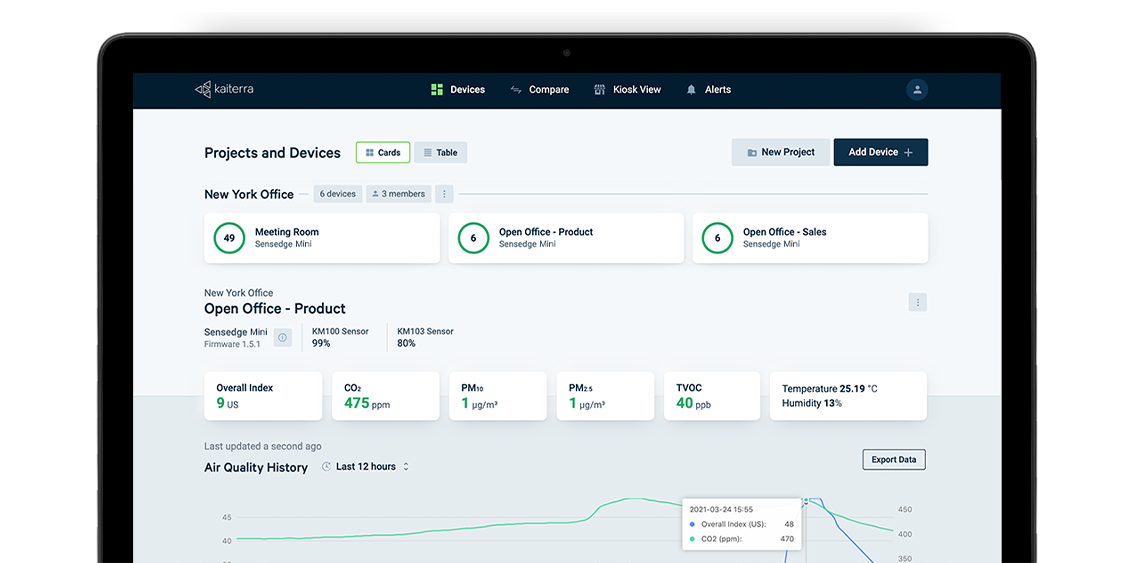
- Agree the points list. For each zone the controls contractor usually needs CO₂, PM2.5, TVOC, temperature and humidity. The Sensedge and Sensedge Mini push data every minute.
How should the BMS use CO₂ readings in Dubai?
A monitor does not control ventilation; the BMS does, using the monitor’s readings. In Dubai, Al Sa’fat clause 502.02 requires demand-controlled ventilation to Dubai Building Code section H.4.8.3: in spaces over 100 m² designed for 25 or more people per 100 m², a CO₂ set-point below 800 ppm and an alarm above 1,000 ppm, with the CO₂ sensors recalibrated at least every 12 months.
For a Kaiterra system in those spaces, that means:
- Give each demand-controlled zone its own monitor, inside the zone.
- Set the BMS to raise fresh air before CO₂ reaches 800 ppm, and to alarm above 1,000 ppm.
- Plan the 12-month CO₂ recalibration from day one. Kaiterra’s published replaceable modules cover particles, TVOC and the extra gases; none is listed for CO₂, so agree with the supplier how the yearly CO₂ check will be done and recorded.
- Keep long periods of very low CO₂ in mind: Kaiterra warns that extended exposure below 400 ppm can upset the sensor’s automatic baseline correction.
Outside Dubai the rules differ; our guide to indoor air quality requirements in the UAE and Saudi Arabia sets out what applies elsewhere in the UAE and in Saudi Arabia.
How do Kaiterra readings compare with Dubai Municipality limits?
Dubai Municipality’s guideline values for existing buildings are averages over set periods, so compare averages over the same period, not single one-minute readings.
| Parameter | Dubai limit (averaging) | Kaiterra reading to compare |
|---|---|---|
| CO₂ | 800 ppm (8 hours) | The 8-hour average of the CO₂ reading |
| PM2.5 | 35 µg/m³ (24 hours) | The 24-hour average of PM2.5 |
| PM10 | 150 µg/m³ (24 hours) | The 24-hour average of PM10 |
| TVOC | 0.6 mg/m³ (8 hours) | The 8-hour average of TVOC, in µg/m³ rather than ppb |
The Core versions (SE-200AL, SE-200PL and SE-300L) do not measure particles, and the Sensedge Mini Core does not measure TVOC, so choose another version where these limits matter.
Watch the TVOC units. Kaiterra reports TVOC from a metal-oxide sensor and converts between ppb and µg/m³ using a 22-compound reference mixture, at 1 ppb = 4.57 µg/m³. On that basis Dubai Municipality’s guideline value of 0.6 mg/m³ (600 µg/m³) is about 131 ppb, and Al Sa’fat’s 300 µg/m³ for listed existing buildings is about 66 ppb. Show TVOC in µg/m³ so the comparison is direct, and treat it as an indicator: a sensor TVOC is not a laboratory result. Our guide to why monitors give different readings explains the difference.
Formaldehyde needs another instrument. No formaldehyde sensor is listed for the Sensedge range, and Dubai limits formaldehyde separately. After a fit-out, add a monitor that measures it, such as Atmocube, or a laboratory test (see air quality after an office fit-out).
Monitoring is not a compliance test. A formal Dubai Municipality indoor air quality test is carried out by an EIAC-accredited company or laboratory. Continuous monitoring shows how the building performs between those tests. The full limits table is in our Dubai Municipality guide.
How do you keep Kaiterra readings accurate?
- Swap modules on time. Kaiterra recalibrates by replacing sensor modules, and its dashboard shows each module’s health. Kaiterra says RESET typically requires annual recalibration, so RESET projects swap modules every 12 months; WELL’s guidebook requires recalibration or replacement every three years. Follow the stricter of your standard and your specification.
- Zero the TVOC baseline. Kaiterra’s RESET directory listing says to keep a new monitor in fresh outdoor air for about five minutes when it is first switched on.
- Allow for dust and humidity. Optical particle sensors read differently in humid air and desert dust. The Sensedge, Sensedge Mini and Sensedge Go all let the particle density factor (K-factor) be adjusted to a project’s particle profile.
- Compare units before mounting. Run new monitors side by side for a day. A unit that disagrees beyond its stated accuracy is easier to deal with on a bench than on a ceiling.
Where to buy Kaiterra in the UAE, and who installs it
PRO TECHnology, an authorised Kaiterra distributor and HawaQ’s group company, supplies Kaiterra monitors in the UAE. Its Kaiterra page sets out what a quotation contains: the exact SKUs, the Kaiterra subscription or perpetual licence the monitors need, the BACnet enterprise licence, gateways for the Sensedge Go, and Kaiterra’s warranty terms.
HawaQ plans the placement, installs and supports the monitors, and can run year-round monitoring with dashboards and quarterly reports, or WELL, LEED and RESET support. When the data shows a problem, we specify the fix: PRO TECHnology is also the exclusive MedicAir distributor for the GCC and the authorised exclusive Stadler Form distributor in the UAE, Saudi Arabia, Bahrain, Kuwait and Oman.
Frequently asked questions
Who supplies and installs Kaiterra monitors in the UAE?
HawaQ plans, installs and supports Kaiterra monitors. The equipment, Kaiterra licences and quotations come from PRO TECHnology Co. L.L.C. in Dubai, an authorised Kaiterra distributor in the UAE and HawaQ’s group company.
Which Kaiterra monitor is best for an office?
For open-plan floors in a new build or fit-out, the Sensedge Mini with PoE, because one cable carries power and data. In reception areas and meeting rooms where people should see the readings, the Sensedge with its touchscreen. In an office already in use, the battery-powered Sensedge Go avoids new cabling.
Can a Kaiterra monitor control ventilation?
Not on its own. The Sensedge and Sensedge Mini send readings to the building management system over BACnet/IP or Modbus, and the BMS controls the ventilation. In Dubai spaces covered by Dubai Building Code section H.4.8.3, the CO₂ set-point is below 800 ppm with an alarm above 1,000 ppm.
How often do Kaiterra sensors need calibrating?
It depends on the standard. Kaiterra says RESET typically requires annual recalibration, WELL requires recalibration or replacement every three years, and in Dubai demand-controlled ventilation spaces the CO₂ sensors are recalibrated at least every 12 months. Kaiterra recalibrates by swapping sensor modules and shows module health on its dashboard.
Does a Kaiterra monitor replace a Dubai Municipality IAQ test?
No. A formal Dubai Municipality indoor air quality test is carried out by an EIAC-accredited company or laboratory. Continuous monitoring shows how the building performs between those tests and helps find problems before the test.
Sources
- Kaiterra. Sensedge (SE-100) technical specifications. kaiterra.com
- Kaiterra. Sensedge Mini (SE-200) technical specifications. kaiterra.com
- Kaiterra. Sensedge Go (SE-300) technical specifications. kaiterra.com
- Kaiterra. Integrations: BMS, BACnet and API (FAQ). kaiterra.com
- Kaiterra. Sensedge Go product page (gateway and BACnet status). kaiterra.com
- Kaiterra. RESET certification (annual recalibration). kaiterra.com
- Kaiterra. Sensedge Mini adds ozone, nitrogen dioxide and carbon monoxide (press release, 28 July 2026). learn.kaiterra.com
- RESET. Accredited monitor directory (RM-003, RM-020, RM-056). reset.build
- IWBI. WELL Performance Verification Guidebook, version 2025-03. a.storyblok.com
- Dubai Municipality. Technical Guidelines for Indoor Air Quality for Healthy Life, DM-HSD-GU119-IAQ, Version 4 (December 2024), Table 2. dmpmedia.dm.gov.ae
- Dubai Municipality. Al Sa’fat, Dubai Green Building System, 2nd edition (January 2023), clause 502.02. dmpmedia.dm.gov.ae
- Dubai Municipality. Dubai Building Code, 2021 edition, section H.4.8.3. dmpmedia.dm.gov.ae
Manufacturer figures are as published by Kaiterra on 25 October 2026. Rules are summarised in plain language; check the current version of each document for compliance decisions.