
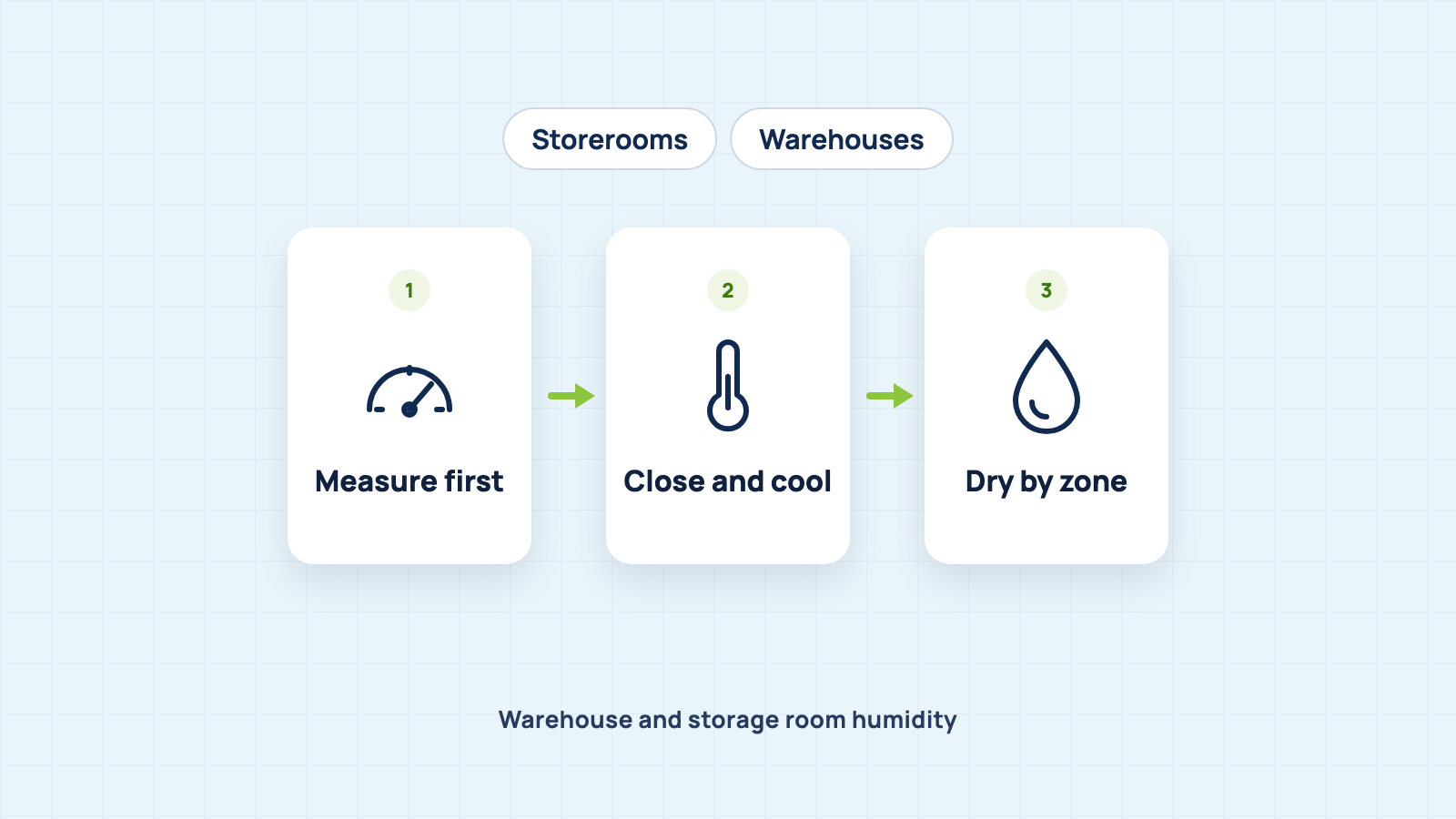
Keep a UAE storeroom or warehouse below 60% relative humidity, as Dubai Municipality and the US EPA advise, and nearer 50% for sensitive goods or rooms with cold surfaces; medicines labelled to be kept dry need no more than 60% (WHO). Log humidity for one to two weeks first. In an enclosed, air-conditioned store on continuous drainage, one Stadler Form Lukas is rated for up to 70 m² (175 m³ of air) and one Lukas Pro for up to 175 m² (435 m³); confirm the result with a logger. Licensed medicine stores follow their licence, and open halls, loading docks, cold stores and spaces above 35 °C need an engineered system.
Why do storage rooms and warehouses get damp in the UAE?
Storage rooms and warehouses in the UAE get damp because humid outdoor air gets in and meets surfaces colder than its dew point. Official WMO climate normals for Dubai International Airport (1991 to 2020) give a mean vapour pressure of about 29 hPa in July and August, a dew point of about 23 to 24 °C; Abu Dhabi and Sharjah airports are close behind at about 23 °C. Any surface colder than that collects water when outdoor air reaches it.
Relative humidity hides this: the monthly mean at Dubai and Abu Dhabi airports is only about 50 to 55% from May to August (WMO, 1981 to 2010) because the air is so hot. As the US EPA notes, the dew point, not relative humidity, predicts condensation.
A checked, hypothetical example: on a humid summer night near the coast, air at 32 °C and 70% relative humidity has a dew point of about 26 °C. Cool it to 24 °C in a storeroom without taking water out and it would need about 112% relative humidity, which is impossible, so the surplus condenses on the coldest surfaces first. Four things let that air into a store:
- Doors, docks and gaps. Outdoor air is the largest humidity load in commercial buildings in the cooling season, entering as ventilation air, make-up air and leaks (US EPA). Every open door or roller shutter adds more.
- Cold surfaces and cold goods. AC ducts, diffusers and chilled-water pipes run much colder than the room (US EPA), as do walls shared with cold rooms. Cartons straight from a refrigerated truck sweat for the same reason, like the US EPA’s example of a cold bottle taken outside on a hot day.
- AC that cycles or switches off. An air conditioner that does not run long enough cools the air without drying it (US EPA). Stores cooled only in working hours take in moisture at night and at weekends.
- Closed rooms with still air. Rooms that stay shut hold on to moisture: in HawaQ’s month-long monitoring of more than 50 waterfront homes, the data showed which rooms stayed humid and why, from air-conditioning cycles to closed doors; wardrobes, storage and laundry areas were among the rooms checked.
What humidity should a storage room or warehouse be kept at?
Keep a storage room or warehouse in the UAE below 60% relative humidity for most stored goods, and at about 50% where stock is sensitive or the room has cold surfaces such as AC diffusers and chilled pipes. Dubai Municipality’s indoor air quality guideline (Version 4, December 2024) says below 60%, and 50% if feasible to control dust mites; the US EPA gives the same 60% ceiling. Some goods have their own rules:
| What is stored | Keep relative humidity | Why, and the source |
|---|---|---|
| General goods and household storerooms | Below 60%; 50% if feasible | Dubai Municipality (2024); US EPA |
| Medicines and pharmaceutical stock | No more than 60% if labelled “store in a dry place” or “protect from moisture” | WHO TRS 1025 (2020); DHA (2021) and Abu Dhabi DoH (2025) also use 60%. The label and your licence come first. |
| Paper records and archives | Below 60%; 30 to 50% for long-term archives | US National Archives (2023), at 10 to 18 °C; the US records rule links mould to humidity above 70%, or above 55% with extreme heat |
| Metals and tools near the coast | As low as practical; no single safe level | Corrosion speeds up sharply above 75%, where common salt (sodium chloride) turns into a corrosive solution (Canadian Conservation Institute, CCI); the magnesium chloride in sea salt does so from about 33%, and salt-contaminated steel kept corroding down to 33% in a lab study (ECS, 2015) |
| Wooden furniture and joinery | About 50 to 60%, held steady | Wood then settles at about 9 to 11% moisture, within the 8 to 13% advised for indoor furniture in damp, warm US coastal areas; at 80% it reaches about 16% (USDA Wood Handbook, 2021) |
| Cardboard-packed stock | Below 60% and steady (the general rule) | Box strength falls once humidity passes 30% (Clemson University, 2019) and drops by about half from 50% to 90% (University of Pretoria, 2010) |
| Leather, textiles and clothing | Below 60%; 30 to 50% if archival | Damp brings mould that stains and weakens them (CCI); US National Archives (2023) |
Archive figures assume cool storage; for collection stores, see our museum and palace humidity monitoring page. Near cold surfaces, 50% is the safer figure: the US EPA advises an indoor dew point below 12.8 °C in cooling mode, for example no more than 50% at about 24 °C. At 24 °C and 60%, the dew point is about 16 °C, so a diffuser or chilled pipe at 13 °C will sweat.
What does high humidity do to stored goods?
High humidity feeds mould, speeds up corrosion, weakens cartons and makes wood swell, and the damage grows the longer humidity stays high.
- Mould. Surfaces can be kept free of fungal growth if the humidity at the surface stays below 75 to 80%, and a cold surface can be more humid than the room around it (WHO). CCI puts visible mould on vulnerable organic materials at about 100 days at 70%, 10 days at 80% and 2 days at 90 to 100%.
- Corrosion, worse near the sea. Common salt (sodium chloride) absorbs water above 75% and forms a corrosive solution (CCI). Sea salt also contains magnesium chloride, which does so from about 33%, and in a Sandia National Laboratories and University of Virginia study, salt-contaminated steel kept corroding down to 33%.
- Weaker cartons. A corrugated box can lose about half its stacking strength between 50% and 90% (University of Pretoria, 2010, citing Whitsitt and McKee, 1972), and humidity swings cut it further (USDA Forest Products Laboratory).
- Wood that swells. The USDA Wood Handbook advises storing furniture timber and joinery in a room where humidity is controlled, and says dehumidifiers can be used in small, well-enclosed spaces.
How do you measure humidity in a store or warehouse?
Measure humidity in a store or warehouse with data loggers that record temperature and relative humidity every few minutes for at least one to two weeks, so the readings cover weekdays, weekends, deliveries and air-conditioning cycles. A single spot reading misses the night the AC switched off.
- Where the goods sit. At shelf or pallet height, behind tall stacks and in the corner furthest from the AC.
- Near the risks. Beside doors and docks, on outside walls and walls shared with cold rooms, and near diffusers and chilled pipes.
- High and low. In tall rooms, near the floor and near the top of the racking, because temperature and relative humidity change with height.
- Outside. One logger outdoors or at the dock, for comparison.
- What to note. AC times, door openings, deliveries and any surface that sweats.
For medicines, WHO recommends temperature mapping of storage areas, and humidity mapping where appropriate, alongside DHA or DoH rules.
Every HawaQ project starts with measurement. Our indoor air quality monitoring service offers a two-week assessment, with monitors in the key rooms, an HVAC inspection and a written report with recommendations, or year-round monitoring with permanent sensors, 24/7 data, live dashboards and alerts, a yearly HVAC inspection and quarterly reports. Where mould is visible or suspected, mould inspection and testing adds a visual check, room-by-room humidity and surface moisture mapping, an AC and HVAC check and, where needed, air and surface samples analysed by a laboratory. Our warehouse air quality monitoring page covers dust, gases and VOCs alongside temperature and humidity.
Which dehumidifier suits a storage room or a warehouse zone?
An enclosed, air-conditioned storeroom or warehouse zone suits a portable compressor dehumidifier sized by air volume: Stadler Form Lukas for storerooms up to 70 m² (175 m³ of air), and Lukas Pro for larger rooms and enclosed warehouse zones up to 175 m² (435 m³). Both should run on continuous drainage, with doors closed and the AC on.
HawaQ is a PRO TECHnology Group company. PRO TECHnology distributes Stadler Form in the UAE and MedicAir in the GCC, so we have a commercial link to the products we name. We measure first and recommend a product only where the readings call for one.
Stadler Form Lukas Pro is a dehumidifier and air purifier in one unit. It removes up to 50 litres of moisture a day and is rated for dehumidifying rooms and spaces up to 175 m² (435 m³ of air, about a 2.5 m ceiling). The 50 litres is a rated maximum: Stadler Form says it is reached only from about 22 °C and 70% humidity. It drains continuously through the included hose, has a digital hygrostat and an H11 particle filter, and carries a 5-year Pro Series warranty. In storage, that means villa storerooms, large apartment storage rooms, hotel linen, luggage and archive rooms, and enclosed warehouse stockrooms and zones.
Stadler Form Lukas removes up to 20 litres a day and is rated for rooms up to 70 m² (175 m³). It becomes a dehumidifier and air purifier in one when its optional H11 particle filter is fitted; Stadler Form UAE sells it with the filter in the box as Lukas Smart. Its 20 litres is also a maximum, reached only from about 22 °C and 70% humidity. By size it suits smaller stores: a villa or apartment storeroom, a small hotel luggage or linen room, or a pool-house store at least 3 m from the water.
Lukas Pro comes with an H11 particle filter and can dehumidify and purify at the same time, or purify on its own. Its clean air delivery rate of up to 327 m³/h (according to AHAM) changes the air about three times an hour in a room of up to 44 m², or once an hour in up to 131 m², so its purifier coverage is smaller than its 175 m² dehumidifying rating. Lukas filters the air only with the optional filter fitted, has no air-quality sensor, and has no published air-change rate. For warehouse dust, see industrial air purification.
| Feature | Stadler Form Lukas | Stadler Form Lukas Pro |
|---|---|---|
| Maximum moisture removal | Up to 20 litres a day | Up to 50 litres a day |
| Rated room (dehumidifying) | 70 m² / 175 m³ | 175 m² / 435 m³ |
| Air purification | Optional H11 particle filter (included in Lukas Smart) | H11 particle filter included; CADR up to 327 m³/h |
| Tank and drainage | 4.2 L tank, stops when full; 100 cm hose included | 5.2 L tank, stops when full; 100 cm hose included |
| Operating range | 5 to 35 °C; up to 90% RH | 5 to 35 °C; up to 80% RH |
| Smallest room allowed | 4 m² | 7.2 m² |
| Warranty | 2 years | 5 years (Pro Series) |
Size by volume, not floor area: the ratings assume a ceiling of about 2.5 m.
| Ceiling height | Lukas (175 m³) | Lukas Pro (435 m³) |
|---|---|---|
| 2.5 m | 70 m² | 174 m² (rated 175 m²) |
| 3 m | 58 m² | 145 m² |
| 4 m | 43 m² | 108 m² |
| 6 m | 29 m² | 72 m² |
| 8 m | 21 m² | 54 m² |
A hypothetical example: an enclosed stockroom of 12 m by 10 m under a 6 m ceiling holds 720 m³ of air. By floor area (120 m²) one Lukas Pro looks enough; by volume, 720 ÷ 435 = 1.7, so it needs two, and more if doors open often (the US National Park Service notes that air exchange also sets the number of units).
- Continuous drainage. Run the hose to a floor drain below the outlet, as water drains by gravity. On the tank alone the unit stops when full: if Lukas Pro removed 20 litres in a day (hypothetical), its 5.2-litre tank would fill in about six hours.
- Doors closed, AC on. A dehumidifier dries the room it stands in. Keep doors shut and the AC running at night and at weekends, because both models are rated to operate only between 5 and 35 °C.
- Clearance. More than 50 cm from walls and stacked goods, on a firm, level, waterproof floor, never inside a closet, and at least 3 m from a pool, bath or shower. Lukas Pro needs a room of at least 7.2 m², Lukas at least 4 m².
- Check the result. Set the hygrostat (30 to 80%) to your target and confirm it with a logger away from the unit.
Stadler Form’s manuals describe both models as household appliances for indoor use; for hotel, storage or warehouse projects, Stadler Form UAE confirms suitability project by project. In hotels, Stadler Form UAE reports a Dubai resort project where relative humidity fell from 79% to 51% with twelve Lukas Pro units. It is one of Stadler Form UAE’s hotel case studies, a supply project within our group, not a HawaQ measurement; our hotel indoor air quality page covers humidity monitoring in hotels. Around a pool, both models belong in the pool-house store, changing room or gym, at least 3 m from the water and from any bath or shower; the pool hall itself needs a purpose-built pool dehumidification system (see indoor pool humidity in UAE villas). For homes, hotels and pool houses, our advice site compares Lukas vs Lukas Pro by space.
When does a warehouse need an industrial or engineered system instead?
A warehouse usually needs an industrial or engineered dehumidification system instead of portable units when the space is open to outdoor air, has a high-bay ceiling, runs hotter than 35 °C, is a cold store, or must hold humidity very low or within tight recorded limits. For how commercial and industrial units differ, see Stadler Form UAE’s guide to commercial vs industrial dehumidifiers.
- Open halls and loading docks. Where doors and shutters stay open, outdoor air keeps replacing the room air, and outdoor air is the largest humidity load in the cooling season (US EPA). Stadler Form UAE’s Lukas Pro page says it should not be used in open warehouse halls.
- Stores without air conditioning. Both models are rated only up to 35 °C; the average daily high at Dubai International Airport is above that from May to October, near 42 °C in August (WMO, 1991 to 2020).
- High-bay halls. Under an 8 m ceiling, one Lukas Pro covers only about 54 m² of floor, so a ducted system designed for the volume is usually more practical.
- Cold stores and chillers. ENERGY STAR says frost can form on a dehumidifier’s coils below about 18 °C and suggests considering a model specified for lower temperatures. Stadler Form recommends Lukas and Lukas Pro only from 5 °C, and says adsorption (desiccant) dryers suit cellars and low temperatures.
- Very low or tight targets. Both hygrostats set from 30% to 80%. A store that must stay drier, or within narrow recorded limits, needs a system designed for that duty, often desiccant based; such systems can also dry fresh air before it enters the building (US Department of Energy).
- Leaks and floods. For water damage, Stadler Form itself says an industrial construction dryer is more suitable.
Here our measurements, and our ventilation and filtration assessment of air changes and airflow, give the HVAC engineer the data to size a fixed system.
How do you fix a damp storeroom or warehouse, step by step?
Fix a damp storeroom or warehouse in five steps: measure, close and seal, keep the AC running, dehumidify each enclosed zone by volume, and verify that humidity holds below 60%.
- Measure. Log temperature and humidity where the goods sit, near doors and cold surfaces, and outdoors for one to two weeks.
- Close and seal. Keep doors and shutters shut, fit door seals, fix leaks and insulate cold pipes and ducts that sweat (US EPA). Keep goods off the floor and slightly away from outside walls so air can circulate.
- Keep the AC running. Run cooling through nights and weekends so the store stays well below 35 °C, and keep drip pans clean and drain lines flowing (US EPA).
- Dehumidify by zone. Treat each enclosed room as its own zone, sized by volume: Lukas up to 175 m³, Lukas Pro up to 435 m³, on continuous drainage, with goods more than 50 cm from the unit.
- Verify. Keep logging and check that humidity holds below 60%, nearer 50% for sensitive goods, through weekends and humid summer nights. If it does not, add units or plan an engineered system.
For living spaces, see our guide to ideal indoor humidity in UAE homes.
Frequently asked questions
Can I use a dehumidifier in my storage unit?
Yes, if the storage unit has a power socket and a drain and meets Stadler Form’s limits for Lukas and Lukas Pro: at least 4 m² of floor for Lukas or 7.2 m² for Lukas Pro, and a temperature between 5 °C and 35 °C. In the UAE that usually means an air-conditioned unit, because the average daily high at Dubai airport is above 35 °C from May to October. Without a drain hose, Lukas stops when its 4.2-litre tank is full and Lukas Pro when its 5.2-litre tank is full. Check that the facility allows appliances to run unattended.
What humidity should a warehouse be?
Keep a warehouse below 60% relative humidity for general goods, as Dubai Municipality and the US EPA advise, and about 50% where stock is sensitive or surfaces run cold. Medicines labelled “store in a dry place” need no more than 60% (WHO), and long-term paper archives are kept at 30 to 50%.
What is the difference between a dehumidifier and an industrial dehumidifier?
The difference is scale and duty. A portable dehumidifier such as Stadler Form Lukas Pro removes up to 50 litres a day and treats one enclosed room of up to 435 m³ of air from a wall socket. An industrial or engineered system is sized for whole halls, open dock areas, cold stores or spaces above 35 °C, and is often ducted or desiccant based, designed with an HVAC engineer.
Where should you not place a dehumidifier?
Not inside a closet or cupboard, not within 3 m of a pool, bath or shower, not closer than 50 cm to walls or stacked goods, and not in a room smaller than 7.2 m² for Lukas Pro or 4 m² for Lukas, as Stadler Form’s manuals require. Stand it on a firm, level, waterproof floor.
How many dehumidifiers does a warehouse need?
Divide each enclosed, air-conditioned zone’s air volume by the unit’s rated volume and round up; Lukas Pro is rated for 435 m³. In a hypothetical 12 m by 10 m stockroom under a 6 m ceiling, 720 m³ ÷ 435 = 1.7, so two units, and more if doors open often. Open halls, dock areas and stores above 35 °C need an engineered system instead.
Do I need a dehumidifier for a storeroom or warehouse in the UAE?
Not always, so measure first. A UAE storeroom or warehouse zone needs one if logging shows it stays above 60% relative humidity for long periods, or if cold surfaces or cartons sweat, even with doors closed and the AC running; if readings hold below 60%, it does not. In HawaQ’s month-long monitoring of more than 50 waterfront homes, the data showed which rooms stayed humid and why, from air-conditioning cycles to closed doors.
Sources
- WMO Climate Normals 1991 to 2020, United Arab Emirates stations (Dubai, Abu Dhabi and Sharjah international airports), published by NOAA NCEI, accession 0253808 v2.2. Dew points calculated by HawaQ from mean vapour pressure. ncei.noaa.gov
- WMO Climate Normals 1981 to 2010, United Arab Emirates (mean relative humidity), published by NOAA NCEI. ncei.noaa.gov
- US EPA. Moisture Control Guidance for Building Design, Construction and Maintenance, EPA 402-F-13053, December 2013 (pp. 14 to 18). epa.gov
- US EPA. Mold Course, Chapter 2 (updated 1 December 2025). epa.gov
- US EPA. A Brief Guide to Mold, Moisture and Your Home (updated 18 February 2026). epa.gov
- Dubai Municipality. Technical Guidelines for Indoor Air Quality for Healthy Life, DM-HSD-GU119-IAQ, Version 4, December 2024 (p. 41). dmpmedia.dm.gov.ae
- WHO Regional Office for Europe. WHO guidelines for indoor air quality: dampness and mould, 2009 (section 3.3). iris.who.int
- Canadian Conservation Institute (S. Michalski). Agent of deterioration: incorrect relative humidity, 2021. canada.ca
- US National Park Service. Museum Handbook, Part I, Chapter 4: Museum Collections Environment, 2016. nps.gov
- US National Archives. NARA 1571 Supplement 2: Temperature, Relative Humidity and Air Pollutant Tables, effective 17 January 2023. archives.gov
- US Code of Federal Regulations. 36 CFR 1234.14, environmental requirements for records storage facilities (eCFR, current). ecfr.gov
- WHO. Technical Report Series No. 1025, Annex 7: Good storage and distribution practices for medical products, 2020 (Table A7.1, clause 12.36). cdn.who.int
- Dubai Health Authority. Pharmacy Guidelines, Version 1, HRS/HPSD/PG/01/2021, 2021 (clause 14.2). dha.gov.ae
- Department of Health Abu Dhabi. Standard for Ensuring Continuous Drug Supply, Storage, Distribution and Therapeutic Governance, V2, December 2025 (section 2.12). doh.gov.ae
- Schindelholz E, Risteen BE, Kelly RG. Impact of salt deliquescence on the humidity-dependence of atmospheric corrosion. 228th ECS Meeting, abstract 697, October 2015. ecs.confex.com
- Glass SV, Zelinka SL. Moisture relations and physical properties of wood. Wood Handbook, FPL-GTR-282, Chapter 4 (Table 4-2), USDA Forest Products Laboratory, 2021. research.fs.usda.gov
- Bergman R. Drying and control of moisture content and dimensional changes. Wood Handbook, FPL-GTR-282, Chapter 13, USDA Forest Products Laboratory, 2021. research.fs.usda.gov
- Dimitrov K. Relationship between the ECT-strength of corrugated board and the compression strength of liner and fluting medium papers. MEng dissertation, University of Pretoria, 2010. repository.up.ac.za
- Brown GA. Relative humidity effects on the compression strength of corrugated boxes. MS thesis, Clemson University, 2019. open.clemson.edu
- Gunderson DE, Considine JM. Measuring the mechanical behavior of paperboard in a changing humidity environment. USDA Forest Products Laboratory, 1986. research.fs.usda.gov
- ENERGY STAR (US EPA and DOE). Dehumidifiers: buying guidance (read 3 November 2026). energystar.gov
- US Department of Energy, FEMP. Greening Federal Facilities, 2nd edition, DOE/GO-102001-1165, May 2001 (section 5.2.5). osti.gov
- Stadler Form. Dehumidifier guide: compressor and adsorption dryers, room volume. stadlerform.com
- Stadler Form. Lukas Pro instructions for use (EU), pp. 7 to 11. stadlerform.com
- Stadler Form. Lukas instructions for use (EU), pp. 7 to 11. stadlerform.com
- Stadler Form UAE. Lukas Pro product page: technical data and FAQ. stadlerform.ae
- Stadler Form UAE. Lukas product page: technical data. stadlerform.ae
- Stadler Form UAE. Hotel dehumidifier case studies, Dubai. stadlerform.ae
Sources read on 3 November 2026. Dew points are HawaQ’s calculations from the published figures (Magnus formula); the sizing table, the stockroom and the tank figures are worked or hypothetical examples, not Stadler Form figures or HawaQ measurements. Product details are as published by Stadler Form on that date. This guide is general information, not engineering, regulatory or medical advice.