
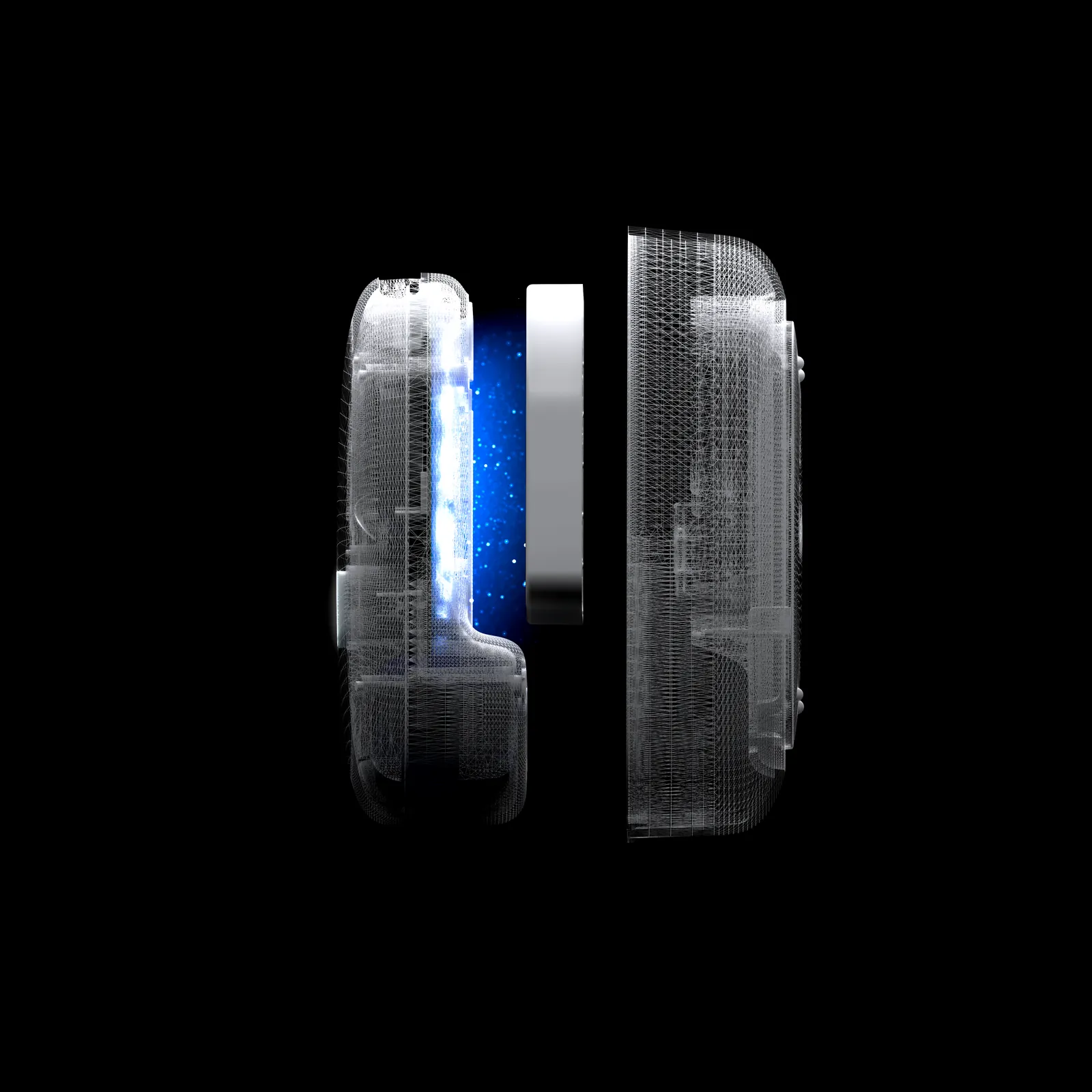
Fridge purifiers work in one of four ways. Photocatalytic (PCO) units such as Vitesy Shelfy use light and a coated filter to break down odour gases; room-temperature catalytic units such as Vitesy Deo use a catalyst and no power; ozone devices release a lung irritant that the US EPA says does not remove many odour chemicals at safe levels; and charcoal or baking soda absorbers hold odours until they are full. Our view: avoid ozone, replace absorbers regularly, and treat PCO and catalytic devices as reasonable in a closed fridge or cupboard, knowing that their published tests come from the maker and do not measure by-products. For room air, ventilation and suitable filtration come first.
What are the four ways fridge purifiers and odour eliminators work?
Almost every fridge purifier, deodoriser or odour eliminator on sale breaks the odour molecule down on a lit surface, breaks it down on a catalyst without light, attacks it with ozone, or holds it on a surface until that surface is full:
- Photocatalytic oxidation (PCO). A fan draws air through a filter whose coating, activated by light, oxidises gases and microbes. Vitesy Shelfy works this way.
- Room-temperature catalytic oxidation. A catalytic filter with no fan, lamp or battery oxidises odour molecules that reach it. Vitesy Deo works this way.
- Ozone. The device releases ozone, a reactive gas, into the space. Fridge deodorisers sold as “ozone” or “O3” units work this way.
- Absorbers. Activated charcoal and baking soda hold odour molecules, or react with some of them, until their capacity is used up.
What is photocatalytic oxidation (PCO)?
A photocatalyst is a material that becomes chemically active when light of the right wavelength reaches it; in room air cleaners it is usually titanium dioxide. The US EPA describes the process: gases adsorb onto a high-surface-area medium coated with the catalyst, the light forms hydroxyl radicals on the surface, and these oxidise the adsorbed pollutants, ideally all the way to carbon dioxide and water. The catalyst is not consumed in the reaction, although the EPA notes that it often has a finite lifespan.
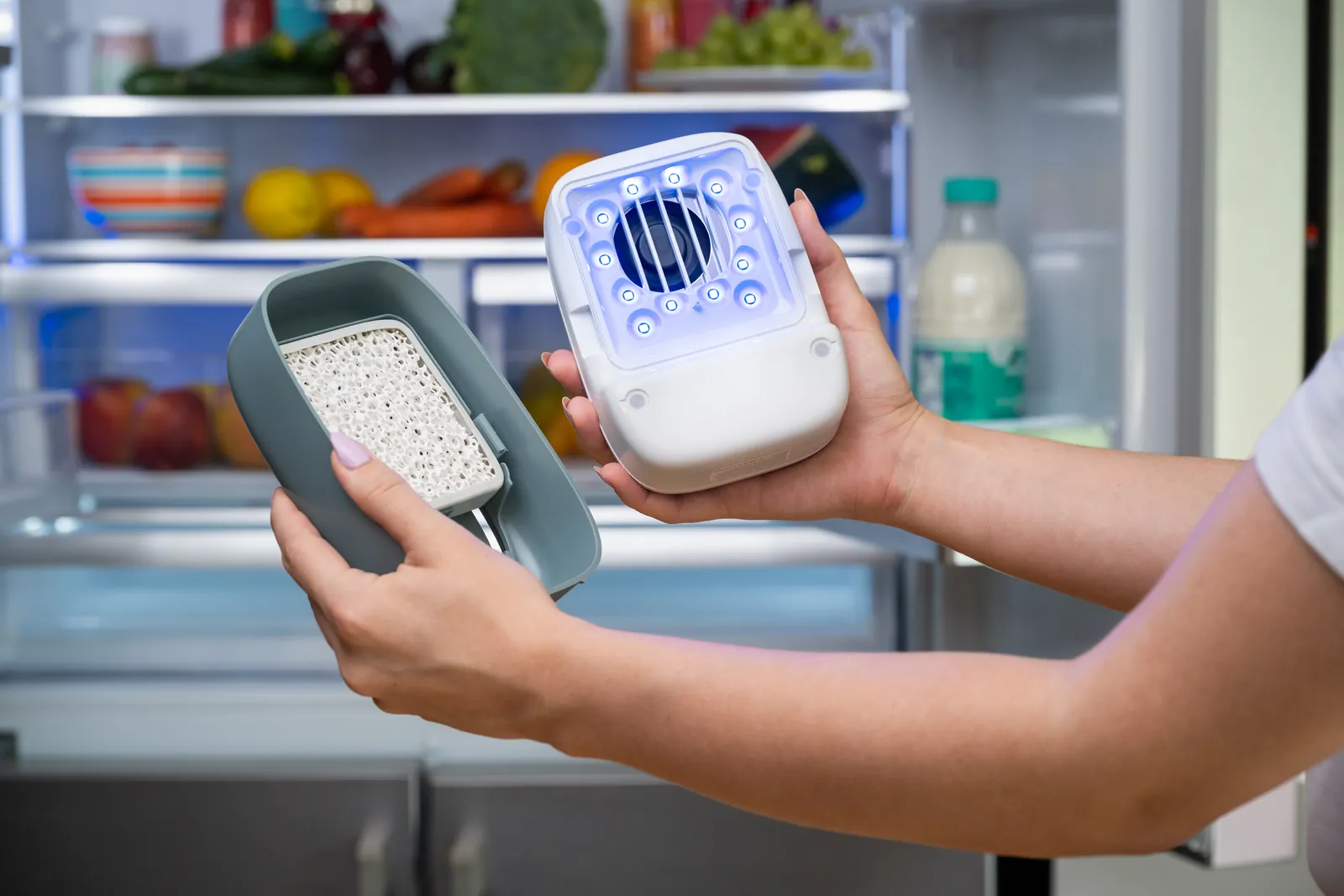
Most PCO room purifiers use ultraviolet lamps, and a UV-C lamp without a suitable coating can itself generate ozone (US EPA). Vitesy says Shelfy uses neither: its washable ceramic filter is activated by visible blue LEDs (12 in the current, upgraded model; the original used white LEDs), and Vitesy states that it “uses no ozone or UV light”. Shelfy treats the air, not the food: in Vitesy’s words, it “acts on the air inside your refrigerator, not directly on the food”. It also runs in purification cycles, alternating periods of activity and inactivity on an hourly basis, rather than running continuously.
Is PCO safe? What research on room air cleaners shows
PCO’s known weakness is incomplete oxidation: when a pollutant is only partly broken down, intermediate compounds leave the filter. The US EPA’s technical summary on residential air cleaners says PCO air cleaners “are often ineffective in completely transforming gaseous pollutants in indoor air” and are known to generate harmful by-products, including formaldehyde, acetaldehyde, nitrogen dioxide and carbon monoxide.
The study behind that statement, from Lawrence Berkeley National Laboratory, tested a UV photocatalytic device (titanium dioxide modified with tungsten oxide) with realistic mixtures of office and cleaning-product VOCs. The share of each VOC converted varied widely, usually above 20% and up to about 80%, but the device produced formaldehyde and acetaldehyde from partly oxidised VOCs: formaldehyde leaving it was 1.9 to 7.2 times the level going in (Hodgson et al., 2007).
Design decides the outcome. The EPA names the amount of catalyst, the contact time and the light reaching the surface as the factors that determine whether a PCO device destroys pollutants or produces new irritants, and it cites a comparison of 15 portable air cleaners in which the PCO units did not effectively remove any of 16 test VOCs at normal indoor concentrations. There is no standard test method for PCO air cleaners. ASHRAE, the engineering society behind the main ventilation standards, takes the position that air cleaners which produce compounds to remove pollutants “should only be used if proven safe”, and that laboratory results should not be assumed to hold in a real building.
In the UAE, Dubai Municipality’s indoor air quality guideline repeats the EPA’s caution on PCO by-products, and the Dubai Building Code asks for Authority approval before photocatalytic or electronic air cleaners are installed in villas, citing “ozone and its volatile reaction products”. It does not accept them as a replacement for mechanical filtration.
Why is a closed fridge a different case?
A fridge purifier works in very different conditions from a room purifier, and some of them favour PCO. This is our reading of the evidence, not a test result:
- The same air passes again and again. A 300-litre fridge holds 0.3 m³ of air; a 4 m by 4 m bedroom with a 2.7 m ceiling holds about 43 m³, roughly 140 times more. With the door shut, a fridge purifier treats the same small volume repeatedly, so a modest single-pass efficiency matters less than in a large, ventilated room.
- The odours are strong and food-specific. Fridge smells come largely from compounds released by food, such as trimethylamine from fish. The room-air PCO studies tested mixtures of building VOCs at the low concentrations normally found indoors.
- Nobody breathes fridge air for hours. Room air cleaners run where people breathe all day, which is where by-products matter most. Air from a fridge reaches you briefly, when the door opens.
The by-product question does not disappear, though. Fridges are cold and humid, and the EPA lists the effect of temperature and water vapour among the open research questions for PCO. Vitesy’s published tests, described below, do not measure by-products. We regard a visible-light PCO device in a closed fridge as a reasonable choice, and we would not extend that view to PCO room air cleaners without independent by-product data.
What did Vitesy’s Shelfy tests measure, and what did they not?
Vitesy publishes a test report for Shelfy (Rev. 1, November 2023) with six studies run by Italian laboratories and university groups. Each compared Shelfy with a control: an identical device without photocatalysis, or an identical fridge or box without Shelfy. The main results, all as reported by Vitesy:
| Test | Conditions | Result reported by Vitesy |
|---|---|---|
| Airborne test bacteria | Sprayed into a 180-litre fridge; air sampled after 10 minutes | 99.37% fewer than with the control device |
| Natural airborne microbes (mostly moulds) | Two 220-litre fridges, one with Shelfy in Eco mode (University of Udine) | 95-97% fewer in two tests |
| VOCs from ripening apples and avocados | 370-litre fridge at 4 °C; total VOCs on a photoionisation meter | 80% lower after 5 hours |
| Trimethylamine (fish odour) | 118-litre sealed box; gas chromatography with mass spectrometry | 73% lower in 5 hours |
| Ethylene (the ripening gas) | 210-litre sealed box | 56.3% lower in 14 hours, against 5% for the control |
| Shelf life of fruit and vegetables | Lab fridges at 6 °C with an avocado as ethylene source (CSI, IMQ Group, 2022) | For example, strawberries 3 to 10 days, courgettes 10 to 22 days |
What the report does not show:
- By-products. The odour tests track the target gas or total VOCs falling. None reports whether formaldehyde, acetaldehyde or other partial-oxidation products formed. A total-VOC reading that falls by 80% is encouraging, but it is a single sum and does not identify individual compounds.
- The current model. Every published figure comes from the original white-LED Shelfy. Vitesy says the blue light of the upgraded version is “particularly effective in activating the photocatalysis process” and that it is finalising a document with tests on the new filters; until that appears, the numbers describe the older model.
- Long-term performance. The tests ran for minutes to weeks; there is no published result for a filter that has been in a fridge, and washed, for a year. ASHRAE recommends assessing air cleaners over their whole service life.
- An ozone-emission test. Vitesy states that Shelfy uses no ozone; we have not seen a published ozone test such as UL 2998, the label ASHRAE recommends for electrically powered air cleaners.
- Food safety. Vitesy itself says results “may vary significantly” and that Shelfy should not be considered “a safeguard against foodborne illnesses or spoilage”.
PRO TECHnology’s guide Does Shelfy work? How to test a fridge purifier shows how to run your own side-by-side check at home.
Do ozone fridge purifiers work, and are they safe?
Ozone devices release a reactive gas into the space instead of breaking odours down on a filter. The California Air Resources Board (CARB) notes that sellers call it “activated oxygen”, “super oxygenated” or “energized oxygen”, implying a healthy kind of oxygen. Regulators agree on four points:
- They do little at safe levels. The US EPA says that at concentrations within public health standards, ozone “is not effective at removing many odor-causing chemicals”; Dubai Municipality’s guideline says the same of most indoor contaminants.
- They mask rather than remove. Ozone deadens the sense of smell, which CARB says disguises odours instead of removing them.
- They create new pollutants. Ozone reacts with some indoor chemicals to form aldehydes such as formaldehyde, and formic acid (EPA, CARB, Dubai Municipality).
- Ozone harms the lungs. Relatively low amounts can cause chest pain, coughing, shortness of breath and throat irritation (EPA).
To decontaminate air of microbes, the EPA says ozone would have to be 5 to 10 times higher than public health standards allow. Industrial users apply high concentrations only under controlled conditions that keep people away (CARB), which is not how a family fridge is used, and the EPA notes that ozone builds up more in a small space with little ventilation.
For reference, CARB-certified air cleaners may not emit more than 0.050 ppm of ozone, and Dubai Municipality’s indoor limit for existing buildings is 0.06 ppm averaged over 8 hours; its guideline also asks people to contact the Municipality before using an ozone generator. Our advice: no ozone generators in the fridge, or anywhere people or pets breathe the air.
Room-temperature catalytic oxidation: how does Vitesy Deo work?
Vitesy Deo has no fan, battery or lamp: it is an 80 × 70 × 70 mm aluminium housing around a ceramic catalytic filter. Air moves through it naturally, and Vitesy says the catalyst uses the oxygen in the air to break odour molecules down into carbon dioxide and water. Its Deo report contrasts this with activated carbon, which adsorbs odours “until saturation” and may later release them.
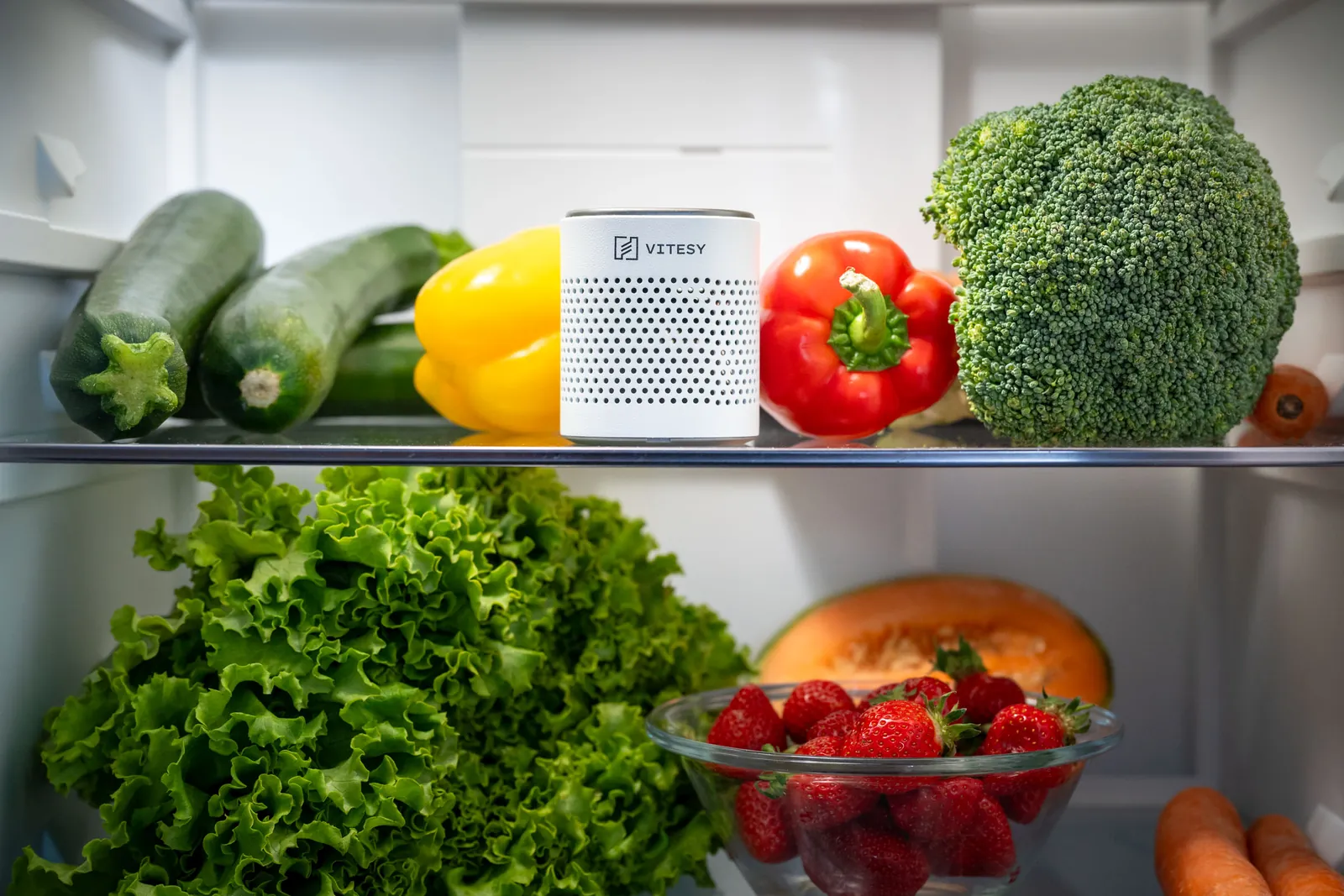
Vitesy’s Deo report (Guangdong Detection Center of Microbiology, September 2025, standard QB/T 2761-2006) gives these results:
- Fish odour (trimethylamine). In a sealed 60-litre box, from 2.19 mg/m³ to below the 0.01 mg/m³ detection limit in 2 hours; Vitesy states this as more than 99.5%.
- Rotten-cabbage odour (methyl mercaptan). In the same box, from 2.26 mg/m³ to below 0.01 mg/m³ in 2 hours.
- Formaldehyde. In a sealed 1.5 m³ chamber, from 0.989 mg/m³ to 0.0322 mg/m³ in 24 hours (96.7%).
These are simple start-to-finish drops in a sealed box; the report shows no parallel run without Deo and no by-product measurements. Vitesy’s guidance for real homes is more modest: most notice a reduction “within 72 hours”, and its test guide for retailers says Deo “may significantly reduce the intensity of odors without necessarily eliminating them completely”. Vitesy says it is most effective between 40% and 80% relative humidity, and that condensation or high humidity can temporarily reduce its efficiency.
Vitesy estimates a 10-year life from accelerated laboratory tests, counted from when Deo leaves its packaging; that test is not in the published report. Use one unit per fridge or small cabinet, with about 5 cm of free space around it, and wipe it with a slightly damp cloth. See Deo on PRO TECHnology’s page.
Activated charcoal and baking soda: do absorbers work?
Yes, within limits. Absorbers are cheap and create no by-products, but they hold odours rather than destroy them.
- Activated charcoal. Activated carbon can adsorb most hydrocarbons, many aldehydes and organic acids, but all adsorbents have limited capacity, adsorption works less well in humid air, and carbon is not especially effective against ammonia, hydrogen sulphide or formaldehyde. Thin layers “can become quickly saturated” and then release what they collected (EPA). A fridge is cold, which helps adsorption, and humid, which does not.
- Baking soda. The USDA suggests an opened box on a shelf to keep a fridge smelling fresh. It acts only on odour molecules that reach its exposed surface and its capacity is finite, so replace it regularly.
Whatever you choose, remove the source first: PRO TECHnology’s fridge smell guide walks through the USDA cleaning steps. Then keep the fridge at or below 4 °C (the USDA’s figure is 40 °F) and clear out food that should no longer be eaten once a week. The bacteria that cause food poisoning generally do not change how food smells, so a fresh-smelling fridge is not the same as a safe one (USDA).
PCO, catalytic, ozone and absorbers compared
| Technology | Power and care | Ozone | What the evidence shows | Where it makes sense |
|---|---|---|---|---|
| PCO (for example Vitesy Shelfy) | Rechargeable; filter rinsed about monthly | None with visible light; uncoated UV lamps can make it (EPA) | Room air: variable removal, by-products such as formaldehyde. Shelfy: maker’s fridge tests, no by-product data | A closed fridge |
| Room-temperature catalytic (for example Vitesy Deo) | No power; wipe only | No power source to make it | Maker’s sealed-box tests: large drops in fish and sulphur odour gases; no control run or by-product data shown | Fridge, shoe cabinet, cupboards; dry wardrobes |
| Ozone generator | Mains or battery | Yes, by design | Not effective against many odour chemicals at safe levels; forms aldehydes (EPA) | Nowhere people breathe the air |
| Absorber (charcoal, baking soda) | No power; replace regularly | None | Limited capacity; can saturate and release odours (EPA) | A low-cost step after cleaning |
Which one for the fridge, shoe cabinet, wardrobe or a whole room?
- The fridge. Clean first and check the temperature. Then an absorber is the low-cost option, Deo the no-maintenance option and Shelfy the active one, whose published tests also cover airborne microbes and ethylene, the gas that speeds ripening. Vitesy sizes Shelfy at one per 300 litres and two above 350 litres; its app, in English and four European languages but not Arabic, shows fridge temperature and door openings. See Shelfy on PRO TECHnology’s page.
- Shoe cabinets and cupboards. Passive options suit closed cupboards: Vitesy lists closets, shoe racks and the space under the sink for Deo. Let shoes dry before they go in.
- The wardrobe. A musty wardrobe in a UAE home usually points to damp, and possibly mould. Deal with the humidity first (see ideal indoor humidity in the UAE and why an AC smells musty): the US EPA notes that air cleaners do not address the cause of musty odours.
- A whole room. These are small-space devices: Vitesy sizes Deo at about one unit per 0.5 to 2 m³, depending on the odour. For a room, HawaQ’s advice is source control and ventilation first, with suitable filtration as a supplement, the order the EPA and Dubai Municipality give. Our guide to air purifiers and cooking smells explains what a room purifier can and cannot remove, and our bakhoor guide covers scented smoke. Be cautious with PCO room purifiers that publish no independent by-product tests.
How to check a fridge purifier before you buy
- Does it make ozone? “Ozone”, “O3”, “active oxygen” or “activated oxygen” on the box means yes. Avoid it.
- Is there an ozone test? ASHRAE recommends electrically powered air cleaners only when tested and labelled for ozone emission to UL 2998 or an equivalent standard.
- What exactly was tested? Ask for the gas, the box size, the time, the control run and who ran it. A sealed laboratory box is not a fridge that is opened and restocked every day.
- Were by-products measured? For any device that breaks gases down, ask about formaldehyde and acetaldehyde.
- What is the upkeep? Absorbers need replacing; Shelfy needs recharging (up to 3 weeks per charge in Eco mode, Vitesy says) and a monthly rinse of its filter; Deo needs a wipe.
HawaQ is a PRO TECHnology Group company, and PRO TECHnology distributes Vitesy, so we have a commercial link to the two Vitesy products named in this guide. The figures we quote for them are Vitesy’s own, with the test conditions given.
PRO TECHnology in Dubai expects the first Vitesy shipment by 20 November 2026; you can reserve Shelfy or Deo now on the PRO TECHnology Vitesy page, with no payment online.
Frequently asked questions
Is a photocatalytic (PCO) fridge purifier safe?
It depends on the design and the evidence. Research on room air cleaners shows that incomplete photocatalytic oxidation can produce formaldehyde and acetaldehyde (US EPA; Hodgson et al., 2007). A closed fridge is a different setting, and Vitesy says Shelfy uses no ozone or UV light, but its published tests report reductions without by-product measurements. We regard a visible-light PCO device in a closed fridge as a reasonable choice and would like to see by-product data.
Do ozone fridge purifiers work?
Not well, and we do not recommend them. The US EPA says that at concentrations within public health standards, ozone is not effective at removing many odour-causing chemicals. Ozone reacts with some chemicals to form aldehydes, and it dulls the sense of smell, so a fridge can seem fresher when the odour is only masked. The EPA and CARB advise against ozone generators where people breathe the air.
Does baking soda absorb fridge odours?
A little. The USDA suggests an opened box on a shelf to keep a fridge smelling fresh. It acts only on the odour molecules that reach its exposed surface and its capacity is finite, so replace it regularly. It does not remove the food that is causing the smell, so clean the fridge first.
Is activated charcoal better than baking soda in the fridge?
Activated charcoal adsorbs many odour gases, but the US EPA notes that all adsorbents have limited capacity, adsorb less well in humid air and are not especially effective against ammonia, hydrogen sulphide or formaldehyde. Thin layers can saturate quickly and release what they hold, so replace charcoal as its maker advises.
What is the difference between Vitesy Shelfy and Vitesy Deo?
Shelfy is an active photocatalytic purifier with a fan, blue LEDs, a washable ceramic filter and a rechargeable battery, tested by Vitesy on fridge odours, ethylene and airborne microbes. Deo is a passive catalytic odour eliminator with no power, for a fridge or a small cabinet. In Vitesy’s words, Shelfy focuses on food preservation and Deo on odours.
Can a fridge purifier make food safe to eat for longer?
No. Vitesy says Shelfy is not a safeguard against foodborne illness or spoilage, and the USDA notes that the bacteria that cause food poisoning generally do not change how food smells. Keep the fridge at or below 4 °C (the USDA says 40 °F) and follow safe storage times.
Sources
- US EPA. Residential Air Cleaners: A Technical Summary, 3rd edition, EPA 402-F-09-002, July 2018 (pp. 9, 18, 29 to 31). epa.gov
- Hodgson AT, Destaillats H, Sullivan DP, Fisk WJ. Performance of ultraviolet photocatalytic oxidation for indoor air cleaning applications. Indoor Air 2007;17(4):305-16 (abstract). pubmed.ncbi.nlm.nih.gov
- ASHRAE. Position Document on Filtration and Air Cleaning, approved 26 June 2024. ashrae.org
- Dubai Municipality. Technical Guidelines for Indoor Air Quality for Healthy Life, DM-HSD-GU119-IAQ, Version 4, December 2024 (Table 2; pp. 54, 55, 56 and 60). dmpmedia.dm.gov.ae
- Dubai Municipality. Dubai Building Code, 2021 edition, Part K, K.10.1.6.3 note. dmpmedia.dm.gov.ae
- Vitesy. Shelfy test report, Rev. 1, November 2023. vitesy.com
- Vitesy. How does Shelfy’s technology work? (FAQ). vitesy.com
- Vitesy. What is the difference between Shelfy and the upgraded version of Shelfy? (FAQ). vitesy.com
- Vitesy. Why does Shelfy turn off when placed in the fridge? (FAQ). vitesy.com
- US EPA. Ozone generators that are sold as air cleaners (updated 19 February 2026). epa.gov
- California Air Resources Board. Hazardous ozone-generating air purifiers. ww2.arb.ca.gov
- California Air Resources Board. Air cleaning devices for the home (fact sheet, 6 November 2020). ww2.arb.ca.gov
- Vitesy. Deo test report, Rev. 0, September 2025. vitesy.com
- Vitesy. How quickly does it work? (Deo FAQ). vitesy.com
- Vitesy. How long does Deo’s technology last? (FAQ). vitesy.com
- USDA Food Safety and Inspection Service. Refrigeration and food safety (removing odours; safe temperature). fsis.usda.gov
- US EPA. Guide to Air Cleaners in the Home, 2nd edition, 2018 (pp. 5 and 6). epa.gov
- Vitesy. Shelfy product page. vitesy.com
- Vitesy. Vitesy Deo product page. vitesy.com
- Vitesy. What is the difference between Vitesy Deo and Shelfy? (FAQ). vitesy.com
Sources read on 5 November 2026. Shelfy’s LED count and app languages, Deo’s size, humidity range and coverage, and the quoted retailer test advice come from Vitesy’s technical sheets and buyer test guides (2025 and 2026), supplied to PRO TECHnology as distributor documents and not published online. The room and fridge volumes are illustrative arithmetic. This guide is general information, not medical or food-safety advice.