
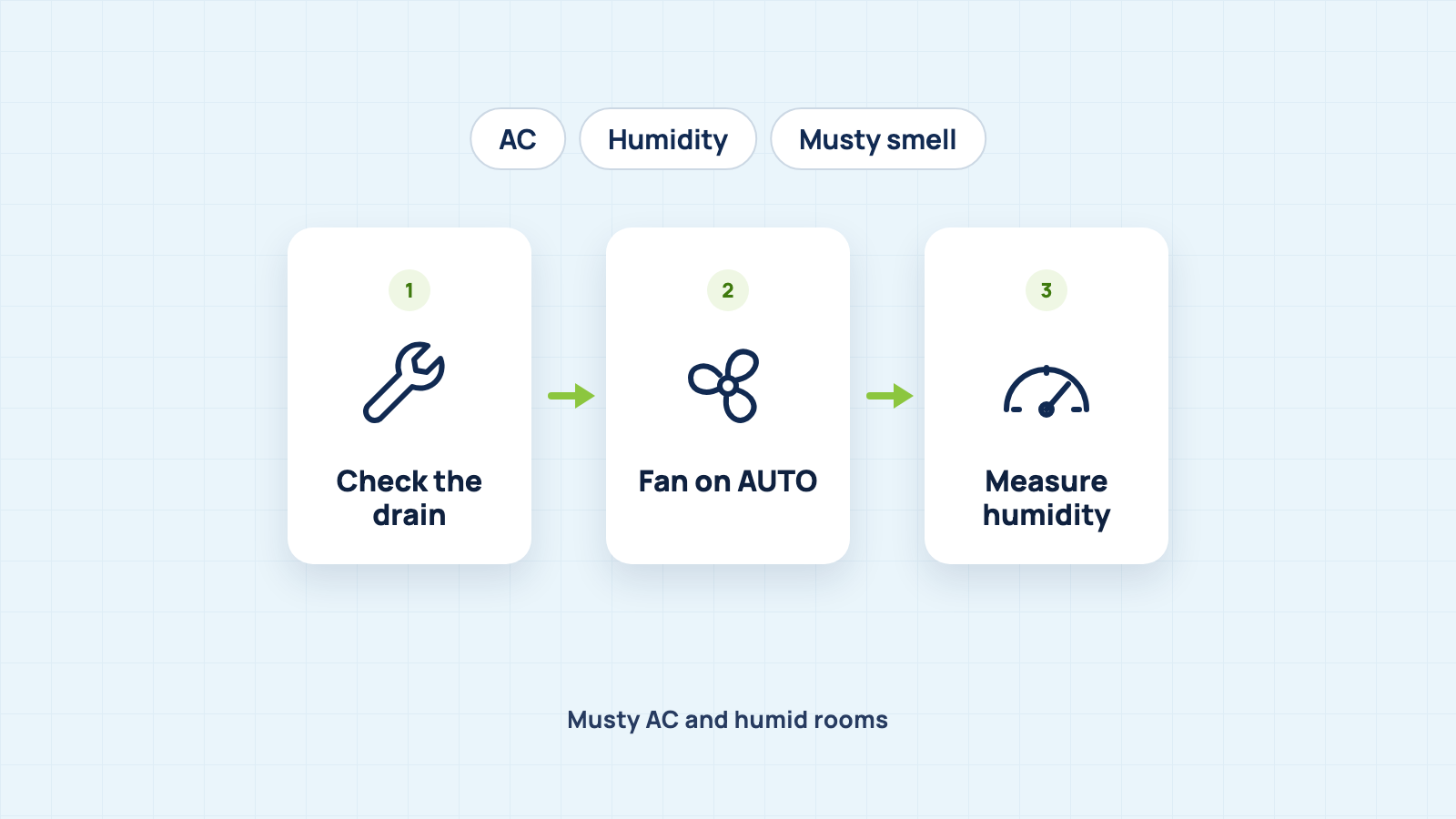
Both usually trace back to moisture. A musty smell suggests mould or other microbes growing on a wet part of the AC (coil, drip tray, duct lining) or elsewhere in the room. A room stays humid when the AC removes less moisture than gets in: the unit is oversized, its fan is set to ON, humid air leaks in or the drain is blocked. Check the drain, set the fan to AUTO and measure humidity for a week.
Why does my AC smell musty?
A musty smell from an AC often points to mould (mold) or other microbes growing where the unit stays wet: the cooling coil, the drip tray, the fan, a dusty duct lining or standing water left by a slow drain. Sometimes the AC is only spreading a smell from elsewhere in the room.
The US EPA explains that moulds release microbial volatile organic compounds (mVOCs), which can cause the musty odour, and that a mouldy smell suggests mould is growing and should be investigated. Mould inside the unit, and its cleaning, is covered in our guide to black mould in an AC.
If the room still smells musty with the AC off, look in the room: the EPA lists hidden places such as walls behind furniture, where condensation forms (see why mould keeps coming back). An air purifier will not solve it: the EPA says air cleaners and HVAC filters do not address the cause of mould and musty odours.
Smells that mean something else
- Burning. Stop the unit and switch off its power, as a split-unit manual instructs, then call your dealer or contractor.
- Drains. A dried-out trap on the condensate drain can let sewer gases into the AC, the EPA notes, for example after a summer with the system unused. Ask for it to be refilled.
- Smoke, cooking or bakhoor. One AC maker notes that indoor units can absorb room smells and release them again, and recommends a technician clean the unit (see our bakhoor guide).
Why is my room humid even with the AC on?
Because an AC dries the air only while its coil is cold and the water it collects drains away. The common causes are an oversized unit that stops too soon, a fan left on ON, humid air getting in, a blocked drain, and set-point habits.
The unit is too big. It cools the room fast and stops before the coil has condensed much water. The US EPA says a unit that is too big “will cycle on and off frequently, resulting in poor moisture removal, particularly in areas with high humidity”.
The fan is set to ON. When cooling stops but the fan keeps blowing, water on the wet coil “evaporates back into air stream”, as the Florida Solar Energy Center (FSEC) put it in research for the US Department of Energy. In one test home with the fan always on, the AC removed no net moisture when it ran less than about 60% of the time; two other homes were clearly more humid on ON than on AUTO. Chilled-water coils showed the same effect, and AUTO lost less.
Humid air is getting in. The EPA counts ventilation air, replacement air for exhaust fans and air leaks among the largest humidity loads, and notes that outdoor air dries a home only when it holds less moisture than the air inside. Extract fans left on all day can pull outdoor air in through gaps; in a tower, a central fresh-air supply that is not dried enough can add moisture to every apartment it serves. Blocking the fresh-air grille is no answer (see stuffy bedroom and CO₂).
Drains, coils or filters are neglected. ENERGY STAR warns that a plugged condensate drain can affect indoor humidity and that dirty coils reduce a system’s ability to cool; a clogged filter restricts airflow and can let the coil freeze up (Minnesota Department of Commerce).
Set-point habits. Two habits backfire. One is turning the temperature right down when a room feels clammy: the EPA calls it counterproductive, because overcooling raises the risk of condensation and mould. The other is switching off, or setting the AC very high, while the home is empty, because an AC that is off removes no moisture. In Florida research on homes left empty in summer, FSEC found most houses with no cooling averaged about 70% relative humidity, and a 29 °C (85 °F) setting failed to control humidity mainly because the AC ran too little.
The system falls short. The EPA’s troubleshooting table lists equipment not designed to dehumidify enough, and chilled water set too warm, among the causes of poor dehumidification; refrigerant level is a routine technician check.
How can I tell which cause I have?
Match what you notice to the rows below. Each cause tends to leave a pattern: when the smell comes, whether humidity climbs when cooling stops, and whether one room or every room is damp. Do your own checks first, then call the right person.
| What you notice | Likely cause | What to check | Who fixes it |
|---|---|---|---|
| Musty smell with the airflow, even with a clean filter | Microbes on the coil, tray, fan or duct lining | Louvres, fan and tray for dark growth | AC contractor |
| Water dripping from the unit, or a full tray | Blocked or slow condensate drain | Water at the drain outlet | AC contractor or building maintenance |
| Cools fast, stops often, feels cold and clammy | Oversized unit | How long each run lasts | AC contractor |
| Humidity climbs when cooling stops but air keeps blowing | Fan set to ON | The thermostat’s fan setting | You: set it to AUTO |
| Every room damp, worse on humid days | Humid outdoor air getting in | Doors, gaps, extract fans, the fresh-air grille | You; building management |
| Weak airflow, poor cooling, ice on the coil | Clogged filter or dirty coil | The filter | You: the filter. AC contractor: the coil |
What does AC dry mode do, and when is it enough?
Dry mode makes the AC better at removing moisture, and on a mild day it can be enough. It does not hold a set humidity, though: if a hygrometer still reads 60% or more after a few days on dry mode, the cause needs fixing or the room needs a dehumidifier.
How it works depends on the model. One split-unit manual says dry mode “decreases the humidity in a room without changing the temperature”. Stadler Form’s UAE guide says dry mode still cools the room and usually works from the temperature sensor rather than a humidity reading, so it “cannot hold a particular relative humidity”; its guide to AC dry mode vs a dehumidifier goes further.
If dry mode or normal cooling keeps your readings below about 50%, the AC is coping. Between 50% and 60%, keep logging; readings that stay at 60% or more point to a cause worth fixing.
What can I check myself before calling anyone?
The filter, the drain, the fan setting, a week or two of humidity readings, when the smell appears, and whether outdoor air is getting in. Switch the AC off at its power supply before opening any panel, and leave the coil and the inside of the unit to a professional.
- Filter. Clean or replace it as the manufacturer says (one split-unit manual says every two weeks); Dubai Municipality’s guideline says filters should never become clogged. Check again after a sandstorm.
- Check the drain. A visible drip tray should hold no standing water, and the drain outlet should run while the AC cools on a humid day. A full tray or drips from the unit can mean a blocked or slow drain (one split-unit manual also names dirty filters and condensation on the unit).
- Fan on AUTO. Choose AUTO on the thermostat if it offers it, so the fan stops when cooling stops. On many split-unit remotes, “Auto” sets the fan speed instead, which is a different thing. If yours has only fan speeds and the fan keeps blowing once the room reaches temperature, ask your contractor about the fan control.
- Measure humidity. Put a hygrometer (a small, inexpensive instrument, says the EPA) in the clammy or smelly room, in one that feels fine, and in the maid’s room, laundry or a wardrobe if they smell. Note readings at night, early morning and after showers or cooking for one to two weeks; readings that stay at 60% or above point to a cause worth fixing.
- Note when the smell appears. With the airflow, at start-up, all the time or with the AC off? If it stays with the AC off, look in the room.
- Doors and extract fans. Keep balcony and outer doors shut while the AC runs, and run kitchen and bathroom extract fans while you cook or shower, as the EPA advises; a fan left running all day can pull humid outdoor air in through gaps.
When do I need an AC contractor, and what should they do?
Call one when the smell stays after the filter is clean, water drips or the tray stays full, ice forms, or rooms keep reading 60% or more with the fan on AUTO. Ask for the coil, tray and drain to be cleaned and the trap, insulation, refrigerant level and unit size checked.
- Coil, tray and drain line cleaned: all on the Minnesota Department of Commerce’s technician checklist; the EPA advises asking for coils and drain pans to be cleaned at every service.
- No standing water: drain pans should slope towards the drain, as the EPA and Dubai Municipality’s guideline both say, and traps should hold water.
- Wet insulation replaced: the EPA says duct insulation that gets wet or mouldy cannot be cleaned effectively and should be removed and replaced.
ENERGY STAR and a split-unit manual both recommend professional maintenance at least once a year. In Dubai, Dubai Municipality’s guideline GU119 says the schedule should follow the manufacturer’s recommendations, with drip trays cleaned at least every month, coils and condensate pipes at least every six months, and the building and its HVAC system inspected at least every three months. This is Dubai guidance for buildings; our guide to mould in an AC has the full schedule.
When is a dehumidifier the right fix?
When the AC holds the temperature, the filter, drain and fan setting are right, and a room still logs 60% or more for days. A dehumidifier works to a humidity set point, so it keeps drying after the thermostat is satisfied, but it will not clear a drain, clean a coil or stop humid air coming in.
Aim for below 60%: the US EPA advises below 60%, ideally 30% to 50%, and Dubai Municipality’s guideline adds 50% where feasible, to control dust mites (see ideal indoor humidity in UAE homes).
Stadler Form Lukas removes up to 20 litres a day and is rated for rooms up to 70 m², which suits a bedroom or a smaller apartment.
For villas and large apartments near the sea, Lukas Pro is the dehumidifier HawaQ recommends most often. In more than 50 waterfront homes on Palm Jumeirah, Dubai Marina, JBR and La Mer, HawaQ logged humidity room by room for a month before recommending anything, then specified Lukas Pro where the data showed it was needed. Stadler Form Lukas Pro removes up to 50 litres a day and is rated for rooms up to 175 m². That is a rated maximum: Stadler Form says it is reached only from about 22 °C and 70% humidity, so a cooled room will see less. It drains continuously through the included hose, has a digital hygrostat and an H11 particle filter, and carries a 5-year Pro Series warranty.
HawaQ is a PRO TECHnology Group company. PRO TECHnology distributes Stadler Form in the UAE and MedicAir in the GCC, so we have a commercial link to the products we name. We measure first and recommend a product only where the readings call for one.
What does HawaQ check in a musty or humid home?
HawaQ logs humidity and temperature room by room across normal AC cycles, checks the AC, its supply air and the fresh air coming in, looks for mould and hidden moisture, and gives you and your contractor a fix plan in order of priority. We measure before anyone recommends a fix.
- Room-by-room logging across AC cycles, including overnight, as in our two-week home check-up with an HVAC inspection and a clear report.
- Supply and fresh air, as in our ventilation and filtration assessment.
- Mould and moisture: a visual inspection, moisture mapping and a check of coils, drip trays, filters and diffusers, with laboratory samples where needed (mould investigation).
- A plan, then a check: what to fix first, then follow-up monitoring to confirm humidity stays in range.
Frequently asked questions
Is a musty smell from my AC dangerous?
Treat it as a warning sign rather than a diagnosis. The US EPA says a mouldy smell suggests mould is growing and should be investigated, and that mould may cause allergic reactions such as sneezing, a runny nose and red eyes in sensitive people, and asthma attacks in people with asthma who are allergic to mould. Anyone with symptoms should see a doctor.
Should the AC fan be on AUTO or ON?
AUTO, on a thermostat that offers it. On ON, the fan keeps blowing over the wet coil after cooling stops and evaporates water back into the room. In US field tests by the Florida Solar Energy Center, one AC with the fan always on removed no net moisture when it ran less than about 60% of the time, and two homes were clearly more humid on ON than on AUTO. On many split-unit remotes, Auto means fan speed, a different setting.
Why does my AC smell when I first turn it on?
Often because part of the unit has stayed damp, such as the coil, the drip tray or the duct lining, where mould can grow; the musty smell can come from gases that moulds release. A unit can also absorb room smells, such as smoke, and release them again. If a clean filter does not help, have the coil, tray and drain cleaned.
Does AC dry mode remove humidity?
Yes, that is its job, but it is not a humidity controller. Stadler Form notes that dry mode usually works from the unit’s temperature sensor rather than a humidity reading, so it cannot hold a set humidity. If a hygrometer still reads 60% or more with dry mode on, look for the cause or use a dehumidifier.
How often should AC filters be cleaned in Dubai?
As often as the manufacturer says, and before they clog. One split-unit manual recommends every two weeks, ENERGY STAR says to check central AC filters monthly, and Dubai Municipality’s indoor air quality guideline says filters should be cleaned or replaced so they never become clogged. Check again after a sandstorm.
Why is my apartment humid when the AC is on all day?
Running all day is not the same as drying. An oversized unit stops before it removes much moisture, a fan left on ON puts water from the coil back into the air, and in a tower, humid fresh air, open balcony doors or extract fans left running can bring in moisture faster than the AC removes it. A week of readings helps show which.
Sources
- US EPA. Should You Have the Air Ducts in Your Home Cleaned? EPA 402-K-97-002 (web page updated 19 February 2026). epa.gov
- US EPA. A Brief Guide to Mold, Moisture, and Your Home. EPA 402-K-02-003 (reprinted 2012), pp. 2, 11 and 14. epa.gov
- US EPA. Mold Course, Chapter 1, Lesson 6: Moldy Smell (updated 18 February 2026). epa.gov
- US EPA. Moisture Control Guidance for Building Design, Construction and Maintenance. EPA 402-F-13053 (December 2013), pp. 17, 57, 58, 88 and 101. epa.gov
- US EPA. Guide to Air Cleaners in the Home, 2nd edition (2018), p. 5. epa.gov
- Shirey DB, Henderson HI, Raustad RA. Understanding the Dehumidification Performance of Air-Conditioning Equipment at Part-Load Conditions. Florida Solar Energy Center, FSEC-CR-1537-05, for the US Department of Energy (January 2006): abstract and report pages 4-1, 4-18, 4-19 and 4-22. stars.library.ucf.edu
- Florida Solar Energy Center. FSEC Looking for Vacant Homes to Study Ways to Control Relative Humidity and Avoid Mold in Seasonal-Resident Homes (press release, 12 May 2005, summarising its earlier vacant-home research). blog.energyresearch.ucf.edu
- Minnesota Department of Commerce. Home Energy Guide: Air conditioner repairs and maintenance. mn.gov
- ENERGY STAR (US government). Maintenance Checklist for heating and cooling systems. energystar.gov
- Daikin. Operation manual, Daikin room air conditioner FTXF20 to 71A2V1B (3P511999-3, November 2017), pp. 5 and 7 to 11. daikinmea.com
- Daikin Europe. Technical support FAQ: troubleshooting, case 5 (the indoor unit gives off odours). daikin.eu
- Dubai Municipality. Technical Guidelines for Indoor Air Quality for Healthy Life, DM-HSD-GU119-IAQ, Version 4 (11 December 2024): clause 9-4 (pp. 27 to 28) and Managing Moisture and Mold (p. 41). dmpmedia.dm.gov.ae
- Stadler Form UAE. Does air conditioning remove humidity? AC dry mode vs a dehumidifier in the UAE. stadlerform.ae
- Stadler Form UAE. Lukas Pro and Lukas product pages (figures as published on 27 October 2026). stadlerform.ae
Sources read on 27 October 2026. Product figures are as published by the manufacturer on that date. Dubai Municipality guidance applies in Dubai. This guide explains public guidance in plain language; it is not medical advice.