
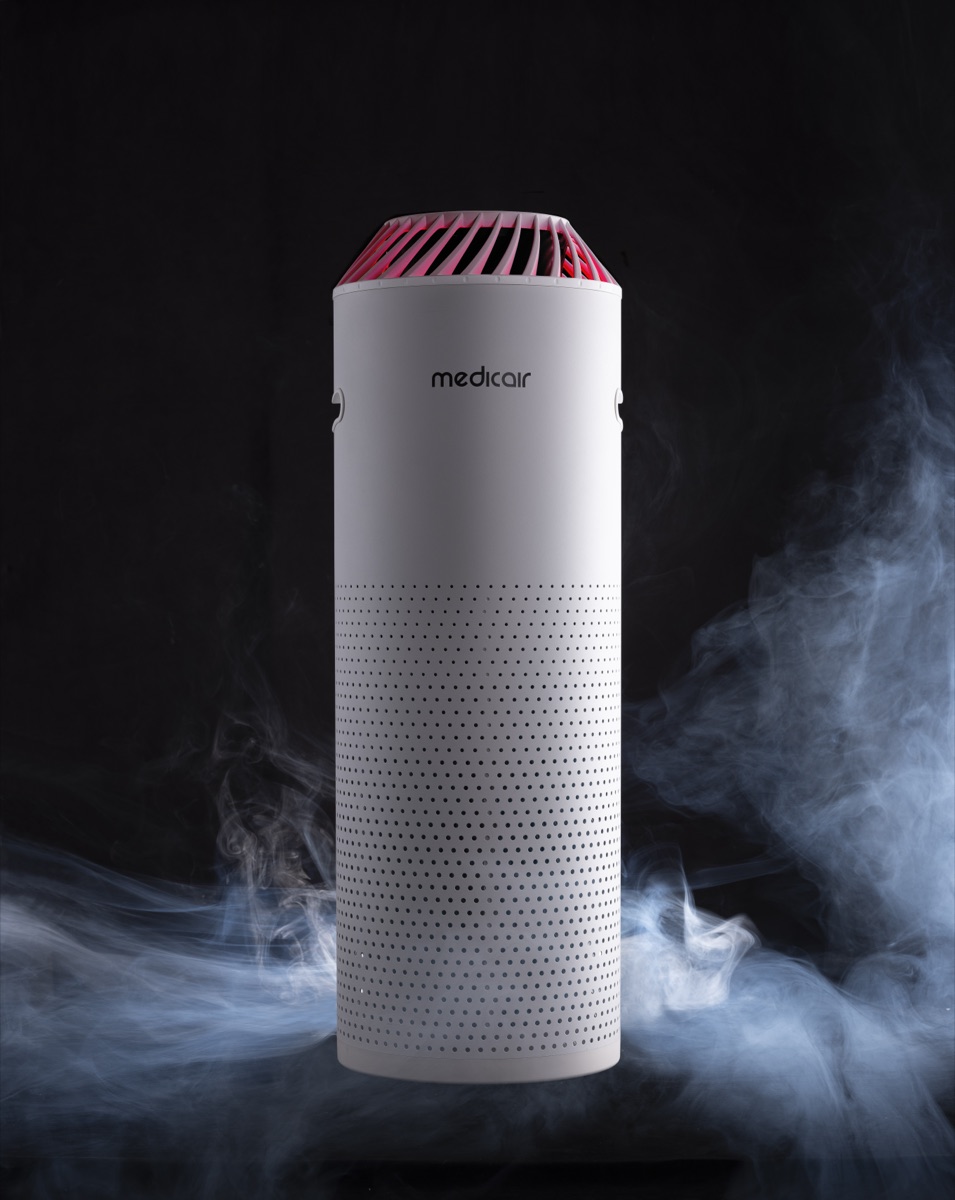
UAE homes get dusty because fine desert dust enters through door and window gaps, fresh-air intakes and on clothes, and air conditioning keeps it moving. Two different problems follow: fine dust that stays in the air, which a HEPA purifier sized to the room’s volume can capture, and coarser dust that settles on surfaces, which only cleaning removes. Close the room, run the purifier at a setting that meets your target, clean surfaces after the storm, and treat any purifier’s capacity figure as its maximum, not what it delivers on its quiet setting.
Why is my house so dusty in Dubai?
Outdoor dust is constant in the region and rises sharply in storms. It enters through gaps around doors and windows, fresh-air intakes with low-grade filters, and every time a door opens. Inside, the AC keeps it moving, and soft furnishings and carpets hold it.
How high do particle levels get in a sandstorm?
During the Dubai sandstorm of 18 May 2022, IQAir reported a city-wide average of 784.7 µg/m³ PM10 and 94.5 µg/m³ PM2.5 outdoors. For comparison, the WHO 24-hour guideline values are 45 µg/m³ for PM10 and 15 µg/m³ for PM2.5. To read the AQI figures that apps show on days like that, see Dubai’s AQI explained.
What PM2.5 and PM10 levels are safe indoors?
| Reference | PM2.5 | PM10 |
|---|---|---|
| WHO guideline (24 h) | 15 µg/m³ | 45 µg/m³ |
| Dubai EIAQI “Good” | 0–12 µg/m³ | 0–50 µg/m³ |
| Dubai Municipality limit (24 h) | 35 µg/m³ | 150 µg/m³ |
The Dubai figures apply to Dubai. Other emirates and GCC countries set their own limits.
Airborne dust and settled dust are two different problems
A dust storm brings in particles of very different sizes, and they behave differently once they are indoors.
- Settled dust and sand. The heavier, coarser particles fall out of the air quickly and land on floors, sills, furniture and AC grilles. A purifier never sees them unless something lifts them again: walking, sweeping, a vacuum without a HEPA filter, or the AC blowing across a dusty surface.
- Airborne fine dust. PM2.5 and the finer part of PM10 stay suspended far longer. This is the fraction people breathe, the fraction that slips through gaps and low-grade filters, and the fraction a HEPA purifier is designed to capture.
So the order of work after a storm matters. Clean surfaces with a damp cloth and a HEPA vacuum, run the purifier during and after the cleaning to catch what it disturbs, and expect visible dust to return on surfaces until the sources of entry are sealed.
Which filters stop fine dust?
HVAC filters are rated on the MERV scale from 1 to 20; higher numbers capture more fine particles. Al Sa’fat requires permanent filters of at least MERV 8 before a building is occupied after construction or renovation. Portable purifiers use HEPA filters, which capture fine particles far more efficiently. The best HVAC filter is the highest rating your system’s fan can handle without losing airflow.
Should I run an air purifier during a sandstorm?
Yes, with windows and doors closed. A HEPA purifier sized to the room keeps indoor PM2.5 down while outdoor levels are high. Run it on a higher setting during the storm and for a few hours afterwards, when settled dust is stirred up again.
A purifier cleans only the room it is in. In an open-plan villa or an apartment with doors left open, its clean air is diluted across every connected space, and dust keeps arriving through whatever gaps are open. Close the doors of the rooms that matter most, usually the bedrooms, and give each of those rooms its own unit.
How to size a purifier for a dusty room
Use the room’s volume, not its floor area, because a 4 m ceiling holds a third more air than a 3 m one.
- Room volume (m³) = length × width × ceiling height.
- Choose a target in air changes per hour (ACH). MedicAir’s own guidance is about three for homes, five for offices and ten for healthcare rooms; during a dust event, aim for the upper end you can manage.
- Clean air needed (m³/h) = volume × ACH. Compare it with the purifier’s rated figure.
Two cautions apply to the last step. A rated figure is the unit’s maximum, measured at full fan speed. And it may be a clean air delivery rate (CADR), the clean air the unit delivers after filtration, or simply the airflow its fan moves; a CADR can never be higher than the airflow behind it. If a manufacturer does not say which, or names no test method, treat the figure as an upper bound.
A bedroom of 4 × 4.5 m with a 3 m ceiling holds 54 m³. At three air changes an hour it needs about 160 m³/h of clean air; at five, about 270 m³/h. A majlis of 8 × 6 m with a 3.5 m ceiling holds 168 m³ and needs about 840 m³/h at five air changes. These numbers are for sizing only. They are not measurements from a HawaQ project.
Noise and airflow: why the quiet setting cleans less
Noise depends on fan speed, and so does the amount of air cleaned: the US EPA puts it simply, the longer and faster an air cleaner runs, the more air it filters. Most manufacturers publish one capacity figure at full speed and one noise figure at the quietest setting. The two never happen at the same moment, and the quiet setting cleans far less air than the headline capacity.
Few manufacturers publish both figures for each speed. MedicAir does so for one model, the Pro, in its January 2024 brochure: up to 180 m³/h at 28 dB on Low, 360 m³/h at 45 dB on Medium, 500 m³/h at 51 dB on High and 605 m³/h at 60 dB on Max. For its other models, MedicAir does not publish the airflow at the quieter settings, and nobody should infer it from the maximum. The practical rule: size so the unit meets your target at a setting you can live with, and listen to it before you buy.
What a purifier cannot do about dust
- It does not remove dust that has already settled. Cleaning does.
- It does not stop dust entering. Sealing gaps, closing doors and better HVAC filtration do.
- It does not bring in fresh air or lower CO₂. If the room feels stuffy, that is a ventilation problem.
- It does not lower humidity. A damp, musty room needs a dehumidifier, not a purifier.
- Its filters load faster in dust season. Check and clean the pre-filter more often than the manual’s interval assumes, and replace the main filter on schedule.
- It is not a medical device, and it cannot promise any health outcome.
Choosing a MedicAir model for dust
HawaQ recommends MedicAir purifiers, which combine a pre-filter, a HEPA filter, activated carbon and an enclosed UV-C chamber. The three models differ mainly in how much air they move and how quietly. All figures below are MedicAir’s published maximums, not independent test results.
| Model | Stated maximum | Room at 5 ACH, full speed | Where it fits for dust | Next step |
|---|---|---|---|---|
| Pro Mini | 400 m³/h (2022 revision) or 410 m³/h (2024 revision), stated as clean air delivery rate | About 80 m³ | One closed bedroom, nursery or study | Specifications · Request a price |
| Pro | 605 m³/h at Max; 360 m³/h at Medium (45 dB) | About 120 m³ at Max, about 70 m³ at Medium | A living room, majlis or classroom, ideally at Medium | Specifications · Request a price |
| Pro Max | 1,500 m³/h, stated as clean air delivery rate in the manual and as airflow on MedicAir’s website | About 300 m³ | Open-plan offices, halls and warehouse zones, on wheels | Specifications · Request a price |
For the majlis in the worked example, 840 m³/h is more than one Pro at Max, so the choice is two Pro units at Medium, or one Pro Max with headroom. For the bedroom, one Pro Mini covers 270 m³/h with headroom at full speed. On a quiet night setting it delivers less, by an amount MedicAir does not publish, so run it higher while the storm is on.
Our MedicAir Pro Mini vs Pro vs Pro Max guide sets out the trade-offs in more detail. PRO TECHnology, the Dubai group HawaQ belongs to and MedicAir’s exclusive GCC distributor, publishes the full specifications, the differences between the manufacturer’s documents, and a price and demonstration enquiry on each model page.
How do I know if dust is getting in?
Compare indoor and outdoor particle readings. If indoor PM2.5 rises within minutes of outdoor levels, your building is leaky or its filtration is weak. A monitor that logs PM2.5 and PM10 continuously makes this visible, and it also shows whether a purifier is bringing the room back down after a storm.
Frequently asked questions
Do sandstorms affect people with asthma?
Fine particles can irritate airways, so people with asthma or other respiratory conditions should limit exposure and follow their doctor’s advice.
Is a HEPA purifier better than an AC filter?
For fine particles, yes. HEPA captures fine dust far more efficiently than typical HVAC filters, so use both: the AC filter protects the system and takes some load, the purifier cleans the room’s air.
Does a purifier remove sand and settled dust?
No. It captures the fine dust that stays airborne. Heavier sand and dust that has already settled on floors, furniture and grilles has to be cleaned away, ideally with a damp cloth and a vacuum with a HEPA filter, and a purifier running while you clean catches what the cleaning lifts back into the air.
How big a purifier do I need for a dusty room?
Work from room volume: floor area times ceiling height. Multiply by the air changes per hour you want, at least three for a home and more during a dust event, and compare the result with the purifier’s rated figure. That figure is the unit’s maximum, so choose one that meets your target below full speed. A 4 × 4.5 m bedroom with a 3 m ceiling holds 54 m³, so five air changes an hour means about 270 m³/h of clean air.
Will a purifier be quiet enough to run at night?
Only at a low setting, and a low setting moves much less air. Noise depends on fan speed, and most manufacturers publish their capacity at full speed and their noise at the quietest setting, so the two figures never describe the same moment. Size so the unit can do its job at a setting you can sleep with, keep the bedroom door closed, and run it higher during the day.
Which MedicAir model suits a bedroom, a majlis or an office?
As a starting point: the Pro Mini for one closed room such as a bedroom, the Pro for a living room, majlis or classroom where it can run at a middle speed, and the Pro Max for open-plan offices, halls and warehouse zones. Every capacity figure MedicAir publishes is a maximum at full speed, so we confirm the model and number of units from your room sizes.
Sources
- IQAir, “Dubai sandstorm” newsroom report, 18 May 2022.
- World Health Organization, WHO Global Air Quality Guidelines (2021), Table 0.1.
- Dubai Municipality, Technical Guidelines for Indoor Air Quality for Healthy Life (DM-HSD-GU119-IAQ, Version 4, December 2024): Table 2 (p33), MERV p56.
- Dubai Municipality, Environmental Indoor Air Quality Index (EIAQI), DM-HSD-GU141-IAQI2, Version 1 (14 February 2025): Table 2 (p10).
- Al Sa’fat – Dubai Green Building System, 2nd edition (January 2023): clause 401.02.
- US EPA, Guide to Air Cleaners in the Home (last updated 1 October 2026): CADR and room size, fan speed, noise and run time.
- MedicAir manufacturer documents: Pro Mini manuals (April 2022, model PFACOABBD; April 2024, model PFACOABBDII), MedicAir 2.0 (Pro) brochure (January 2022), MedicAir Pro brochure (January 2024) and Pro Max manual (May 2022) and specification sheet, as summarised on the PRO TECHnology MedicAir comparison.
This guide explains public standards and manufacturer figures in plain language. It is not legal or medical advice; check the current version of each document for compliance decisions.