
Dubai’s AQI turns the outdoor pollutant with the worst reading, usually dust or fine particles, into one number from 0 to 500. Apps disagree because they use different scales and averages: PM2.5 that the UAE’s own index calls “Good” can be “Unhealthy for sensitive groups” on the US AQI that IQAir shows. A closed home keeps out part of the outdoor pollution, not all of it, and an indoor monitor shows how well yours does.
What does Dubai’s AQI measure?
The air quality index (AQI) is a translation. Monitoring stations measure pollutants in the outdoor air: fine particles (PM2.5), coarser dust (PM10), ozone, nitrogen dioxide, sulphur dioxide and carbon monoxide. Each reading is converted to a score on the same 0 to 500 scale, and the AQI you see is the highest of those scores. One pollutant decides it.
The UAE and the US use the same six bands and colours: Good (green, 0–50), Moderate (yellow, 51–100), Unhealthy for sensitive groups (orange, 101–150), Unhealthy (red, 151–200), Very unhealthy (purple, 201–300) and Hazardous (maroon, 301 and above). What differs is how much pollution it takes to reach each band.
The AQI describes outdoor air. Dubai Municipality’s Environmental Indoor Air Quality Index is a separate score for the air inside buildings, explained in our guide to the EIAQI.
Why do AQI apps show different numbers for Dubai?
Because they do not measure, average or score the air the same way. On the morning of 20 October 2026, a weather website showing a computer model’s estimate put Dubai at 135, “unhealthy for sensitive groups”. That morning, IQAir’s sensor network showed 79, “moderate”. Four things explain gaps like that.
- Different scales. The UAE’s own index, the Emirati Air Quality Index set out by the Ministry of Climate Change and Environment in 2023, puts its bands at much higher particle levels than the US AQI that IQAir and most international apps use. The table below shows how far apart they are.
- Different averaging. The Emirati index uses a 24-hour rolling average for particles and is reported every hour. IQAir updates hourly from the previous hour’s average. The US EPA, which created the AQI, bases its daily index on 24-hour averages and its current reading on a 12-hour “NowCast”, and says it is not valid to calculate an AQI from hourly data.
- Different sources. Government stations use reference instruments. IQAir’s Dubai figure combines government stations, low-cost sensors and community monitors: 71 stations from 67 contributors. Some weather apps show a model’s estimate rather than a measurement; the 135 above came from the Copernicus Atmosphere Monitoring Service.
- Different pollutants and places. The National Center of Meteorology’s air quality platform calculates its index from five pollutants: carbon monoxide, nitrogen dioxide, sulphur dioxide, ozone and PM10. PM2.5 is not on that list. And a station beside a highway or a building site reads differently from one in a quiet residential street.
| Band | US AQI | Emirati AQI |
|---|---|---|
| Good | 0–9.0 | 0–50.4 |
| Moderate | 9.1–35.4 | 50.5–60.4 |
| Unhealthy for sensitive groups | 35.5–55.4 | 60.5–75.4 |
| Unhealthy | 55.5–125.4 | 75.5–150.4 |
| Very unhealthy | 125.5–225.4 | 150.5–250.4 |
| Hazardous | 225.5 and above | 250.5–500.4 |
Take a day averaging 40 µg/m³ of PM2.5. It is “Good” on the Emirati index, “Unhealthy for sensitive groups” on the US AQI, and more than two and a half times the World Health Organization’s 24-hour guideline of 15 µg/m³. The Emirati guideline itself notes that PM2.5 is not yet part of the UAE’s national air quality standard, Cabinet Decree 12 of 2006, and includes it as a reference value.
Which should you follow? If anyone at home is in a sensitive group, use the US AQI or the WHO guideline, because they warn earlier. For particle pollution, the US EPA’s sensitive groups are people with heart or lung disease, older adults, and children and teenagers. The Emirati guideline adds infants, pregnant women and people with diabetes.
Why is Dubai’s air worse on some days and in some months?
Mostly because of dust. A study of 14 Dubai Municipality monitoring stations from 2013 to 2021 found that “a large portion of PM10 pollution is attributed to natural desert dust sources rather than urban pollution sources”. PM10 was lowest in December and January and peaked in July, and ozone was also highest in summer. In Abu Dhabi, researchers found particle levels high from April to September, peaking in July, and linked this to dust and sandstorms.
Fine particles have more mixed sources. A source study at Abu Dhabi sites, funded by the Environment Agency – Abu Dhabi, traced about 40% of PM2.5 to pollution from human activity carried in from elsewhere, and about 25% to natural mineral dust. It found local traffic, industry and shipping were significant sources too.
Over a full year, the levels are high by world standards. IQAir’s 2025 figures put the UAE’s average PM2.5 at 36.4 µg/m³, 7.3 times the WHO annual guideline of 5 µg/m³, and ranked the country 13th of 143. Dubai averaged 35.8 µg/m³.
For what a dust storm does inside a home, and how to clean up afterwards, see our guide to sandstorms and indoor dust.
How much outdoor pollution gets inside your home?
Some of it. How much depends on the building, and on what you do inside it.
- In a study of ten homes in Kuwait, 40 to 60% of outdoor particles got through the walls, windows and gaps on ordinary days. During dust storms the share fell below 20 to 30%.
- In a Dubai apartment monitored in 2023, indoor fine-dust levels stayed below outdoor levels while the flat was empty. Once people were home, indoor levels sometimes rose above outdoor ones, because of what the researchers call “occupants’ indoor activities”.
So on a high-AQI day, two things decide the air you breathe at home: how well the building keeps outdoor particles out, and how much you add inside. The US EPA’s list of indoor sources to avoid on high-particle days includes frying or broiling food, burning candles or incense, and vacuuming without a HEPA filter. Bakhoor counts as incense: see what bakhoor adds to indoor air and how to reduce it.
What should you do at each AQI level?
The outdoor advice below is the US EPA’s for particle pollution, on the US AQI that most apps in Dubai show. The indoor column is our advice, built on the EPA’s guidance for keeping particles out of homes. If your app uses the Emirati index, its colours allow more pollution, so check which scale it shows.
| US AQI | Outdoors (US EPA, particle pollution) | Indoors (HawaQ) |
|---|---|---|
| 0–50 Good | It’s a great day to be active outside | Open the windows and air the home out |
| 51–100 Moderate | Unusually sensitive people: consider making outdoor activities shorter and less intense | Normal routine. Keep the bedroom window shut for anyone very sensitive |
| 101–150 Unhealthy for sensitive groups | Sensitive groups: make outdoor activities shorter and less intense, and take more breaks | Keep windows closed. Run a purifier where sensitive people sleep. Skip frying, bakhoor and candles |
| 151–200 Unhealthy | Sensitive groups: consider moving all activities inside. Everyone else: keep outdoor activities shorter and less intense | Keep windows and doors closed. Run purifiers in the rooms you use. Ask your AC contractor whether your system can take MERV 13 filters |
| 201–300 Very unhealthy | Sensitive groups: avoid all physical activity outdoors. Everyone else: limit outdoor physical activity | As above, and keep sensitive people in the cleanest room |
| 301 and above Hazardous | Everyone: avoid all physical activity outdoors | As above. Air the home out only once readings fall |
In extreme heat, the EPA warns that staying indoors with the windows closed may be dangerous without an air conditioner.
How can you check your own indoor air on a high-AQI day?
The AQI tells you about the street. An indoor monitor tells you about the air you actually breathe at home.
- Put a PM2.5 monitor in the room you use most, at breathing height, away from the kitchen, windows and AC vents. Our guide to testing air quality at home explains placement.
- Compare it with the outdoor reading for the same hour. Indoor well below outdoor means your home is holding up. Indoor tracking outdoor means air is getting in through windows, gaps or a fresh-air intake. Indoor above outdoor means something inside is adding particles.
- Watch CO₂ while the home is shut. Closing up cuts fresh air, so CO₂ builds. Washington State’s health department suggests keeping CO₂ below 800 ppm when buildings are closed against smoke, and the US EPA advises airing out “when the air quality improves, even temporarily”.
- Treat low-cost sensors as a guide, not a lab result. Humidity and coarse desert dust can throw their particle readings off, as our guide to why air quality monitors give different readings explains.
- For indoor limits, compare your readings with Dubai Municipality’s EIAQI.
For a full picture of your home, HawaQ’s two-week home check-up measures the air room by room. For offices, schools and clinics, we install continuous monitoring.
Frequently asked questions
Is Dubai’s air quality bad?
Over a full year, yes by world standards. IQAir’s 2025 figures put Dubai’s average PM2.5 at 35.8 µg/m³, about seven times the WHO annual guideline of 5 µg/m³. Day to day it varies a lot, and particle levels usually peak in summer, when desert dust is at its highest.
Is an AQI of 150 bad?
On the US AQI, 101 to 150 is “Unhealthy for sensitive groups”. The US EPA advises people in those groups to make outdoor activities shorter and less intense, and to take more breaks. Check which scale your app uses: the UAE’s Emirati index reaches 150 only at a much higher particle level.
Why does one app say Dubai’s air is good and another says unhealthy?
They use different scales, averages and data. PM2.5 up to 50.4 µg/m³ counts as “Good” on the UAE’s Emirati index, while the US AQI calls anything from 35.5 µg/m³ “Unhealthy for sensitive groups”. Some apps also show a computer model’s estimate rather than a measurement.
Should I close my windows when the AQI is high?
Yes, when particle levels are high: keeping windows and doors closed is the first step in US EPA guidance. Air the home out when outdoor readings improve, even briefly, and keep an eye on CO₂, which builds up in a closed home.
Does an air purifier help when the AQI is high?
For particles, yes, if it is sized for the room and running. The US EPA advises running a portable air cleaner as often as possible on its highest fan speed when smoke keeps particle levels high. Purifiers do not remove carbon dioxide or carbon monoxide, so the home still needs fresh air.
Is it safe to exercise outside when Dubai’s AQI is over 100?
On the US AQI, above 100 the US EPA advises sensitive groups to make outdoor activities shorter and less intense. Above 150, it advises everyone else to do the same, and sensitive groups to consider moving all activities inside. Summer heat adds its own risk.
Sources
- US EPA, Technical Assistance Document for the Reporting of Daily Air Quality – the Air Quality Index (AQI): AQI bands, PM2.5 and PM10 breakpoints, activity advice and sensitive groups.
- US Code of Federal Regulations, 40 CFR Part 58, Appendix G: AQI breakpoints as amended on 6 March 2024.
- UAE Ministry of Climate Change and Environment, Guideline for calculating the Emirati Air Quality Index (EAQI), 2023.
- National Center of Meteorology, National Air Quality Platform.
- Environment Agency – Abu Dhabi, Abu Dhabi Air Quality.
- IQAir, Why don’t AirVisual and NowCast’s air quality readings always match? (22 July 2026).
- IQAir, IQAir implements 2024 update to U.S. EPA Air Quality Index (AQI).
- IQAir, Dubai air quality; United Arab Emirates air quality; World’s most polluted cities (2025 annual data).
- Weather Underground, Dubai air quality, Copernicus Atmosphere Monitoring Service data, viewed on the morning of 20 October 2026.
- World Health Organization, What are the WHO Air quality guidelines? (22 September 2021).
- Akasha et al. (2024), Air pollution and economic growth in Dubai, a fast-growing Middle Eastern city, Atmospheric Environment: X.
- Abuelgasim and Farahat (2020), Investigations on PM10, PM2.5, and their ratio over the Emirate of Abu Dhabi, United Arab Emirates, Earth Systems and Environment.
- Hak and López-Aparicio (2013), Source apportionment of PM2.5 at Abu Dhabi sites, NILU.
- Yuan et al. (2020), Dust events and indoor air quality in residential homes in Kuwait, International Journal of Environmental Research and Public Health.
- Jung and Mahmoud (2023), Navigating dust storms and urban living: an analysis of particulate matter infiltration in Dubai’s residences, Frontiers in Built Environment.
- US EPA, Wildfires and Indoor Air Quality (updated 2 September 2026).
- Washington State Department of Health, Improving Ventilation and Indoor Air Quality During Wildfire Smoke Events (DOH 333-208, May 2025).
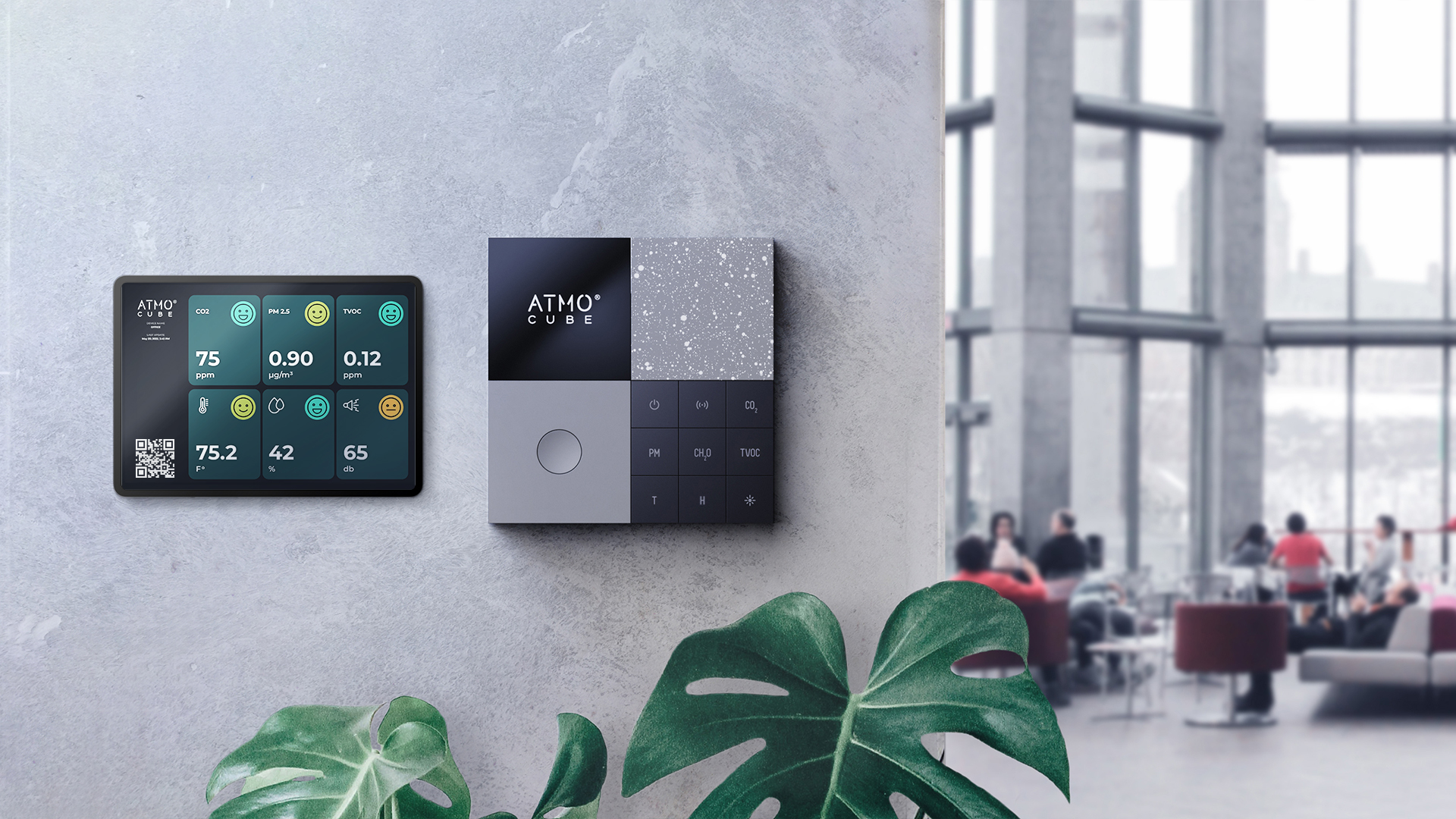
The side-by-side PM2.5 table and the 40 µg/m³ example are our comparison of the US EPA, Emirati and WHO values above. This guide explains public guidance in plain language. It is not medical advice. Cover image: Atmocube product photograph.