
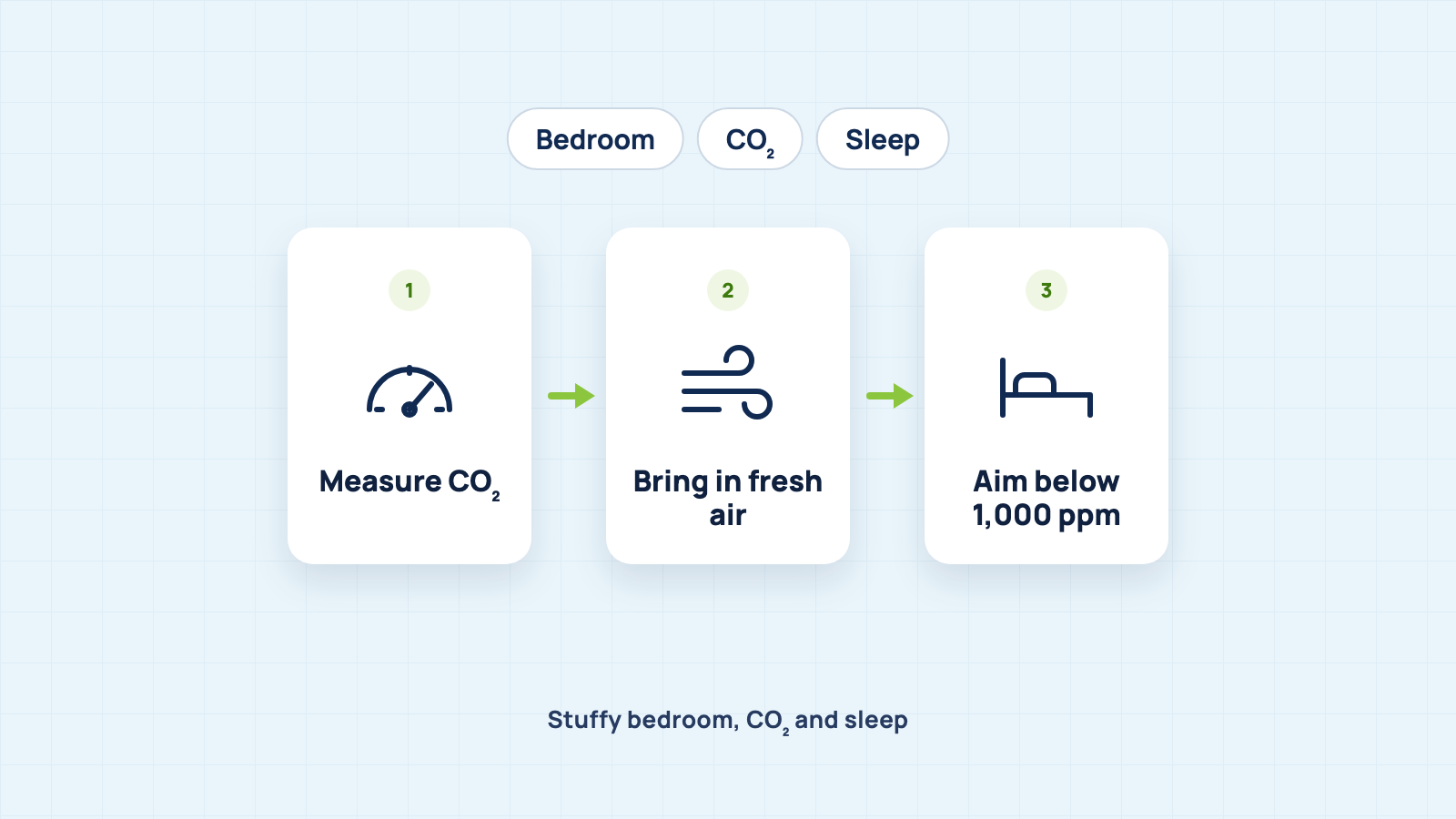
A bedroom feels stuffy with the AC on because most home air conditioners cool and recirculate indoor air without bringing in outdoor air. With the door shut, CO₂ from breathing builds up overnight, and studies link better bedroom ventilation with better sleep. Measure with an NDIR CO₂ monitor, aim below 1,000 ppm (below 800 ppm is better) and bring in fresh air in ways that work with the door shut. An air purifier will not lower CO₂.
Why does my bedroom feel stuffy with the AC on?
Because the AC keeps cooling the same air. A typical wall-mounted split unit draws in room air, cools it and blows it back; it does not bring in outdoor air. With the door shut, the CO₂ and moisture you breathe out build up, so the room feels staler as the night goes on.
The US EPA says most home heating and cooling systems, forced-air systems included, do not mechanically bring fresh air into the house.
Fresh air has to come from elsewhere: a fresh-air supply (some towers feed one to each apartment from a central unit), extract fans, leaks around doors and windows, or a door or window you open. In a home kept shut with the AC on, that can be very little.
Stuffiness is not only CO₂: when one study cut bedroom ventilation, humidity rose too. If the room feels clammy, read why the AC can leave a room humid and our guide to ideal indoor humidity in UAE homes. If it smells of paint or new furniture, see air quality in a new or renovated home.
How high does CO₂ get in a closed bedroom overnight?
It can climb well past 1,000 ppm. In one-person student rooms, nights with the window shut averaged 2,585 ppm, against 660 ppm with it open. In the bedrooms of 17 healthy young adults, nights with the window and door shut averaged 1,150 ppm, against 717 ppm with either open. Outdoor air is about 426 ppm, the 2025 global average.
The cause is simple arithmetic. In a chamber study, sleeping young adults each breathed out about 11 litres of CO₂ an hour. In a small, closed room that CO₂ builds up hour by hour, and two sleepers add twice as much as one. In the student rooms, a fan in the air intake that switched on whenever CO₂ passed 900 ppm brought the average down from 2,395 to 835 ppm.
A UAE bedroom with the windows shut and the split unit running faces the same arithmetic, and a single daytime reading will not show it.
Does CO₂ affect sleep?
Higher CO₂ at night has been linked with poorer sleep, but mostly as a sign of too little fresh air. Some studies that gave bedrooms more outdoor air found better sleep and, in one, better next-day logical-thinking scores. A 2020 review called the evidence limited, and studies cannot yet show whether CO₂ itself or the pollutants that build up with it are responsible.
| Study | What changed | Average CO₂ | What the researchers found |
|---|---|---|---|
| Strøm-Tejsen et al., 2016: 14, then 16, students in one-person rooms | Window open or shut; intake fan on or off | Window open 660, shut 2,585 ppm; fan on 835, off 2,395 ppm | At lower CO₂: better measured sleep and fresher-feeling air; next day, less reported sleepiness, better reported concentration and better logical-thinking test scores |
| Mishra et al., 2018: 17 healthy young adults | Window or bedroom door open, or both shut | Open 717, shut 1,150 ppm | Rated depth of sleep and an actigraphy sleep-phase measure differed between open and shut nights |
| Fan et al., 2023: 29 bedrooms with extract ventilation | Fan speed changed without telling the sleepers | Higher at lower ventilation | Where the CO₂ difference was clear (12 bedrooms): less deep sleep, more light sleep and more awakenings; no change in thinking tests |
| Klausen et al., 2023: 36 children aged 10 to 12 in a test chamber | Ventilation cut, or pure CO₂ added | About 700 ppm, against 2,000 to 3,000 ppm | No effect on next-morning thinking tests |
A 2020 review found some research linking bedroom air quality with sleep, but called the evidence limited. A 2025 review suggested that minimum ventilation rates for homes may be too low for bedrooms, and treated CO₂ as a sign of whether ventilation is sufficient, not as a pollutant. Health Canada makes a similar point about its own evidence: it cannot tell whether CO₂ or another factor causes the effects. Either way, a bedroom that climbs well above 1,000 ppm every night is short of fresh air.
What CO₂ level should a bedroom stay under?
Aim below 1,000 ppm through the night, and below 800 ppm where you can. Health Canada’s recommended long-term exposure limit for homes is 1,000 ppm as a 24-hour average, and a 2025 review of bedroom studies suggested keeping CO₂ from sleepers below 1,000 ppm at minimum and preferably below 800 ppm, the figure Dubai Municipality uses as its 8-hour guideline value.
| Value | Who sets it | What it applies to |
|---|---|---|
| Below 1,000 ppm; preferably below 800 ppm | Akimoto et al. (2025), a review of bedroom studies | A research recommendation for bedroom ventilation, not a rule |
| 1,000 ppm, 24-hour average | Health Canada (2021) | Recommended long-term exposure limit for homes; Canadian guidance, not a UAE rule |
| 800 ppm, 8-hour average | Dubai Municipality, guideline GU119 (2024) | Technical guidance for existing buildings in Dubai; its examples include residential buildings |
| Set-point below 800 ppm; alarm above 1,000 ppm | Dubai Building Code (2021), H.4.8.3 | Demand-controlled ventilation in Dubai spaces over 100 m² designed for 25 or more people per 100 m², not bedrooms |
| Good 400 to 600 ppm; Moderate 601 to 1,000 ppm | Dubai Municipality indoor air quality index (EIAQI, 2025) | Index bands for rating indoor air in Dubai buildings |
| 5,000 ppm over a working day of up to 10 hours | US NIOSH | Occupational limit for workers; not a target for homes |
Three cautions. Health Canada based its limit on studies in schools and offices and on controlled exposure studies, and asks for at least 24 hours of readings, so a short peak at dawn is not the same as exceeding it. The 5,000 ppm figure is a limit for workers, not a level for a bedroom. And the Building Code’s 800 and 1,000 ppm figures are for demand-controlled ventilation in large, densely occupied spaces; our guide to CO₂ levels in classrooms explains where they apply.
Can CO₂ cause headaches when I wake up?
Possibly, but it is hard to blame CO₂ alone. Health Canada lists headache and tiredness among the symptoms linked with higher CO₂ in school and office studies, yet says the evidence cannot show whether CO₂ or another factor is responsible. Morning headaches have many causes, so see a doctor if they keep coming back.
The NHS lists common causes that have nothing to do with the air, such as dehydration, alcohol, stress and eyesight problems, and suggests a headache diary. It also lists a headache on waking among the signs of sleep apnoea, with loud snoring, gasping or choking at night. Those need a doctor, not an air test.
If several people at home feel unwell and improve when they go out, read our guide to sick building syndrome symptoms, but rule out carbon monoxide first.
Carbon monoxide is a different, dangerous gas. It comes from burning fuel, for example in gas cookers and heaters, fires and portable generators. It has no colour or smell, its most common symptoms are headache, dizziness and weakness, and the US CDC warns that people who are asleep can die from it before they have symptoms. Fit battery-operated or battery back-up CO alarms near every sleeping area, never run a generator indoors, and if you suspect CO, stop using the appliance, go outside and get medical advice as soon as possible.
How do I measure CO₂ in a bedroom?
Use a monitor with an NDIR CO₂ sensor, which measures CO₂ directly, and log whole nights rather than checking one reading. Values labelled eCO₂ or CO₂-equivalent are calculated from other gases and are not CO₂ measurements. Then test what changes it: a short door test while you are awake, and one fix at a time with the door shut at night.
A chip that reports eCO₂ estimates it from VOC and hydrogen signals, so it also reacts to smells such as cooking. Many CO₂ monitors also correct themselves automatically, assuming the room regularly returns to outdoor air; in a bedroom that never does, readings can drift low. Our guide to why monitors give different readings explains how to check.
- Place it at bed height. That is your breathing height when asleep. Keep it an arm’s length from anyone’s face and away from the AC outlet, windows, the door and direct sun.
- Night one, door shut. Sleep as usual; note bedtime, wake time and how many people slept in the room.
- Next morning, a short door test. Before anyone leaves the room, open the door for a short while and watch the reading. A quick fall suggests the bedroom needs an air path or its own fresh air; little change suggests the whole home needs more outdoor air. The fixes below work with the door shut.
- Night two, one fix. Keep the door shut, try one change, such as the bathroom extract fan running, and compare.
- Read the curve. Note how fast CO₂ climbs after bedtime, the peak before you wake and the overnight average. Aim below 1,000 ppm; below 800 ppm is better.
For a full picture of the home, measure for one to two weeks, as our guide to testing air quality at home explains.
How do I get more fresh air into a bedroom?
Bring in outdoor air in ways that work with the bedroom door shut: a gap under the door or a transfer grille, working extract fans and fresh-air grilles, a window opened briefly when the outdoor air is good and, in a villa, a fresh-air or energy-recovery system. An air purifier cleans particles but does not lower CO₂.
Keep the bedroom door shut at night. UK government fire-safety guidance says to close inside doors at night to stop a fire from spreading.
- Give the air a path. A gap under the door or a transfer grille lets air move between the bedroom and the rest of the home while the door stays shut. England’s building guidance for homes asks for internal doors to have at least the free area of a 10 mm undercut, so that air can flow through the home. Do not cut or add a grille to a fire-rated door without checking with your building management first.
- Use the fresh air you already have. If your apartment has a fresh-air grille fed from the building’s system, keep it open and clean, and ask the building manager whether it runs at night. Extract fans that vent outdoors also increase outdoor air exchange, the US EPA notes.
- Add mechanical fresh air in a villa. A fresh-air system can supply outdoor air to each bedroom. Energy-recovery ventilators save energy doing it: in summer the cool outgoing air pre-cools the warm incoming air, and they transfer some water vapour, says the US Department of Energy. Villas built to the Dubai Building Code (2021) must meet ASHRAE 62.2 outdoor air rates.
- Air the room when the outdoor air is good. Health Canada advises opening windows with outdoor air quality in mind, so check Dubai’s AQI first and skip dusty days. Humid summer air also brings moisture in.
- Fewer sleepers in a small room. Each sleeper adds CO₂, and Health Canada suggests avoiding crowded living situations where possible. A small maid’s room shared by two people fills faster.
- Do not rely on a purifier for CO₂. The US EPA notes that air cleaners are generally not designed to remove gases, and CO₂ is a gas. For a blocked nose or sneezing in bed, see our guide to dust mites and allergies in UAE homes.
What does HawaQ check in a stuffy bedroom?
HawaQ measures first: our two-week home check-up puts professional monitors in key rooms agreed with you, so the bedroom can be one of them, records CO₂, humidity and temperature day and night, and adds an HVAC inspection and a written report that explains the causes behind the numbers and recommends what to change.
Where the readings point to a ventilation problem, our ventilation and filtration assessment measures how much fresh air reaches each room and how air moves between rooms, inspects the HVAC and, where needed, verifies airflow with tracer testing. The report sets out practical fixes in order of impact and cost. To keep watching the air afterwards, see our indoor air quality monitoring.
We measure the air; we do not diagnose health problems. If you or your family have symptoms, see a doctor, and share our report with them if it helps.
Frequently asked questions
Is 1,500 ppm CO₂ in a bedroom bad?
It is a sign the room gets too little fresh air for the people sleeping in it. A night averaging 1,500 ppm is well above the 800 to 1,000 ppm a 2025 review of bedroom studies suggested, and Dubai Municipality’s indoor air quality index rates 1,001 to 1,500 ppm as Unhealthy for Sensitive Groups. Improve the ventilation rather than worry about a single peak.
Should I sleep with the bedroom door open?
For fire safety, keep it shut: UK government fire-safety guidance says to close inside doors at night to stop a fire from spreading. Use an open door only as a short test while you are awake. If CO₂ drops, fit a fix that works with the door shut, such as a transfer grille, a gap under the door or a fresh-air supply.
Does a split AC bring in fresh air?
Usually not. A typical split unit takes air from the room, cools it and returns it, and the US EPA says most home heating and cooling systems do not mechanically bring in fresh air. Outdoor air has to come from a fresh-air supply, an extract fan, gaps around doors and windows, or a door or window you open.
Do air purifiers reduce CO₂?
No. A purifier filters particles such as dust and pollen, and the US EPA notes that air cleaners are generally not designed to remove gases. CO₂ is a gas, so it takes more fresh air, not filtering, to bring it down. A purifier can still reduce airborne dust in a bedroom; it just does not touch CO₂.
Can high CO₂ wake you up at night?
Studies cannot yet separate CO₂ from the other effects of poor ventilation. In a 2023 study of 29 bedrooms where ventilation was changed without the sleepers knowing, the 12 bedrooms with a clear difference showed less deep sleep and more awakenings at lower ventilation. Waking often with loud snoring, gasping or choking is a reason to see a doctor.
Does a CO₂ monitor detect carbon monoxide?
No. Carbon dioxide (CO₂) and carbon monoxide (CO) are different gases, and a CO₂ sensor does not detect CO. Carbon monoxide comes from burning fuel, has no colour or smell and can kill people in their sleep. The US CDC advises battery-operated or battery back-up CO alarms near every sleeping area.
Sources
- Daikin Australia. Can I use my air conditioner to ventilate my home? (FAQ). daikin.com.au
- US EPA. Improving Indoor Air Quality (last updated 3 August 2026). epa.gov
- Fan X, Liao C, Matsuo K, et al. A single-blind field intervention study of whether increased bedroom ventilation improves sleep quality. Science of the Total Environment 2023;884:163805. doi.org
- Strøm-Tejsen P, Zukowska D, Wargocki P, Wyon DP. The effects of bedroom air quality on sleep and next-day performance. Indoor Air 2016;26(5):679-686. doi.org
- Mishra AK, van Ruitenbeek AM, Loomans MGLC, Kort HSM. Window/door opening-mediated bedroom ventilation and its impact on sleep quality of healthy, young adults. Indoor Air 2018;28(2):339-351. doi.org
- NOAA Global Monitoring Laboratory. Global annual mean CO₂ (2025: 425.62 ppm). gml.noaa.gov
- Fan X, Sakamoto M, Shao H, et al. Emission rate of carbon dioxide while sleeping. Indoor Air 2021;31(6):2142-2157. doi.org
- Klausen FB, Amidi A, Kjærgaard SK, et al. The effect of air quality on sleep and cognitive performance in school children aged 10-12 years. International Journal of Occupational Medicine and Environmental Health 2023;36(2):177-191. doi.org
- Sekhar C, Akimoto M, Fan X, et al. Bedroom ventilation: Review of existing evidence and current standards. Building and Environment 2020;184:107229. doi.org
- Akimoto M, Fan X, Lan L, et al. New research on bedroom ventilation and sleep quality suggests that building standards should be revisited (ASHRAE 1837-RP). Science and Technology for the Built Environment 2025;31(8):905-916. doi.org
- Health Canada. Residential indoor air quality guidelines: Carbon dioxide (2021). canada.ca
- Dubai Municipality. Technical Guidelines for Indoor Air Quality for Healthy Life (DM-HSD-GU119-IAQ, Version 4, December 2024): scope (p7) and Table 2 (p33). dmpmedia.dm.gov.ae
- Dubai Municipality. Dubai Building Code, 2021 edition: H.4.8.3 (demand-controlled ventilation, p. H 23) and K.10.1.6.2 (villa outdoor air rates, p. K 148). dmpmedia.dm.gov.ae
- Dubai Municipality. Environmental Indoor Air Quality Index (EIAQI), DM-HSD-GU141-IAQI2, Version 1 (14 February 2025): Table 2 (p10). dmpmedia.dm.gov.ae
- NIOSH Pocket Guide to Chemical Hazards: Carbon dioxide (recommended exposure limit). cdc.gov
- NHS. Headaches (page last reviewed 17 April 2024). nhs.uk
- NHS. Sleep apnoea (page last reviewed 11 May 2026). nhs.uk
- US CDC. Carbon Monoxide (CO) Poisoning Basics (reviewed 26 October 2026). cdc.gov
- NHS. Carbon monoxide poisoning (page last reviewed 16 December 2025). nhs.uk
- ScioSense. ENS161 datasheet, version 1.1 (November 2024), section 5.2: equivalent CO₂ (eCO₂). sciosense.com
- US Department of Energy, Building Science Education. HVAC energy recovery ventilation. bsesc.energy.gov
- UK Home Office. Fire safety in the home (accessible version, updated 25 May 2022): make a bedtime check. gov.uk
- UK Ministry of Housing, Communities and Local Government. Approved Document F, Volume 1: Dwellings, 2021 edition (for use in England), paragraph 1.25. assets.publishing.service.gov.uk
Sources read on 27 October 2026; the Dubai documents and the NIOSH entry were checked against the original files on 23 October 2026. Study results are summarised from the published abstracts. This guide explains research and public guidance in plain language; it is not medical advice.