
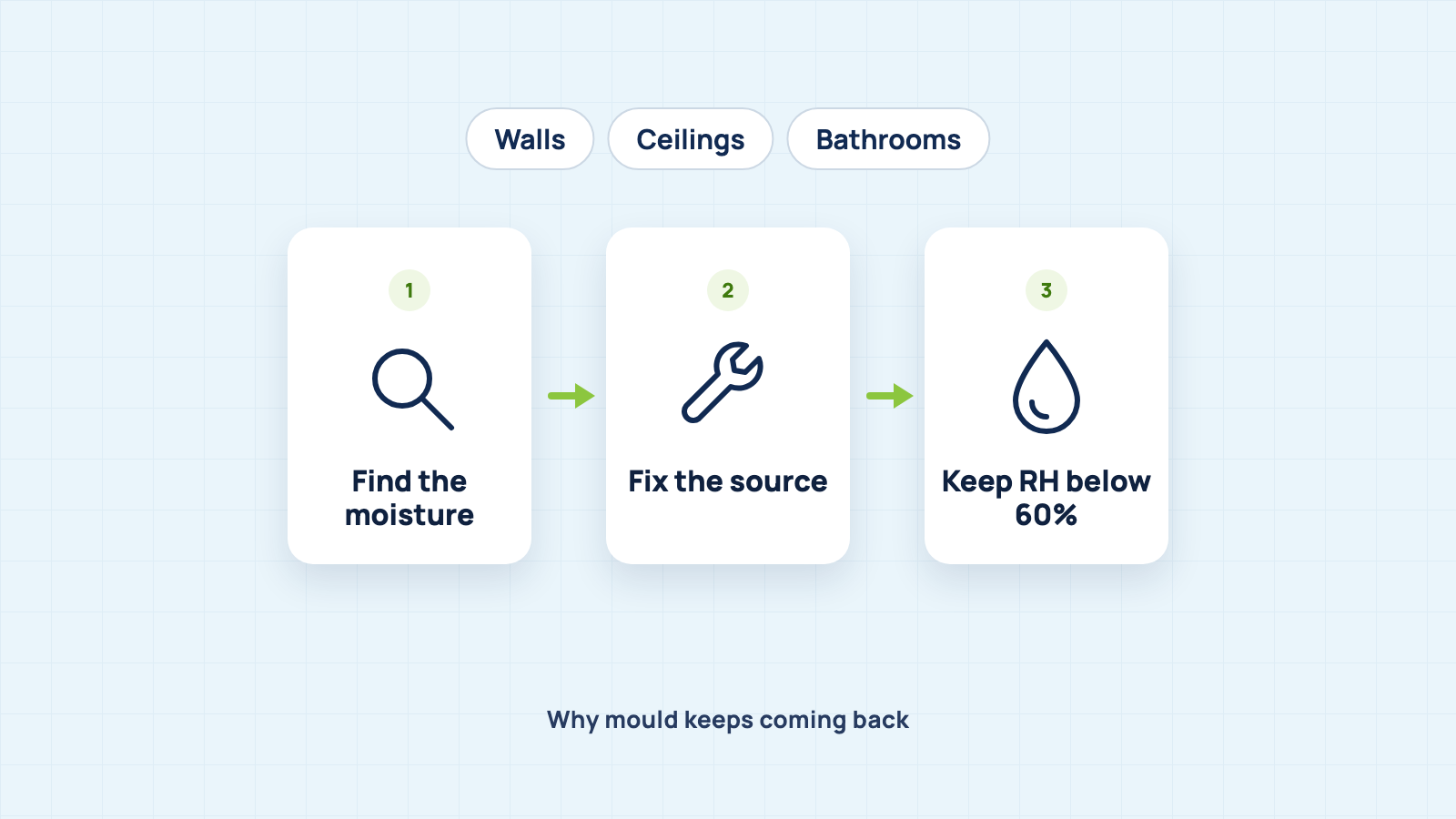
Mould (mold) keeps coming back because cleaning removes the growth but not the moisture that feeds it: the US EPA calls moisture control the key to mould control. In a UAE home, look for condensation on AC-cooled surfaces, humid outdoor air getting in, wet rooms that never dry, and leaks. Log humidity for one to two weeks to find the source, fix it, clean, then keep relative humidity below 60%.
Why does mould keep coming back after cleaning?
Because cleaning removes the mould you can see, not the moisture that let it grow. Mould spores are always present in indoor air and house dust, and they can start growing when they land on a surface that stays damp, including one you have just cleaned.
The US EPA puts it in one line: “The key to mold control is moisture control.” Clean up the mould without fixing the water problem, it says, and the mould will most likely come back. Dubai Municipality’s 2025 mould guideline adds that Dubai’s hot, humid climate makes buildings more susceptible to mould.
Where does the moisture come from in a UAE home?
Moisture reaches walls and ceilings in five main ways: condensation on AC-cooled surfaces, humid outdoor air getting in, steam and laundry, leaks, and a home closed with the AC off. Each leaves its own pattern, and a home can have more than one at once.
| Moisture source | How to recognise it | What fixes it |
|---|---|---|
| Condensation on AC-cooled surfaces | Spots around AC grilles, on ceilings below cold ducts or pipes, in cold corners and behind furniture | Insulate cold ducts and pipes; lower the humidity reaching the surface |
| Humid outdoor air getting in | Mould near worn door and window seals, gaps and service openings; more likely near the sea | Replace seals and close gaps; ask whether the building’s fresh air is dehumidified |
| Steam and laundry | Spots on grout, sealant and bathroom ceilings; damp laundry rooms; mirrors that stay misted | Extractor fans during and after showers and cooking; dryers vented outside |
| Leaks | Yellow or brown stains, peeling paint, warped wood; under roofs and terraces, around windows, below bathrooms, along AC drain lines | Repair the leak, then dry within 24 to 48 hours |
| Home closed with the AC off | A musty smell or new spots after weeks away | Keep the AC or a dehumidifier controlling humidity, and log it |
WHO notes that, apart from leaks and floods, most moisture arrives with incoming air or from indoor activities, and that coastal areas can be substantially damper than national averages. EPA counts removing moisture among the AC’s jobs, so a home closed with the AC off loses its main way of drying the air. New and renovated homes add water from drying concrete and coatings (see air quality in a new or renovated home).
Why does mould grow when the room humidity looks normal?
Because mould responds to the water at the surface, not the room reading. Air touching a colder surface cools, and its relative humidity (RH) rises although it holds the same water. At the dew point it reaches 100% and water condenses; just short of that, the surface can stay damp enough for mould.
The US EPA’s building guidance shows how small the margin is: at 50% RH a surface must be about 11 °C (20 °F) colder than the air for water to condense on it, at 90% only about 1.7 °C (3 °F). In its Miami example, humid outdoor air with a dew point above 21 °C (70 °F) leaks in and condenses on a duct carrying 13 °C (55 °F) air, and possibly on the diffuser.
Air conditioning chills all indoor surfaces, some more than others, EPA notes, and ducts, diffusers and chilled-water or refrigerant lines are much colder than the room. So measure beside the affected surface as well as in the room, including its temperature: a surface below the dew point of the air around it will collect water.
Why does mould grow behind wardrobes, on ceilings and in bathrooms?
Because moisture collects there and dries slowly: still air behind furniture, cold surfaces in and on the ceiling, and rooms that get wet every day. Where the mould sits is your first clue to the source, so photograph it before cleaning, as UK health guidance advises.
- Behind wardrobes and beds. Furniture stops air moving, so the wall behind it stays damp once moisture reaches it. EPA lists walls behind furniture among the places hidden mould grows, and describes outdoor water vapour condensing behind vinyl wallpaper on the cool inside of outside walls in hot, humid weather. Leave a gap between furniture and outside walls.
- On ceilings. Spots around an AC grille can point to condensation on the cold grille and ceiling, although dark marks there can also be dust from the airflow. Stains below a duct, chilled-water pipe or AC drain line suggest sweating from missing or damaged insulation, or a leak; EPA and Dubai Municipality both say cold pipes should be insulated. Under a roof or terrace, check for leaks.
- In bathrooms and laundry rooms. EPA names both as common places for mould in homes, and notes that rooms that are often wet are hard to keep completely free of it. Mould that spreads beyond the shower can point to weak extraction or a leak from the shower tray, pipes or the apartment above.
What does a musty smell mean if you cannot see mould?
It suggests that water is or was present and mould growth is likely, as the US EPA puts it, even if nothing is visible. Dubai Municipality’s mould guideline goes further: persistent musty or earthy odours, especially after water damage or high humidity, strongly indicate hidden mould.
Growing moulds give off gases that WHO calls microbial volatile organic compounds, but few are specific to fungi, so a general VOC reading cannot confirm mould or show where it is. Your eyes and nose come first, EPA says, and humidity readings show where moisture builds up.
Check behind and inside wardrobes, under carpets and rugs, behind wallpaper and panelling, above the ceiling, around pipes and in the AC. Do not peel wallpaper to look: EPA warns that removing wallpaper with mould underneath can release a massive burst of spores. If the smell is strongest when the AC starts, see our guides to black mould in an AC and to an AC that smells musty.
How do you stop mould coming back?
Work in this order: find the moisture, fix the source, clean or remove the mould, dry the area, keep RH below 60%, then measure again. The order matters: cleaning without fixing the source is exactly when the US EPA says the mould will most likely return.
- Find the moisture. Log humidity and temperature in the room for one to two weeks, including nights and the hours when the AC cycles off, and take spot readings beside the affected surface. A moisture meter shows if the material itself is wet.
- Fix the source. Repair leaks, insulate cold ducts and pipes, clear the AC drain and drip tray, get the extractors working and replace worn seals. If you rent, report leaks and damp to the landlord or building management straight away, as EPA advises.
- Clean or remove the mould. Scrub hard surfaces with detergent and water, then dry them, wearing gloves, goggles and an N-95 mask; porous materials such as ceiling tiles and carpet may have to go. EPA says that in most cases you can clean an area under about 1 m² (10 square feet) yourself, the size Dubai Municipality also treats as small. For larger areas EPA refers you to its fuller remediation guide, and any contractor should have experience cleaning up mould. Do not paint over mould or rely on bleach (see below).
- Dry it. Dry the area and anything wet within 24 to 48 hours; EPA says that in most cases mould will not grow if materials dry that quickly.
- Keep RH below 60%. EPA and Dubai Municipality both say below 60%: ideally 30 to 50% (EPA), or 50% where feasible to control dust mites (Dubai Municipality). Where condensation was the cause, aim lower: EPA’s design guidance against condensation in cooled buildings keeps the indoor dew point below 13 °C (55 °F), for example at most 50% at 24 °C (75 °F). See our indoor humidity guide.
- Measure again. Keep logging, and check the area again at least six weeks after the work, the follow-up UK health guidance sets for landlords. EPA does not count a cleanup as finished while a mouldy smell remains.
Is mould in the home a health risk?
It can be, especially for some people. WHO’s 2009 guidelines found sufficient evidence that people in damp or mouldy buildings, homes included, are at increased risk of respiratory symptoms, respiratory infections and worsening asthma, and recommend preventing persistent dampness and mould and fixing them when they occur.
The US EPA adds that moulds produce allergens and irritants, and can cause hay fever-type symptoms in sensitive people and asthma attacks in people with asthma who are allergic to mould. UK health guidance names those most at risk, including people with allergies, asthma or other lung conditions or weakened immunity, pregnant women, children and older people.
HawaQ measures homes; it does not diagnose. If anyone at home has symptoms, see a doctor. Lower humidity can also discourage dust mites, EPA notes: see dust mites and allergies in UAE homes.
When does a dehumidifier help, and when does it not?
A dehumidifier helps when the moisture is in the air: rooms that stay above 60% after leaks, extraction and AC faults are fixed. It does not fix a leak, a blocked AC drain or missing pipe insulation, and it cannot dry a wall that water keeps reaching.
EPA and Dubai Municipality’s mould guideline both list dehumidifiers among the ways to control indoor humidity. Measure first and size the unit to the room. Stadler Form Lukas removes up to 20 litres a day and is rated for rooms up to 70 m², which suits a bedroom or a smaller apartment.
For villas and large apartments near the sea, Lukas Pro is the dehumidifier HawaQ recommends most often. In more than 50 waterfront homes on Palm Jumeirah, Dubai Marina, JBR and La Mer, HawaQ logged humidity room by room for a month before recommending anything, then specified Lukas Pro where the data showed it was needed. Stadler Form Lukas Pro removes up to 50 litres a day and is rated for rooms up to 175 m². That is a rated maximum: Stadler Form says it is reached only from about 22 °C and 70% humidity, so a cooled room will see less. It drains continuously through the included hose, has a digital hygrostat and an H11 particle filter, and carries a 5-year Pro Series warranty. Stadler Form’s coastal villa guide compares the two.
An air purifier does not stop mould growing: EPA says air cleaners do not address the cause of mould and musty odours.
HawaQ is a PRO TECHnology Group company. PRO TECHnology distributes Stadler Form in the UAE and MedicAir in the GCC, so we have a commercial link to the products we name. We measure first and recommend a product only where the readings call for one.
What does a HawaQ mould investigation cover?
It finds where the mould is, what is feeding it and what to fix first. A HawaQ mould investigation combines a visual inspection, moisture and humidity mapping, an AC and HVAC check, air quality monitoring, air and surface sampling analysed by a laboratory where needed, and a report with a fix plan in order of priority.
For mould that keeps returning, room-by-room readings of humidity and surface moisture, with humidity and temperature logged over days, are what find the source. Prefer to measure first? Our guide to testing air quality at home explains what to log; HawaQ’s two-week home check-up adds professional monitors in your key rooms, an HVAC inspection and a clear report.
Frequently asked questions
Why does black mould keep coming back in my bathroom?
Because the room gets wet every day and the moisture is not leaving fast enough. Run the extractor during every shower and for a while after, check that it really pulls air, and wipe down wet tiles. The US EPA says more ventilation and more frequent cleaning usually stop bathroom mould recurring, or keep it to a minimum. Mould spreading beyond the shower can mean a hidden leak.
Is it safe to paint over mould?
No. The US EPA says not to paint or caulk mouldy surfaces: clean up the mould and dry the surface first, because paint applied over mould is likely to peel. Paint also hides the growth while the moisture behind it keeps feeding it. Fix the source, clean, let the wall dry fully, and only then repaint.
Does bleach kill mould for good?
No. A background level of mould spores remains in every home and can grow again wherever moisture returns. The US EPA does not recommend biocides such as chlorine bleach as a routine part of mould cleanup, and notes that dead mould may still cause allergic reactions in some people, so it must be removed, not just killed. Never mix bleach with cleaners that contain ammonia: toxic fumes can form.
Why does my wardrobe smell musty?
A closed wardrobe holds still air, and against an outside wall any moisture that reaches the wall dries slowly behind it, so mould can grow out of sight. Empty it, check the back panel and the wall, leave a gap between wardrobe and wall, and log the humidity inside for a week. If the smell stays after cleaning, the moisture source is probably still there.
Should I open the windows to dry out a damp room?
Only when the outdoor air holds less water than the indoor air. The US EPA notes that ventilation dries a building only when the outdoor dew point is below the indoor dew point. A dew point calculator turns temperature and RH readings into a dew point, so compare the two first. Otherwise keep the windows shut and let the AC or a dehumidifier dry the air.
Is white powder on a wall mould?
Not always. The US EPA notes that alkaline salt crystals on concrete walls can look like mould but, unlike mould, usually dissolve in water. Mould itself comes in many colours, not just black. Either way, check the wall for moisture before you clean or repaint.
Sources
- US EPA. A Brief Guide to Mold, Moisture, and Your Home, EPA 402-K-02-003 (reprinted 2012). epa.gov
- US EPA. Mold Course, Chapter 2: Why and Where Mold Grows (updated 1 December 2025). epa.gov
- US EPA. Mold Course, Chapter 3: Finding Mold and Moisture (updated 1 December 2025). epa.gov
- US EPA. Moisture Control Guidance for Building Design, Construction and Maintenance, EPA 402-F-13053 (December 2013), pp. 2, 5, 14 to 18. epa.gov
- US EPA. Guide to Air Cleaners in the Home, 2nd edition (2018), p. 5. epa.gov
- WHO Regional Office for Europe. WHO guidelines for indoor air quality: dampness and mould (2009), executive summary and sections 2.3.6 and 4.3.4. iris.who.int
- UK Office for Health Improvement and Disparities, with MHCLG and UKHSA. Understanding and addressing the health risks of damp and mould in the home (updated 1 April 2026). gov.uk
- Dubai Municipality. Technical Guidelines for Indoor Air Quality for Healthy Life, DM-HSD-GU119-IAQ, Version 4 (December 2024), p. 41. dmpmedia.dm.gov.ae
- Dubai Municipality. Technical Guideline for Mold Remediation and Control, DM-HSD-GU142-MRC2, Version 1 (12 May 2025), pp. 8, 12, 20, 24 to 25. dmpmedia.dm.gov.ae
Sources read on 27 October 2026. EPA temperatures are converted from °F and rounded. Product figures are as published by Stadler Form on stadlerform.ae on that date. This guide explains public guidance in plain language; it is not medical advice.