
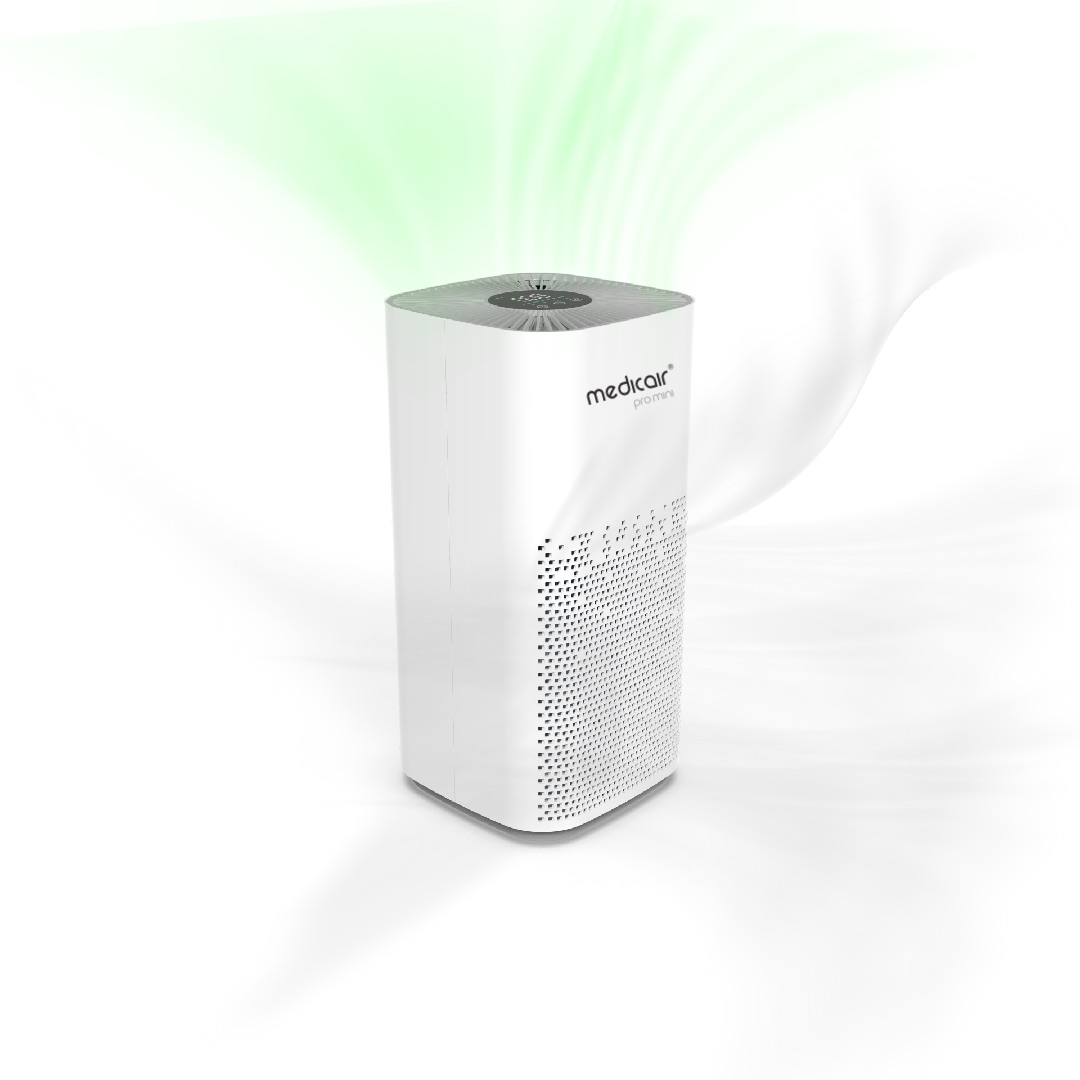
The three MedicAir models share the same approach: a pre-filter, a HEPA filter, activated carbon and an enclosed UV-C chamber. They differ in how much air they move, how loud they are while doing it, and how easily they move between rooms. Choose by the room’s volume and the noise it can tolerate: the Pro Mini for one closed room, the Pro for a living room, majlis or classroom, the Pro Max for open-plan spaces and warehouse zones. Every capacity figure is MedicAir’s stated maximum at full speed, so size for headroom.
The decision in one table
| Pro Mini | Pro | Pro Max | |
|---|---|---|---|
| Best for | One closed room: bedroom, nursery, study, private office, consultation room | Living room, majlis, meeting room, classroom | Open-plan offices, halls, lobbies, gyms, warehouse and production zones |
| Stated maximum | 400 m³/h (2022 revision) or 410 m³/h (2024 revision), as clean air delivery rate | 605 m³/h at Max | 1,500 m³/h, clean air delivery rate in the manual, airflow on MedicAir’s website |
| At a quieter setting | Not published | 360 m³/h at 45 dB (Medium); 180 m³/h at 28 dB (Low) | Not published |
| Noise as stated | Up to 55 or 54 dB(A) by revision; 21 dB lowest on MedicAir’s website | 28 to 60 dB across four speeds | 28 to 54 dB, settings not given |
| HEPA grade (manufacturer) | H14 | H13 | H14 |
| CO₂ reading | No | No | Shown on screen (no CO₂ sensor listed) |
| Weight and handling | 5 to 5.6 kg, carried by hand | 14 kg, 88 cm tower | 29 kg, on wheels |
| Rated input power | 42 W | 85 W | 120 W |
| Manufacturer warranty | 2 years in the manual, 3 years on MedicAir’s website | 3 years (manual) | 3 years (manual) |
| Full specifications and price | Pro Mini | Pro | Pro Max |
The detailed specifications, the points where MedicAir’s own documents disagree, and price and demonstration enquiries are on PRO TECHnology’s MedicAir comparison. PRO TECHnology is MedicAir’s exclusive distributor for the GCC.
How do you size an air purifier for a room?
Multiply the floor area by the ceiling height to get the air volume, multiply by the number of air changes per hour (ACH) the space needs, and compare the result with what the purifier delivers. MedicAir’s own guidance suggests about 3 air changes an hour for homes, 5 for offices and 10 for healthcare.
Then allow for headroom. A stated maximum is what the unit does flat out, and a unit that has to run flat out to meet its target is the unit somebody turns down. The examples below are sized so the purifiers can run below full speed.
| Space | Air volume | ACH | Clean air needed | Starting point |
|---|---|---|---|---|
| Bedroom, 20 m² × 3 m | 60 m³ | 3 | 180 m³/h | 1 × Pro Mini, with plenty of headroom |
| Living room, 80 m² × 3.5 m | 280 m³ | 3 | 840 m³/h | 1 × Pro Max, or 2 × Pro between Medium and High |
| Majlis, 120 m² × 4 m | 480 m³ | 3 | 1,440 m³/h | 1 × Pro Max plus 1 × Pro, so neither runs flat out |
| Office floor, 200 m² × 3 m | 600 m³ | 5 | 3,000 m³/h | 3 × Pro Max, spread across the floor |
| Warehouse zone, 500 m² × 4 m | 2,000 m³ | 3 | 6,000 m³/h | 5 × Pro Max, placed by dust source |
Trade-off 1: capacity against noise
Every purifier is quietest when it moves the least air. MedicAir publishes the relationship for one model only: the Pro moves up to 180 m³/h at 28 dB, 360 m³/h at 45 dB, 500 m³/h at 51 dB and 605 m³/h at 60 dB (January 2024 brochure; the 2022 edition printed 35 and 57 dB, its wattage figures). For the Pro Mini and the Pro Max, MedicAir gives the noise range and the maximum capacity, but not the airflow in between.
That makes the Pro the easiest model to size honestly for an occupied room: you can choose the speed the room will tolerate and size against that figure. For a bedroom, the Pro Mini’s small volume works in its favour, because one closed bedroom needs little air even at three or five air changes an hour. Hear any model at the showroom before you commit a room to it.
Trade-off 2: one large unit or several small ones
A purifier cleans the air that reaches its intake. In a single open space, one large unit is simpler and cheaper to maintain. In a space divided by doors, partitions or furniture, several smaller units spread the clean air more evenly and keep running when one is being serviced.
- Villas: one Pro Mini per bedroom beats one large unit in a corridor, because a closed bedroom door is a wall to a purifier.
- Large living rooms and majlis spaces: one Pro Max, or two Pro units on opposite sides of the room.
- Offices and warehouses: several Pro Max units placed where people sit or where dust is made, not all in one corner.
Trade-off 3: what filter grades and tests do and do not tell you
MedicAir specifies H14 HEPA for the Pro Mini and Pro Max and H13 for the Pro. These are the manufacturer’s specifications; we have not seen an EN 1822 certificate for any of the three cartridges. In practice the grade matters less than airflow and how well the filter seals in the unit: an H13 machine moving more air through a room can clean it faster than an H14 machine running slowly.
Independent testing exists for two models. Dr Iyad Al-Attar examined the Pro and the Pro Max in Kuwait in 2025, and MedicAir’s brochure summarises chamber tests of the MedicAir 2.0 tower, whose figures match the Pro. His Pro report found 98–100% single-pass removal of particles above 1 µm and 99% below. With the UV lamp off, a strong VOC challenge read zero at the outlet; with it on, about 0.5 ppm, and he recommended checks for by-products. His Pro Max report found 95–96% removal below 1 µm and stated the supplied filters did not achieve an H13 or H14 rating under EN 1822. It described the carbon stage as a few pellets, too thin for gas capture, and measured VOCs, including about 0.11 ppm of formaldehyde, coming from the unit as it started. With a certified H13 filter fitted, the Pro Max captured particles far better. Those are particle-removal and chamber results, not room performance, and no independent test of any model’s clean air delivery rate has been published. The evidence record sets out what each test covered.
Trade-off 4: weight, mobility and sensors
The Pro Mini, at 5 to 5.6 kg depending on the revision, moves between rooms by hand. The Pro is a 14 kg tower that usually stays where it is put. The Pro Max is 29 kg on wheels, which suits a venue or a warehouse where the dusty spot moves with the work.
Only the Pro Max shows a CO₂ figure on screen; MedicAir lists only particle and TVOC sensors for it, so treat the figure as an estimate. CO₂ rises when a room is short of fresh air; the reading tells you when to ventilate, but no purifier can lower CO₂.
Running costs: filters and power
Each model takes one combined cartridge, changed at least every twelve months and sooner in dust season. Rated input power is 42 W for the Pro Mini, 85 W for the Pro and 120 W for the Pro Max, all at full speed. PRO TECHnology’s replacement filters page lists the cartridge codes and works through the electricity cost at UAE tariffs.
When none of the three is the answer
A purifier cleans particles from the air. It does not remove moisture, bring in fresh air or remove settled dust.
- Damp or musty rooms. Measure humidity first. In more than 50 waterfront homes we fixed humidity with Stadler Form Lukas Pro dehumidifiers after a month of monitoring.
- Stuffy rooms and high CO₂. That is a ventilation problem. Our ventilation and filtration assessment finds the cause.
- Visible dust on surfaces. Cleaning removes settled dust; a purifier catches what stays airborne. Our guide to sandstorms and indoor dust explains the difference.
For production floors, see how Sun Studio Dubai uses Pro Max units on its UV printing floor in Al Quoz 1.
Frequently asked questions
Which MedicAir is best for a villa?
Usually a combination: a Pro Mini in each bedroom with the door closed, and a Pro or a Pro Max for the large living room or majlis. We size it room by room, so each unit can run below full speed.
Is the MedicAir Pro Max too big for a home?
Not for a very large room. In a big majlis or open-plan living area one Pro Max can replace two or three smaller units. It weighs 29 kg on wheels, and MedicAir states 28 to 54 dB without saying which setting each figure belongs to, so hear it before you put it in a space where people sit for hours.
Is the MedicAir Pro Mini 400 or 410 m³/h?
Both, for two revisions. MedicAir’s 2022 manual (model PFACOABBD) states up to 400 m³/h and 5.6 kg; its 2024 manual for the revised unit (PFACOABBDII) states up to 410 m³/h and 5 kg. Both call the figure a clean air delivery rate at full speed, and neither has been independently tested.
Which MedicAir is the quietest?
At the lowest setting, the Pro Mini: MedicAir’s website lists 21 dB. But quiet settings move far less air, and only the Pro has published airflow at each speed: 180 m³/h at 28 dB, 360 m³/h at 45 dB. The useful question is which model meets your room’s target at a noise level you can accept.
How often do MedicAir filters need replacing?
MedicAir recommends replacing the cartridge at least once every twelve months, and sooner in dusty conditions; its website quotes about 5,000 hours of use. Each model takes a single combined cartridge.
Are MedicAir purifiers medical devices?
No. MedicAir’s manuals state that they are not medical devices. They support cleaner air alongside ventilation; they do not prevent infection or disease.
Sources
- MedicAir manufacturer documents: Pro Mini manuals (April 2022, model PFACOABBD; April 2024, model PFACOABBDII), MedicAir 2.0 (Pro) brochure (January 2022), MedicAir Pro brochure (January 2024) and specification card, Pro Max manual (May 2022, model WAAMSSFL6) and specification sheet, as summarised in PRO TECHnology’s MedicAir comparison.
- MedicAir room calculator guidance on air changes per hour for homes, offices and healthcare.
- Dr Iyad Al-Attar, MedicAir Pro and Pro Max air cleaner reports, Kuwait, August and September 2025, as summarised by MedicAir.
- US EPA, Guide to Air Cleaners in the Home (last updated 1 October 2026).
- HawaQ project data: Sun Studio Dubai and Dubai waterfront homes case studies.
This guide explains manufacturer figures in plain language. Figures change between product revisions; check the revision on your quotation.