
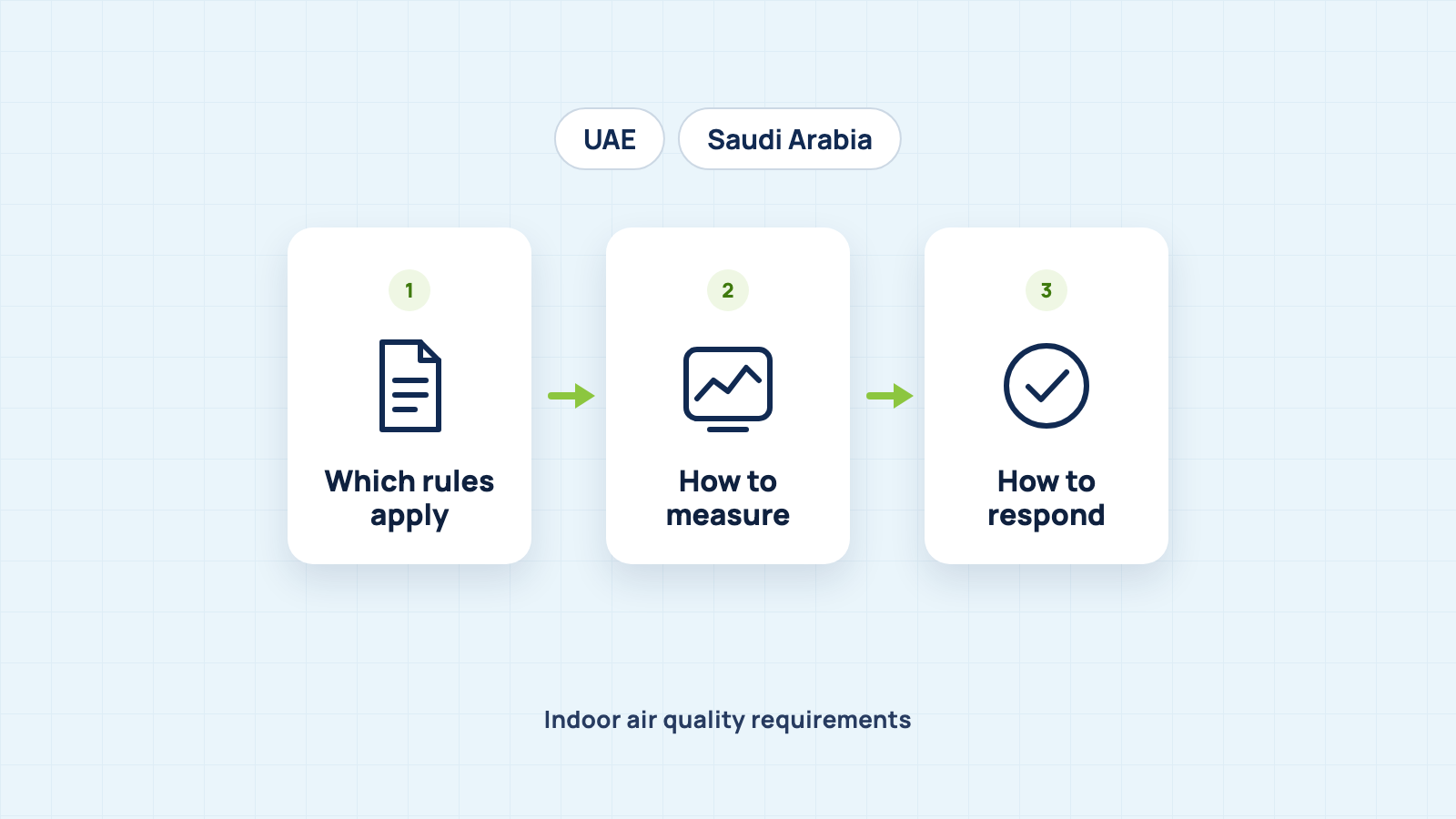
Indoor air quality requirements depend on where a building is, which authority permits it, what it is used for and what stage it is at. The UAE has no federal health- or comfort-based indoor air limits; federal workplace exposure limits apply in offices as occupational ceilings. Dubai has the most detailed rules: a test before occupancy under the Dubai Building Code, the Al Sa’fat green building system, and municipal limits for existing buildings. Abu Dhabi relies on Estidama ratings, its building codes and workplace codes, and Ras Al Khaimah on Barjeel. In Saudi Arabia, the Saudi Building Code sets ventilation design requirements, and no indoor concentration limits were found. In both countries a monitor shows patterns, but a compliance result needs the applicable document’s method, averaging period and tester.
Scope. This guide explains public documents as they stood when the sources were checked. It is not legal advice. Requirements for a specific project depend on its location, permit authority, use, stage and permit date, so confirm them with the relevant authority.
How do requirements vary between the UAE and Saudi Arabia?
Requirements come from different kinds of documents. Each binds different buildings in a different way:
- Laws set general duties, such as ventilating enclosed public places or keeping indoor air healthy.
- Building codes set design requirements for new buildings and alterations, mostly ventilation rates and controls. Dubai’s code also requires a test before occupancy for non-villa buildings.
- Green building regulations set a mandatory minimum for new buildings in Dubai, Abu Dhabi and Ras Al Khaimah. In Dubai it is Al Sa’fat Silver, with Gold and Platinum optional. In Abu Dhabi it is Estidama 1 Pearl, or 2 Pearls for government-funded projects. In Ras Al Khaimah it is Barjeel’s requirements, which vary by building type and size.
- Technical guidelines from municipalities and health or safety bodies give limits and methods. Some use mandatory wording, or another guideline makes them binding for a sector, such as hotels or malls in Dubai. How they are enforced is usually not stated.
- Voluntary certifications such as WELL, LEED and RESET apply only when an owner, tenant or contract commits to them.
The UAE and Saudi Arabia differ most in one respect. Dubai publishes indoor concentration limits for existing buildings and requires new non-villa buildings permitted under its Building Code to pass an air test before occupancy. Saudi Arabia regulates indoor air through ventilation design in the Saudi Building Code. We found no published indoor concentration limits, although parts of the code and the Mostadam rating could not be reviewed. Elsewhere in the UAE, ventilation design and green building ratings carry most of the weight. For the certification thresholds, see our comparison of WELL, RESET, LEED and Al Sa’fat.
How do you work out which requirements apply to your building?
Work through these questions in order. Their answers decide which documents apply, and so which numbers, methods and testers count.
- Where is the building? Name the emirate or Saudi region and city, and whether it sits in a free zone or special development zone. In Dubai, the Building Code also applies in free zones such as DIFC.
- Who permits it? The authority that issued, or will issue, the building permit and completion certificate decides which building code and green building rules apply.
- When was it permitted? Codes and green building rules usually apply to permits issued after their effective date, and to later alterations and extensions. The Dubai Building Code and Al Sa’fat both work this way (Decree 45/2021, Art. 3) (AR 154/2020, Art. 3). Check what applied when the building was permitted, and what applies to any planned works.
- What is it used for? Hotels, malls, schools, healthcare buildings and workplaces may have sector rules on top of the general ones. Some indoor air guidelines exclude healthcare buildings altogether.
- What stage is it at? Design, construction, handover, operation, renovation, fit-out or change of use. A pre-occupancy test, a periodic test and continuous monitoring are different duties.
- Which ratings or contracts apply? Separate mandatory minimums (such as Al Sa’fat Silver, Estidama 1 or 2 Pearls, or Barjeel) from voluntary certifications (such as WELL, LEED and RESET) and from lease or tenant clauses.
- What exactly does each document require? List each parameter, value, unit, averaging period, method and sampling location, and who may test.
- Who may test? Check whether the document asks for an accredited laboratory, a company approved by the authority, or simply a specialist.
- What must be recorded or submitted? Reports, certificates, calibration records and how long data must be kept.
- What if documents conflict? Confirm with the authority rather than picking the strictest number from another document.
What applies in the UAE?
No UAE-wide regulation sets health- or comfort-based indoor air quality limits for homes, schools or offices. The federal environment ministry’s 2023 strategy stated that there were “no federal regulations relating to indoor air quality” (MOCCAE, National Air Quality Agenda 2031, p9). Since January 2024, a federal regulation has set rules for how indoor air is measured, but not limits. Federal law also sets general ventilation duties and workplace exposure limits, which apply inside every workplace, offices included, as occupational ceilings. Numerical indoor air requirements come from the emirates, mainly through building codes, green building regulations and municipal guidelines, and they differ from one emirate to the next.
Federal level: duties without indoor limits
- Ventilation duties. Federal Law No. 24 of 1999 on the environment requires closed and semi-closed public places to have “sufficient” ventilation, proportionate to their size, capacity and activity. It also requires adequate ventilation in workplaces (Federal Law 24/1999, Arts 55–57). Cabinet Resolution No. 12 of 2006 on air pollution repeats the duty for enclosed public places and leaves the detailed conditions to each emirate’s authorities. It sets no indoor limits for those places (Cabinet Resolution 12/2006, Art. 13).
- Workplace exposure limits. The same resolution lists exposure limits for “working areas”, including 5,000 ppm of CO₂ as a time-weighted average (Annex 7b). Offices are workplaces, so these limits apply there too. They are occupational ceilings for a working day, not ventilation or comfort targets. The resolution’s separate ambient air standards (Annex 8) apply to outdoor air.
- Measurement quality. Cabinet Resolution No. 86 of 2023, in force since 31 January 2024, regulates air quality measurement. Its scope includes indoor air quality measurements. Laboratories that test air quality must register with the Ministry of Industry and Advanced Technology and hold ISO/IEC 17025 accreditation. Instruments used by laboratories, monitoring networks and other bodies that measure air pollutants must meet maximum permissible errors, for example ±5% for CO₂, particles and several gases in “non-industrial establishments and workplaces”. The resolution does not say whether this covers monitors run by building owners, and it sets no concentration limits (Cabinet Resolution 86/2023, Arts 2–5, Table 3).
- Policy. The National Air Quality Agenda 2031 includes indoor air as a focus area and aims to increase the number of national indoor standards. Its “90%” targets refer to outdoor air (Agenda 2031, pp13 and 36).
- Accreditation. Laboratories in the UAE are commonly accredited against ISO/IEC 17025 by the Emirates International Accreditation Centre (EIAC), established under Dubai Law No. 27 of 2015 (EIAC). Cabinet Resolution 86/2023 refers to accreditation under the National Accreditation System, so confirm that a laboratory’s accreditation is accepted for the purpose.
Dubai: four layers that apply in different ways
Dubai has the most detailed indoor air quality rules of the jurisdictions reviewed here. They sit in four layers, and each binds a different building, at a different stage, in a different way.
- The law. Local Order No. 11 of 2003 on public health requires a building’s “Occupant” to ensure healthy indoor air quality. The Occupant is whoever has operational control: the owner, tenant or possessor. They must ventilate “in accordance with the approved standards” and keep indoor air within acceptable levels. Dubai Municipality may test and inspect, and fines run from AED 100 to AED 500,000. The Order sets no numbers of its own (Local Order 11/2003, Arts 53–56 and 86).
- The building code, for new buildings. The Dubai Building Code (2021 edition) is binding on building designs permitted after it took effect. It applies across the emirate, including free zones such as DIFC (Decree 45 of 2021, Arts 3 and 5). Part H requires outdoor-air rates that meet ASHRAE 62.1, 62.2 and 170. It requires an indoor air quality test before occupancy, with a report to the authority. The test limits are formaldehyde below 0.08 ppm, TVOC below 300 µg/m³ and particles under 10 µm below 150 µg/m³, the last two as 8-hour averages. The test is done by specialised companies or laboratories accredited by the authority (Dubai Building Code 2021, H.4.10.2–H.4.10.3). Spaces over 100 m² designed for 25 or more people per 100 m² need CO₂-based demand-controlled ventilation. The CO₂ set-point must be below 800 ppm, with an alarm above 1,000 ppm, and the sensors must be recalibrated at least every 12 months (H.4.8.3). Villas follow Part K, which has no pre-occupancy test.
- The green building regulation. Under Administrative Resolution No. 154 of 2020, the Silver level of Al Sa’fat, Dubai’s green building system, is mandatory for buildings permitted after the Resolution took effect. Gold and Platinum are optional (AR 154/2020, Arts 3 and 5). The second edition has applied since 20 January 2023 (DM Circular 10-1-2). For new buildings it points back to the Building Code’s pre-occupancy test and ventilation controls. Clause 401.07 also lists existing building types that “must” test their air, with re-testing that “should be within 5 years”: hotels, malls, education, government and healthcare buildings, worship buildings, theatres, cinemas and any other existing buildings the municipality designates. The document does not say how that duty is enforced for buildings permitted before the Resolution (Al Sa’fat 2nd edition, 401.06–401.07).
- Municipal technical guidelines. The municipality’s indoor air quality guideline, DM-HSD-GU119-IAQ (version 4, December 2024), sets limits for existing buildings. It also sets an optional route to a municipal IAQ certificate for new buildings, with testing by an EIAC-accredited company or laboratory (GU119 V4, §9-8-3 and §9-8-4). It recommends (“should”) an audit within six months of the HVAC system starting and at least every two years after that (GU119 V4, §9-7). Sector guidelines go further. The hotels guideline says new hotels “must” be tested before occupancy and calls for a comprehensive assessment at least every two years (DM-HSD-GU90, §13). The malls guideline requires compliance with GU119 (DM-HSD-GU125, §6-5). The 2025 indoor air quality index, the EIAQI, describes continuous monitoring with calibrated sensors and five years of stored data. It calls these monitoring rules “legally enforceable” and says owners “must” meet its thresholds. However, it cites no enabling instrument, deadline or list of buildings that must install continuous monitoring, and it refers schools and elderly-care homes to sector guidelines that it does not name (DM-HSD-GU141 V1, §7.9 and Appendix 1). Our guides to Dubai Municipality’s limits and the EIAQI cover the tables in full.
Healthcare is handled differently. GU119 excludes buildings used exclusively for medical or industrial purposes, the EIAQI excludes healthcare facilities with special requirements, and the Building Code defers to the Dubai Health Authority’s rules. Al Sa’fat 401.07, however, lists existing healthcare facilities among the buildings to test.
Where Dubai documents disagree
The layers do not use identical numbers, so a single “Dubai limit” can be misleading:
- Formaldehyde: GU119 sets 0.01 ppm over 8 hours, and 0.08 ppm over 30 minutes. Al Sa’fat uses below 0.08 ppm as an 8-hour average; the Building Code uses below 0.08 ppm with no averaging time stated.
- Particles: 150 µg/m³ is an 8-hour value in the Building Code and Al Sa’fat, but a 24-hour value in GU119.
- TVOC in existing buildings: 0.6 mg/m³ in GU119 against below 300 µg/m³ in Al Sa’fat 401.07.
- Relative humidity: the lower bound is 20% in GU119, 30% in the Building Code, and 40% for the EIAQI’s “comfortable” band.
- Who may test: GU119 says an EIAC-accredited company or laboratory. The Building Code says “specialized companies or laboratories accredited by the Authority”. Al Sa’fat says “specialized companies or laboratories”.
Do not settle this by picking the strictest number. First establish which document applies to the building, at its stage, and for what purpose: a permit, a certificate, a sector inspection or a voluntary target. Then use that document’s value, averaging period and test method. If two documents genuinely both apply, confirm the approach with the authority.
Abu Dhabi: Estidama, the building codes and workplace rules
- Estidama Pearl rating. New projects need at least a 1 Pearl rating to be approved, and government-funded projects need at least 2 Pearls (Abu Dhabi City Municipality, January 2025). The design rating is tied to the building permit, and the construction rating to the completion certificate (Estidama Construction Rating Site Audit Protocol). The 1 Pearl minimum includes three required indoor credits: ventilation to ASHRAE 62.1-2007 using its ventilation rate procedure, or the local code where that is more stringent; a smoking ban with 25 m smoke-free zones around entrances, outdoor-air intakes and operable windows; and legionella prevention. CO₂ monitoring is an optional credit: sensors at each return point, with CO₂ not allowed above 1,000 ppm. Flush-out before occupancy, low-emitting materials and car-park air monitoring are optional credits too. The building rating system sets no indoor air test thresholds (Pearl Building Rating System v1.0, April 2010, LBi credits). Villas follow a separate rating system that requires International Mechanical Code 2009 ventilation and has no CO₂ credit (Pearl Villa Rating System v1.0).
- Building codes. The Abu Dhabi International Mechanical Code (2013 edition, based on the 2009 International Mechanical Code) sets minimum outdoor-air rates. For offices this is 5 cfm (about 2.5 L/s) per person plus 0.06 cfm per ft² (about 0.3 L/s per m²) (ADIMC 2013, Table 403.3). The 2013 energy code requires demand-controlled ventilation in spaces over 50 m² with an average occupant load of 40 people per 1,000 ft². This applies only where the system has an economiser, a modulating outdoor-air damper or more than 3,000 cfm of design outdoor air, and there are exceptions, including systems with energy recovery and those with less than 1,200 cfm of design outdoor air (ADIECC 2013, 503.2.5.1). The codes were adopted in 2013, with use mandated for government buildings from 1 October 2014.
- Workplaces. The Abu Dhabi Occupational Safety and Health System Framework (ADOSH-SF, formerly OSHAD-SF) says its codes of practice are mandatory for all entities, regardless of risk classification. Entities not yet nominated or notified by their sector regulator comply voluntarily unless directed otherwise (ADOSH-SF Manual v4.0, pp11 and 20). Code of Practice 8.0 requires HVAC systems designed to allow 15 cfm of outdoor air, or 20 cfm where contaminants such as smoking are present. It does not say per what. It also lists air-change rates, such as 4–6 per hour for offices and 7–10 for meeting rooms (CoP 8.0 v4.0, §3.7). The framework’s technical guideline on occupational air quality sets measurement methods, not limit values (ADOSH-SF Technical Guideline, v4.0). Its standards-and-guideline-values document is suspended (ADOSH-SF Manual v4.0, p20).
Other emirates
Ras Al Khaimah’s Barjeel green building regulations are mandatory for new buildings (RAK REEM). Their requirements are set by building type and size. For the comprehensive tier, which covers larger, hospitality and public buildings, they require ventilation to ASHRAE 62.1-2013 and MERV 6 filters. They also limit VOCs in interior paints. They set no indoor air test (Barjeel v1.2, May 2021, 405.01–405.05). The Ministry of Energy and Infrastructure has published a National Green Building Regulation (version 1.06, 2021) with similar ventilation and filter clauses. It describes itself as applying in emirates without their own green building rules (MOEI NGBR v1.06, 305.03). The environment ministry’s 2023 strategy, however, describes federal sustainable-building rules as limited to projects carried out by the Ministry of Energy and Infrastructure (Agenda 2031, p9). We could not confirm the regulation’s approval or in-force status. We found no published indoor air provisions for Sharjah, Ajman, Fujairah or Umm Al Quwain. For a project there, ask the municipality or the relevant free-zone authority which codes and green building rules apply.
What applies in Saudi Arabia?
Saudi Arabia regulates indoor air mainly through building design and ventilation. We found no Saudi rule in force that sets indoor concentration limits for CO₂, particles, TVOC or formaldehyde.
The Saudi Building Code is the main instrument
- Legal basis. The law on applying the Saudi Building Code (Royal Decree M/43 of 1438H) covers all public and private building work: design, execution, operation, maintenance and modification. Existing buildings are covered when they are restored, change use, are extended or are modified. Compliance is a condition of building, restoration, modification and change-of-use permits. Violations can be fined up to SAR 1 million per violation per building (SBC application law, Arts 2, 6 and 12).
- Application. The code was phased in by building type. The fifth and final phase, covering all classified building types, began in July 2022 (SBC announcement, 30 July 2022). The 2024 edition replaced the 2018 edition and has been mandatory since 30 June 2025, after a 180-day transition that began on 1 January 2025 (SBC announcement, 6 January 2025). The implementing regulation treats the code’s requirements as one mandatory whole and lists adequate ventilation among its purposes. Permits are issued only after drawings are checked against the code (Implementing Regulation, Arts 2, 4 and 13).
- Issuing body. Since March 2025 the code has been maintained by the Saudi Building Code Center, formerly the Saudi Building Code National Committee. The Center is linked to the Minister of Municipalities and Housing (Council of Ministers Resolution 656, 1446H).
Where the ventilation requirements sit
- SBC 201, the general building code, has a chapter on the interior environment that includes ventilation (SBC 201-CR-2024, Chapter 12).
- SBC 501, the Saudi Mechanical Code, holds the detailed ventilation rules. Its Chapter 4 covers natural and mechanical ventilation, enclosed car parks, system controls and minimum outdoor-air tables. Other chapters cover energy recovery ventilation and air filters (SBC 501-CR-2024, contents). We could not read the 2024 table values: the code texts open only after signing in to the code portal. For a project, take the outdoor-air rate for each space type from the current SBC 501 text.
- SBC 601 and SBC 602, the energy conservation codes for non-residential and residential buildings, list indoor air quality and ventilation systems in their scope (SBC portal, SBC 601 and 602 (2024)). SBC 1001, the green building code, covers indoor environmental quality (SBC portal, SBC 1001 (2024)). We did not review their detailed provisions.
- One- and two-family dwellings of up to three storeys follow the Saudi Residential Building Code (SBC 1101 and 1102).
Municipal requirements
The Ministry of Municipalities and Housing issues building requirements (اشتراطات) that point back to the code. For new residential permits, rooms need natural light and ventilation. Glazing must be at least 8% of the room’s floor area, with an openable part of at least 4%. An opening that is coupled to an air-conditioning unit does not count (MOMAH residential building requirements, 1446H, 5-1-15). The requirements for private schools and private health buildings call for compliance with SBC 501 Chapter 4 and its minimum ventilation table. Private health buildings must also be ventilated to ASHRAE 170 (2017 or later). Both documents use 2018 code numbering (MOMAH private schools requirements, 2019) (MOMAH private health buildings requirements, 2019).
Green building rating
The ministry’s sustainability assessment system, known as Mostadam, rates residential and commercial buildings at five levels. We found no instrument that makes it mandatory, and we could not review its indoor air credits (MOMAH, Sustainable Building Program).
What does not apply indoors
- Outdoor air standards. The Executive Regulation for Air Quality under the Environmental Law lists ambient standards for pollutants such as PM2.5, PM10, nitrogen dioxide and ozone. Its English translation heads the values column “Proposed Standards”. It defines ambient air as atmospheric air “not including indoor air” (Executive Regulation for Air Quality, Art. 1 and Appendix 1). Do not use its values as indoor limits.
- Workplace rules. The occupational safety and health regulation is a management-system rule. We found no Saudi list of occupational exposure limits for workplace air (OSH Management Regulation, Decision 161238).
- Accreditation. The Saudi Accreditation Center (SAAC) accredits laboratories to ISO/IEC 17025 (SAAC). We found no Saudi rule that requires indoor air testing by an accredited laboratory, because no indoor test requirement was found.
UAE and Saudi Arabia compared
The table summarises the main documents. The sections above give the clauses, and the sources at the end give editions and dates.
| Jurisdiction | Authority or document | Scope | Status | Testing or monitoring provisions |
|---|---|---|---|---|
| UAE (federal) | Federal Law 24/1999; Cabinet Resolution 12/2006 (source) | Enclosed public places; workplaces | Law | “Sufficient” ventilation in enclosed public places; occupational exposure limits for workplaces, offices included; no health- or comfort-based limits and no testing duty |
| UAE (federal) | Cabinet Resolution 86/2023 (source) | Air quality measurement, including indoor | Law (technical regulation), in force since 31 January 2024 | Laboratories registered and ISO/IEC 17025-accredited; instrument error limits; no concentration limits |
| Dubai | Local Order 11/2003 (source) | All buildings; duty on the occupant in control | Law | General duty to keep indoor air acceptable; the municipality may test and inspect |
| Dubai | Dubai Building Code 2021 (source) | Building designs permitted after it took effect (late 2021), emirate-wide including free zones | Adopted code | Test before occupancy for non-villa buildings (formaldehyde, TVOC, particles under 10 µm) by specialised companies or laboratories accredited by the authority; CO₂-based ventilation control with alarm in dense spaces |
| Dubai | Al Sa’fat, 2nd edition (source) | Buildings permitted after Administrative Resolution 154/2020 | Silver mandatory; Gold and Platinum voluntary | Refers to the Building Code test; listed existing building types to test, with re-testing that “should” be within 5 years |
| Dubai | Municipal guideline GU119 and sector guidelines (source) | Occupied buildings (not exclusively medical or industrial); hotels; malls | Technical guidance (the hotels guideline uses mandatory wording) | Limits for existing buildings; EIAC-accredited testing; audits recommended within 6 months of HVAC start and every 2 years; hotels assessed at least every 2 years |
| Abu Dhabi | Estidama Pearl Rating System v1.0 (source) | New buildings and villas | Mandatory permit requirement (1 Pearl; 2 for government-funded) | Buildings: ventilation to ASHRAE 62.1-2007 (or a stricter local code); villas: International Mechanical Code 2009. CO₂ monitoring (up to 1,000 ppm) optional; no indoor air test |
| Abu Dhabi | Building codes 2013; workplace codes of practice (source) | Buildings; all employers | Adopted code (mandatory for government buildings from 1 October 2014; others after a transition with no stated end date); workplace codes mandatory for notified entities | Ventilation rates and demand-controlled ventilation; workplace outdoor-air and air-change values; no indoor limits |
| Ras Al Khaimah | Barjeel v1.2 (source) | New buildings | Mandatory permit requirement | Comprehensive tier (larger, hospitality and public buildings): ventilation to ASHRAE 62.1-2013 and MERV 6 filters; no indoor test |
| Saudi Arabia | Saudi Building Code 2024: SBC 201, 501, 601 and 602 (SBC 1001’s applicability not verified) (source) | All building work; existing buildings when altered, extended or changed in use | Law and adopted code; 2024 edition mandatory since 30 June 2025 | Ventilation design, mainly SBC 501 Chapter 4; checks at permit and inspection; no indoor concentration limits found |
| Saudi Arabia | Municipal building requirements (source) | New permits, by building type | Mandatory permit requirement | Window and opening sizes; SBC 501 ventilation; ASHRAE 170 for private health buildings |
| Saudi Arabia | Mostadam sustainability assessment (source) | Residential and commercial buildings | Voluntary (no mandate found) | Indoor air credits not reviewed |
| Saudi Arabia | Executive Regulation for Air Quality (source) | Outdoor (ambient) air | Law | Does not apply indoors: ambient air is defined as excluding indoor air |
Which numbers are limits, and which are targets?
Four kinds of number are often mixed together. Keep them apart:
- Limits come from a document that applies to the building, with a defined averaging period and method.
- Design and control values tell engineers how to size or run a system.
- Health-based guidance describes levels associated with health effects.
- Certification thresholds apply only to buildings pursuing that certification.
Two more kinds belong to other settings. Occupational exposure limits protect workers over a working day; examples are 5,000 ppm of CO₂ as a time-weighted average in UAE Cabinet Resolution 12/2006 and in NIOSH’s recommended limit (NIOSH). Outdoor ambient standards apply to outdoor air. Neither is an indoor air quality target.
| Parameter | Value | Averaging period | Short-term value in the same table | Applies to | Source |
|---|---|---|---|---|---|
| Formaldehyde | below 0.08 ppm | not stated | — | Non-villa buildings permitted under the Dubai Building Code, before occupancy | (DBC Table H.4) |
| TVOC | below 300 µg/m³ | 8-hour average | — | Same | (DBC Table H.4) |
| Particles under 10 µm | below 150 µg/m³ | 8-hour average | — | Same | (DBC Table H.4) |
| CO₂ | 800 ppm | 8-hour average | 700 ppm above outdoor air (no averaging time stated) | Existing buildings within GU119’s scope | (GU119 V4, Table 2) |
| PM2.5 | 35 µg/m³ | 24 hours | 100 µg/m³ over 1 hour | Same | (GU119 V4, Table 2) |
| PM10 | 150 µg/m³ | 24 hours | 100 µg/m³ over 8 hours (as printed) | Same | (GU119 V4, Table 2) |
| TVOC | 0.6 mg/m³ | 8-hour average | 3 ppm (no averaging time stated) | Same | (GU119 V4, Table 2) |
| Formaldehyde | 0.01 ppm | 8-hour average | 0.08 ppm (0.1 mg/m³) over 30 minutes | Same | (GU119 V4, Table 2) |
| Value | What it is | Applies to | Source |
|---|---|---|---|
| CO₂ set-point below 800 ppm; alarm above 1,000 ppm | Control set-points for demand-controlled ventilation | Dubai: spaces over 100 m² designed for 25 or more people per 100 m² | (DBC H.4.8.3) |
| CO₂ not above 1,000 ppm | Rating threshold in an optional credit for CO₂ monitoring at return points | Abu Dhabi buildings that choose the credit | (Estidama LBi-1) |
| 5 cfm (about 2.5 L/s) per person plus 0.06 cfm per ft² (about 0.3 L/s per m²) | Minimum outdoor air for offices | Abu Dhabi buildings designed to the 2013 mechanical code | (ADIMC 2013, Table 403.3) |
| Openable area at least 4% of room floor area | Natural ventilation opening | New Saudi residential permits | (MOMAH 1446H, 5-1-15) |
Saudi Arabia’s ventilation rates sit in SBC 501. We could not read the 2024 values, so none are shown here.
WHO states that its 2021 air quality guidelines apply to both outdoor and indoor environments, though not to occupational settings (WHO 2021, p. xx). Its 2010 indoor guidelines set a short-term value for formaldehyde (WHO 2010).
| Parameter | Guideline | Averaging period | Source |
|---|---|---|---|
| PM2.5 | 15 µg/m³; 5 µg/m³ | 24 hours (99th percentile, about 3–4 exceedance days a year); annual | (WHO 2021, Table 0.1) |
| PM10 | 45 µg/m³; 15 µg/m³ | 24 hours (99th percentile); annual | (WHO 2021, Table 0.1) |
| Formaldehyde | 0.1 mg/m³ (about 0.08 ppm at 25 °C) | 30 minutes | (WHO 2010) |
Comparing a monitor reading with a limit
Compare like with like. An 8-hour limit is compared with an 8-hour average of readings taken in the way the document describes, not with a single reading or a one-minute peak. Illustrative example: in a meeting room, CO₂ reaches 1,150 ppm for twenty minutes, while the average over the eight occupied hours is 720 ppm. The peak is a useful signal that the room needs more outdoor air during meetings. Where the Dubai Building Code requires CO₂-based ventilation control, it would also trigger the 1,000 ppm alarm. It does not show that an 8-hour limit of 800 ppm was exceeded. Check every column of the applicable table, though: GU119 also lists a short-term CO₂ value of 700 ppm above outdoor air, with no averaging time stated. Outdoor CO₂ is usually somewhat above 400 ppm, so a 1,150 ppm peak is likely to exceed that short-term value.
Monitoring, testing and laboratory analysis: what can each establish?
Three different activities are often all called “air quality testing”. They answer different questions, and only some of them can support a compliance decision.
| Approach | What it involves | What it can establish | What it cannot establish |
|---|---|---|---|
| Continuous monitoring | Fixed sensors log readings every few minutes for weeks, months or permanently. | Patterns over time: CO₂ rising with occupancy and falling when rooms empty, particle peaks during dust events or indoor activities, humidity drift, the effect of HVAC schedules, and whether a change worked. | Which chemicals are present. It is not a compliance result unless the instruments, method, averaging and tester meet what the applicable document asks for. |
| Short assessment | Portable instruments over hours or days, usually with an inspection of the HVAC system. | Conditions at that time, obvious faults, and where to monitor or sample next. | Typical conditions across occupancy patterns and seasons. It gives no 8-hour or 24-hour average unless the measurement covers that period, or follows a shorter sampling scheme that the applicable document accepts. |
| Laboratory sampling | Air is drawn through a sorbent tube, cartridge or filter on site, then analysed in a laboratory by a standard method, such as ISO 16000-3 for formaldehyde (ISO 16000-3:2026) or ISO 16000-6 for VOCs (ISO 16000-6:2021). | The identity and concentration of specific compounds, or particle mass, over the sampling period, with a documented method. Check which method the applicable document asks for: continuous monitoring, direct-reading instruments or a laboratory method. Dubai’s Building Code, for example, specifies 8-hour continuous monitoring for TVOC and particles. | What happens outside the sampling period, or why, unless sampling is planned around the question. |
| Specialist investigation | Targeted work such as a mould and moisture survey, airflow measurement at the air-handling unit, or a check for combustion gases. | The cause of a specific problem: a hidden leak, a blocked condensate drain, an outdoor-air damper that never opens. | Overall air quality, on its own. |
Why a dashboard is not a compliance result
A compliance decision compares a measurement with a limit that has a defined parameter, unit, averaging period, method and sampling location, and often a defined tester. A dashboard usually shows one-minute or hourly values from sensors whose accuracy is stated as a margin around the reading. A one-minute CO₂ peak and an 8-hour average describe different things: only the average can be set against an 8-hour limit, and only if the data cover the period. An average built from half the hours is not the same as one built from all of them, unless the document defines a shorter scheme. GU119, for example, accepts the average of four half-hour measurements spread over business hours in place of 8-hour sampling (GU119 V4, §9-8-7).
Monitoring data are still valuable before and after a formal test. They show where and when to sample, and whether a fix has worked. Our guide to why air quality monitors give different readings covers accuracy, drift and placement in detail.
Calibration, accreditation and certification are different things
- Calibration compares an instrument with a reference of known uncertainty under stated conditions and records the relationship. Adjusting the instrument afterwards is a separate step (JCGM 200:2012). A certificate describes one instrument at one time; sensors drift, so calibration has to be repeated.
- Accreditation is formal third-party recognition that a laboratory is competent to carry out specific tests or calibrations (UAE Cabinet Resolution 86/2023, Art. 1). For testing and calibration laboratories it is assessed against ISO/IEC 17025 (ISO/IEC 17025:2017). It covers the methods listed on the laboratory’s scope, not every test it offers. In the UAE, laboratories are commonly accredited by the Emirates International Accreditation Centre (EIAC); in Saudi Arabia the national accreditation body is the Saudi Accreditation Center (SAAC).
- Certification is a rating or label awarded to a building under a scheme such as WELL, LEED, RESET, Al Sa’fat, Estidama or Mostadam. It shows the building met that scheme’s criteria when assessed. It is a legal requirement only where an authority mandates the scheme, or a tier of it.
What does each parameter tell you?
Most monitors and assessments cover the same core readings. Each answers a narrow question, and each can mislead if it is read as a verdict on “the air”.
| Parameter | What it indicates | Usual sensor | Main limitation |
|---|---|---|---|
| CO₂ | Whether the outdoor air supply keeps up with the number of people in a room. | Non-dispersive infrared (NDIR). | It is not a measure of overall air quality: it says nothing about particles, chemicals or moisture (ASHRAE 2025). Converting it into air per person assumes steady state (stable occupancy and ventilation), a well-mixed room and a known CO₂ generation rate. A reading labelled eCO₂ or CO₂eq is estimated from other gases, not measured (ScioSense ENS161 datasheet). |
| PM2.5 and PM10 | The mass of fine and coarse particles from outdoor dust, traffic, cooking, incense and indoor activity. | Optical (light-scattering) sensors in most monitors. | Mass is estimated from scattered light, not weighed. Readings rise in very humid air (Jayaratne et al. 2018), and many low-cost sensors under-read coarse particles (Kuula et al. 2020); one widely used sensor severely under-read PM10 during dust events (Kaur and Kelly 2023). |
| Temperature and relative humidity | Comfort, and the moisture conditions that favour mould and dust mites. | Thermistor and capacitive humidity sensors. | Placement distorts both: sunlight, supply diffusers, external walls and equipment heat. |
| TVOC | A combined signal from many volatile organic compounds. | Metal-oxide sensors, reported as an index or as an equivalent of one reference gas. | It does not identify compounds or show that a level is harmful (ECA Report 19). Sensor TVOC and laboratory TVOC are defined differently, so the numbers are not interchangeable. |
| Formaldehyde | One common indoor pollutant, released by composite wood, adhesives and some finishes. | Electrochemical sensors in some monitors. Many monitors do not measure it. | In laboratory tests, low-cost electrochemical formaldehyde sensors had detection limits of about 0.011–0.022 ppm and reacted to other gases (Pei et al. 2023) (Pei and Kelly 2025). That cannot confirm a 0.01 ppm limit; a pass-or-fail result needs laboratory sampling such as ISO 16000-3. |
| Carbon monoxide | Incomplete combustion: charcoal and bakhoor burners, generators, kitchens, car parks. | Electrochemical. | For diagnostic monitoring, measure it where there is a combustion source; a formal test may require it regardless. A CO₂ or particle monitor does not detect it. |
For diagnostic monitoring, add other parameters only for a reason. Ozone is relevant near ozone-generating devices and where outdoor ozone enters. Nitrogen dioxide matters near traffic or gas combustion. Microbial sampling belongs in a mould or hygiene investigation.
For a formal test, measure every parameter the applicable document lists. GU119’s table for existing buildings and Al Sa’fat’s table for existing buildings both include carbon monoxide, ozone, bacteria and fungi (GU119 V4, Table 2) (Al Sa’fat, Table 401.07(1)).
Five things change a number without any change in the air:
- the stated accuracy, given as an absolute amount plus a percentage of the reading;
- drift, and automatic baseline correction in some CO₂ sensors, which assume the sensor regularly sees outdoor air;
- placement, which should be in the breathing zone and away from diffusers, windows and local sources;
- the averaging period;
- missing data.
No single sampling duration or sensor spacing suits every building. Where a document sets them, follow it.
What should you do when readings are high?
Treat a high reading as a question, not a verdict. Start with the pattern: when it happens, where, and what else changes at the same time. The matrix below covers the patterns that come up most often in air-conditioned GCC buildings. It is a starting point for diagnosis, not a substitute for the requirements that apply to your building.
| Observed pattern | Possible causes | Checks needed | Corrective options | How to verify |
|---|---|---|---|---|
| CO₂ climbs through occupied hours and stays high until people leave | Outdoor air below what the occupancy needs; outdoor-air dampers closed or stuck; fan schedules or demand-controlled ventilation set-points; more people than the design assumed | Measure outdoor airflow at the air-handling unit or terminal; inspect dampers and controls; compare actual occupancy with the design basis; check the sensor’s calibration and position | Restore or rebalance outdoor air within the system’s cooling and dehumidification capacity; correct schedules and set-points; reduce occupancy or reallocate rooms; review the design if the system cannot deliver the code minimum | Repeat CO₂ logging with similar occupancy, and record the measured airflow |
| CO₂ high overnight in bedrooms | Closed doors and recirculating split units with no fresh-air path | CO₂ trend with the door open and shut; whether any fresh air reaches the room | A controlled fresh-air supply, or extract with make-up air; transfer grilles or door undercuts. Windows are not a reliable answer on hot, humid or dusty nights | Overnight CO₂ trend after the change |
| PM2.5 and PM10 rise indoors when outdoor dust is high | Infiltration through doors and the envelope; outdoor-air intake with low-grade filters; air bypassing filters; negative building pressure | Compare indoor and outdoor readings over the same hours; inspect filter grade, fit and pressure drop; check building pressure | Higher-efficiency filters the fans can handle; seal filter frames; keep the building slightly pressurised; portable HEPA cleaners sized by clean air delivery rate in critical rooms; during dust events, adjust operation without going below the required minimum outdoor air | Indoor-to-outdoor ratio during the next comparable dust event. See sandstorms and indoor dust |
| Particle spikes during indoor activities | Cooking, incense, cleaning, printing or building works | Match the timing of spikes to activities; check that local exhaust works and discharges outdoors | Reduce or relocate the source; local extract to outdoors; isolate and control dust during works; portable HEPA cleaners as a supplement | Peak height and decay time after the change |
| TVOC or formaldehyde high after a fit-out or new furniture | Emissions from new materials, adhesives and coatings; cleaning products | Sensor trends by room; walk through the materials list; laboratory sampling where a decision depends on which compounds are present | Remove or seal the main sources; extend the flush-out with the HVAC running; increase outdoor air where outdoor conditions and capacity allow; sorbent (gas-phase) filtration only for identified compounds; specify low-emitting materials next time | Repeat laboratory sampling under the same conditions where a formal result is needed |
| Relative humidity persistently above about 60% | Air conditioning not removing moisture (oversized or short-cycling units, control settings); untreated humid outdoor air; leaks; blocked condensate drains | Trend humidity and temperature together; inspect coils, drain pans and drainage; look for leaks; check how outdoor air is dehumidified | Fix the moisture source; correct HVAC dehumidification and controls; repair drainage. A dehumidifier lowers humidity in one space as a supplement; it does not remove existing mould or fix a leak | A week or more of humidity data across occupied and unoccupied hours; inspect the affected surfaces again. See indoor humidity in UAE homes |
| Musty smell, visible mould or water damage | Persistent moisture | A mould and moisture investigation: visual inspection, moisture mapping, and laboratory analysis where it answers a defined question | Fix the water problem first, then clean or remove affected materials following recognised guidance, protecting occupants during the work (US EPA) | Post-remediation inspection and moisture readings. See black mould in AC units |
| Two monitors disagree, or a reading looks implausible | Different units or averaging, accuracy margins, drift, placement | Compare datasheets; run the monitors side by side; check calibration records and positions | Recalibrate, relocate or replace the instrument | A side-by-side check after the change |
What the main corrective options do, and do not do
- Source control comes first: remove, replace, seal or relocate what emits the pollutant. Filtration does not replace controlling sources and ventilating (US EPA 2018).
- Ventilation dilutes pollutants generated indoors, including the CO₂ people exhale. More outdoor air is not automatically better. In the Gulf it can bring in dust and moisture, and every extra litre has to be filtered, cooled and dehumidified within the system’s capacity. During wildfire-smoke events, US EPA advises temporarily reducing outdoor-air intake to the minimum that still protects health and equipment, keeping the building pressurised and watching CO₂ (US EPA 2026). The same logic may apply to dust events: in Kuwait, homes kept closed during dust storms let in a smaller share of the outdoor dust (Yuan et al. 2020). Assess first, then adjust.
- Particle filtration, in the HVAC system or in portable HEPA cleaners, reduces particles. Devices designed only for particles cannot control gases (US EPA 2018). Filtration and most other air cleaning leave CO₂ unchanged (ASHRAE 2026).
- Gas-phase filtration with sorbents such as activated carbon can reduce some gases and odours. Sorbent capacity is limited, and activated carbon works poorly for some compounds, including formaldehyde (US EPA 2018). It needs an identified target compound and a replacement schedule.
- UV-C is designed to inactivate microorganisms, for example on cooling coils. It does not capture particles, there is no evidence that it removes gases, and uncoated lamps can produce ozone (US EPA 2018). Dubai’s Building Code asks for authority approval before electronic or photocatalytic air cleaners are used, because of ozone and its reaction products (Dubai Building Code, H.4.10.3). Ozone generators sold as air cleaners should not be used in occupied spaces (US EPA 2018).
- Dehumidification keeps relative humidity down. US EPA advises keeping indoor humidity below 60%, ideally 30–50%. Where mould has grown, its advice is to clean it up and fix the water problem (US EPA). A dehumidifier does neither: it does not remove existing mould or stop a leak.
- HVAC maintenance, such as clean coils, draining condensate pans, sealed filters and working dampers, prevents many problems the other options only treat.
- No portable appliance makes a building compliant. Compliance depends on what the applicable document requires and on measurement by its method.
After any change, measure again in the same places, with similar occupancy and the same HVAC mode, so that the before and after results can be compared.
What should a monitoring plan cover?
This is an illustrative template, not a regulatory protocol. Where a document sets the method, duration, locations or who may test, follow it. The example entries describe a hypothetical office floor; they are not a HawaQ project.
| Element | What to decide | Example entry (hypothetical) |
|---|---|---|
| 1. Purpose | The question the data must answer: diagnosis, verification after a fix, ongoing assurance, or preparation for a formal test. | Are the meeting rooms on level 4 under-ventilated since the layout changed? |
| 2. Governing documents | The requirements that apply (see the checklist above) and what each asks for. | The building code’s ventilation and control provisions, and the municipality’s IAQ guideline ahead of a later accredited test. |
| 3. Parameters | Each parameter and the reason for it. Leave out what does not serve the purpose. | CO₂, PM2.5, temperature and humidity. Add TVOC and formaldehyde only if materials changed. |
| 4. Instruments | Measurement principle, range, stated accuracy, calibration date; whether results are indicative or for compliance. | NDIR CO₂ and optical PM sensors, calibrated within the last 12 months; indicative only. |
| 5. Locations | Representative occupied zones at breathing height, away from diffusers, windows and local sources; include the worst-case rooms; an outdoor or supply-air reference where useful. | Three meeting rooms, two open-plan zones, one reference at the air-handling unit intake. |
| 6. Duration and timing | Cover occupied and unoccupied hours, working days and weekends, and HVAC schedules; repeat in another season if humidity or dust matter. | Two working weeks, including one weekend. |
| 7. Averaging and data rules | Logging interval; averages that match any limit you compare with; minimum data completeness; time zone. | One-minute logging; hourly and 8-hour averages; flag any average built from less than 75% of the data, a rule borrowed from US ambient monitoring (40 CFR 50 App. N); local time stated (Gulf Standard Time in the UAE, Arabia Standard Time in Saudi Arabia). |
| 8. Conditions log | Occupancy, HVAC mode, outdoor events such as dust, and activities such as cleaning or works. | Room bookings exported daily; dust days noted. |
| 9. Quality checks | A side-by-side check before deployment; calibration records; drift checks during long campaigns. | All monitors co-located for 24 hours before installation. |
| 10. Triggers and actions | Which pattern prompts which check, and who acts. | If CO₂ in a booked room stays above the design set-point for more than an hour, the FM team checks damper position the same day. |
| 11. Reporting and retention | What the report contains; where raw data are kept and for how long. | Summary with hourly charts; raw exports kept with the FM records. |
| 12. Review | When to repeat, extend or stop. | Repeat for one week after any rebalancing. |
Which records should a facility manager keep?
Good records turn measurements into evidence. They also make a formal test, a certification renewal or a complaint investigation much quicker. Keep these:
- Design basis: ventilation calculations, design occupancy, outdoor-air rates and filter specifications.
- Commissioning and balancing: testing, adjusting and balancing reports, with measured outdoor airflows.
- Control settings: schedules, demand-controlled ventilation set-points and alarm thresholds, with a history of changes.
- Instruments: model, serial number and location of each sensor; calibration certificates, adjustments and replacements.
- Monitoring data: raw exports and the averages used, with the time zone and any gaps noted.
- Laboratory reports: method, sampling points and times, and the laboratory’s accreditation certificate and scope.
- Maintenance logs: filter changes and pressure drops, coil and drain-pan cleaning, damper and fan checks.
- Moisture events: leaks, floods and condensation, and what was done about each.
- Fit-outs and materials: product data, emissions information and flush-out records.
- Complaints: what was reported, what was measured, what changed and when.
- Authority and certification correspondence: approvals, submitted test results, certificates and expiry dates.
- Changes in use: layout changes, new uses and headcount changes that alter the design assumptions.
Operational checklist
- Identify what applies. Note the location, permit authority, building type, project stage, permit date and any rating or certification commitments.
- List what each document requires. Separate design provisions, testing before occupancy, periodic testing, continuous monitoring, records, and who may test.
- Check the basics. Outdoor air delivered against design, filter grade and fit, condensate drainage, control schedules and set-points.
- Monitor to find patterns in representative rooms, over occupied and unoccupied periods.
- Investigate causes before buying equipment.
- Correct in order: sources first, then ventilation, filtration and moisture control, within what the system can deliver.
- Verify with comparable measurements.
- Commission formal testing by a qualified, accredited tester where a document requires it.
- Keep the records listed above.
- Review after changes in use, layout or season, and when a document is revised.
Glossary: terms that are easily confused
The Arabic terms are those used in official UAE and Saudi texts we reviewed for this guide. A dash means we did not find a consistent official term.
| Term | Meaning | Arabic |
|---|---|---|
| Indoor air quality (IAQ) | The condition of the air inside a building as it affects health and comfort. | جودة الهواء الداخلي |
| Ambient air | Outdoor air. National ambient standards apply to it, not to indoor air. | الهواء المحيط |
| Ventilation | Supplying outdoor air to a space, naturally or mechanically, to dilute pollutants generated indoors. | التهوية الطبيعية / التهوية الميكانيكية |
| Demand-controlled ventilation | Varying outdoor air with occupancy, often using CO₂ sensors. | التهوية بالتحكم عند الطلب |
| Limit value | A maximum concentration set by a document, with a stated averaging period and method. | الحدود المسموح بها |
| Averaging period | The time over which readings are averaged before comparison with a limit, such as 8 or 24 hours. | — |
| Set-point | A control target, such as the CO₂ level at which ventilation increases. It is not an air quality limit. | — |
| Occupational exposure limit | The maximum exposure for workers over a working day or a short period. | حدود التعرض المسموحة |
| Calibration | Comparing an instrument with a reference of known uncertainty. Adjustment is a separate step. | المعايرة |
| Maximum permissible error | The largest error allowed for a measuring instrument by a regulation or standard. | الخطأ الأقصى المسموح به |
| Accreditation | Formal third-party recognition that a laboratory is competent for a defined scope of tests. | الاعتماد |
| Certification (rating) | A rating awarded to a building under a scheme such as Al Sa’fat, Estidama, Mostadam, WELL or LEED. | — |
| Volatile organic compounds (VOCs) | Carbon-based chemicals that evaporate at room temperature, from paints, adhesives, furnishings, cleaning products and fragrances. | المركبات العضوية المتطايرة |
| TVOC | Total volatile organic compounds: one combined value for many VOCs. It does not identify them. | — |
| Occupancy certificate | Permission to occupy a building once compliance has been checked. | شهادة الإشغال |
| Saudi Building Code; Saudi Mechanical Code | Saudi Arabia’s national building code; SBC 501 holds its ventilation rules. | كود البناء السعودي؛ الكود السعودي الميكانيكي |
Frequently asked questions
What are the acceptable limits for indoor air quality in the UAE?
There are no UAE-wide health- or comfort-based limits for general occupancy. Federal workplace exposure limits apply in all workplaces, offices included, but they are occupational ceilings rather than targets. In Dubai, the municipality’s technical guideline sets limits for existing buildings, such as 800 ppm of CO₂ as an 8-hour average and 35 µg/m³ of PM2.5 over 24 hours. The Dubai Building Code requires new non-villa buildings to pass a test before occupancy. Abu Dhabi and the other emirates rely mainly on ventilation codes and green building rules. Check which document applies to your building and stage.
Does Saudi Arabia have indoor air quality limits?
We found none in force. The Saudi Building Code regulates indoor air through ventilation design, mainly in SBC 501, the Saudi Mechanical Code. The national air quality regulation sets outdoor standards and defines ambient air as excluding indoor air.
Is a monitor reading above a limit a breach?
Not by itself. A limit has a defined averaging period and method, and often a required tester. A one-minute peak cannot be compared with an 8-hour or 24-hour limit. Use monitoring to find patterns, and commission a formal test where the applicable document requires one.
Does the 5,000 ppm CO₂ workplace limit apply to offices?
In the UAE it does, as an occupational ceiling: Cabinet Resolution 12/2006 sets 5,000 ppm as a time-weighted average for working areas, and offices are workplaces. It is not a ventilation or comfort target. Offices with adequate outdoor air run far below it, and Dubai’s guideline for existing buildings uses 800 ppm as an 8-hour average.
Do the WHO air quality guidelines apply indoors?
WHO states that its 2021 air quality guidelines apply to both outdoor and indoor environments, though not to occupational settings. They are health-based guidance. They are not legal limits in the UAE or Saudi Arabia unless a document adopts them.
What is the ISO standard for indoor air quality?
The ISO 16000 series covers sampling strategies and measurement methods for indoor air. Examples are formaldehyde (ISO 16000-3), VOCs (ISO 16000-6), the CO₂ sampling strategy (ISO 16000-26) and PM2.5 (ISO 16000-37). ISO 16000-40 describes an indoor air quality management system. These standards are methods, not legal limits.
Sources and verification
UAE federal
- Ministry of Climate Change and Environment (MOCCAE). UAE National Air Quality Agenda 2031 (© 2023). Policy. Printed pp9, 13 and 36.
- Federal Law No. (24) of 1999 Concerning the Protection and Development of the Environment. Issued 17 October 1999, in force 31 January 2000, last amended 2006; listed as active. Articles 55–57.
- Cabinet Resolution No. (12) of 2006 Regarding the Regulation Concerning Protection of Air from Pollution (قرار مجلس الوزراء رقم (12) لسنة 2006 في شأن نظام حماية الهواء من التلوث). Issued 1 May 2006, in force 16 May 2006 (Official Gazette No. 447); listed as in force. Articles 12–13; Annex 7b (working areas); Annex 8 (ambient air). Official Arabic text.
- Cabinet Resolution No. (86) of 2023 Concerning the Technical Regulations for Air Quality Measurements. Issued 20 July 2023, Official Gazette No. 756 (31 July 2023), in force 31 January 2024; listed as active. Articles 2–5, Table 3.
- Emirates International Accreditation Centre (EIAC), established by Law No. (27) of 2015. About EIAC.
Dubai
- Government of Dubai. Local Order No. (11) of 2003 Concerning Public Health and Community Safety in the Emirate of Dubai. Law. Articles 53–56 and 86 (Dubai Legislation Portal English translation; the Arabic text prevails).
- Government of Dubai. Decree No. (45) of 2021 Concerning the Dubai Building Code, issued 18 November 2021, in force 30 days after publication in the Official Gazette. Articles 3, 5 and 9.
- Dubai Municipality. Dubai Building Code, 2021 edition (first edition). Adopted code. Part H: H.4.7, H.4.8.3, H.4.10.2 and H.4.10.3 with Table H.4 (pages H 22–H 24); Part K: K.10.1.6.
- Dubai Municipality. Administrative Resolution No. (154) of 2020 Concerning the Bylaw on the Dubai Green Building System “Al Sa’fat”, issued 9 August 2020. Articles 3, 5 and 13.
- Dubai Municipality. Al Sa’fat – Dubai Green Building System, 2nd edition, January 2023. Clauses 401.06, 401.07 (Table 401.07(1)) and 502.02.
- Dubai Municipality. Circular No. (10-1-2), dated 26 January 2023: the 2nd edition of Al Sa’fat applies from 20 January 2023.
- Dubai Municipality. Technical Guidelines for Indoor Air Quality for Healthy Life, DM-HSD-GU119-IAQ, Version 4, issued 11 December 2024 (the file name says V2; the cover says V4). Technical guidance. Scope p7; §9-7 pp29–30; §9-8-3 and Table 1 pp31–32; §9-8-4 and Table 2 pp32–33; Table 3 p34; §9-8-7 p35.
- Dubai Municipality. Environmental Indoor Air Quality Index (EIAQI), DM-HSD-GU141-IAQI2, Version 1, issued 14 February 2025. Technical guidance. Scope p5; §7.9 p15; Appendix 1 pp16–17.
- Dubai Municipality. Technical guide for compliance of hotel and resort establishments, DM-HSD-GU90, Version 5 (English issue 9 December 2024; Arabic issue 26 March 2026). Section 13.
- Dubai Municipality. Technical guideline for shopping malls and centres, DM-HSD-GU125-SC1, Version 1.0, 22 June 2023 (Arabic). Section 6-5.
Abu Dhabi
- Abu Dhabi City Municipality (Department of Municipalities and Transport). News, 8 January 2025: Pearl rating minimums for building permits.
- Estidama. Construction Rating Site Audit Protocol, Version 1.0, March 2012: design rating linked to the building permit, construction rating to the completion certificate.
- Abu Dhabi Urban Planning Council. Pearl Building Rating System: Design & Construction, Version 1.0, April 2010. Mandatory permit requirement at 1 Pearl. Credits LBi-R1, LBi-R2, LBi-R3, LBi-1 to LBi-4 (printed pp76–96).
- Abu Dhabi Urban Planning Council. Pearl Villa Rating System: Design & Construction, Version 1.0, April 2010. LV-R3, LV-2, LV-6.
- Abu Dhabi International Mechanical Code (ADIMC), 2013 edition, based on the 2009 International Mechanical Code; adopted by Executive Council Resolution 7C 26/2013. Chapter 4, Table 403.3.
- Abu Dhabi International Energy Conservation Code (ADIECC), 2013 edition. 503.2.5.1 demand-controlled ventilation.
- Abu Dhabi Public Health Centre. ADOSH-SF Manual, Version 4.0, July 2024. Section 3 (status of codes of practice, technical guidelines and the suspended standards document), p20.
- Abu Dhabi Public Health Centre. ADOSH-SF Code of Practice 8.0: General Workplace Amenities, Version 4.0, July 2024. §3.7.
- Abu Dhabi Public Health Centre. ADOSH-SF Technical Guideline: Occupational Air Quality Management, Version 4.0, July 2024.
Other emirates
- Ras Al Khaimah Energy Efficiency and Renewables Strategy (REEM). Green Building Regulations programme page: Barjeel mandatory for new buildings after a one-year voluntary phase from 29 January 2019.
- Ras Al Khaimah Municipality. Barjeel Green Building Regulations, Version 1.2, May 2021. Clauses 405.01, 405.03 and 405.05.
- Ministry of Energy and Infrastructure. National Green Building Regulation, Version 1.06, 2021. Clause 305.03 (approval and in-force status not confirmed).
Saudi Arabia
- Law on Implementation of the Saudi Building Code (نظام تطبيق كود البناء السعودي), Royal Decree M/43 of 26/4/1438H, published 21/3/1440H; amended by M/15 (1441H), M/88 (1446H) and M/204 (1446H). Law, in force. Articles 2, 6, 9 and 12.
- Implementing Regulation of the Law on Implementation of the Saudi Building Code, Decision 1213ق/أع/39 of 14/10/1439H, as amended in 1441H, 1443H and 1444H (consolidated copy published by MOMAH). Articles 2, 4 and 13, and the annex on application phases.
- Saudi Building Code National Committee. Announcement of 6 January 2025: the SBC 2024 edition replaces 2018 and is mandatory from 30 June 2025, after a 180-day transition from 1 January 2025.
- Saudi Building Code National Committee. Announcement of 30 July 2022: start of the fifth and final application phase.
- Organizational Arrangements of the Saudi Building Code Center, Council of Ministers Resolution 656 of 4/9/1446H (4 March 2025).
- Saudi Building Code Center. SBC 201-CR-2024, Saudi General Building Code: contents, Chapter 12 Interior Environment, Section 1202 Ventilation (full text requires sign-in).
- Saudi Building Code Center. SBC 501-CR-2024, Saudi Mechanical Code: contents, Chapter 4 Ventilation (Sections 401–407 and tables), Section 514 and Section 605 (full text requires sign-in; values not reviewed).
- Saudi Building Code Center. SBC 601 and SBC 602 (2024), Saudi Energy Conservation Codes for non-residential and residential buildings: portal descriptions.
- Saudi Building Code Center. SBC 1001 (2024), Saudi Green Building Code: portal description.
- Ministry of Municipalities and Housing. Residential Buildings Construction Requirements (اشتراطات إنشاء المباني السكنية), Ministerial Decision 4500943139/1 of 8/1/1446H, applying to new construction permits; listed as in force. Clause 5-1-15.
- Ministry of Municipal and Rural Affairs. Private Schools Requirements (اشتراطات المدارس الأهلية), 1441H/2019, Ministerial Decision 4100128804. Clause 5-4-1.
- Ministry of Municipal and Rural Affairs. Private Health and Social Services Buildings Requirements, 1441H/2019. Section 4-1.
- Ministry of Municipalities and Housing. Sustainable Building Program: sustainability assessment (Mostadam).
- Ministry of Environment, Water and Agriculture. Executive Regulation for Air Quality under the Environmental Law (Royal Decree M/165 of 19/11/1441H), English translation; the Arabic text prevails. Article 1 (ambient air "not including indoor air") and Appendix 1 (its column header reads "Proposed Standards"; the Arabic text was not seen). Archived copy of the ministry’s file (the live link returned 404 on 23 October 2026).
- Ministry of Human Resources and Social Development. Occupational Safety and Health Management Regulation, Ministerial Decision 161238 of 10/08/1439H, in force 1 July 2018.
- Saudi Accreditation Center (SAAC). Laboratory accreditation to ISO/IEC 17025.
Health guidance
- World Health Organization. WHO global air quality guidelines: particulate matter (PM2.5 and PM10), ozone, nitrogen dioxide, sulfur dioxide and carbon monoxide. Geneva, 2021. Table 0.1, p. xvii; settings, p. xx.
- WHO Regional Office for Europe. WHO guidelines for indoor air quality: selected pollutants. Copenhagen, 2010. Formaldehyde, executive summary and Table A.
- NIOSH Pocket Guide to Chemical Hazards: Carbon dioxide (page last reviewed 30 October 2019). Occupational exposure limits.
Measurement
- ASHRAE. Position Document on Indoor Carbon Dioxide, revised 12 February 2025.
- ASHRAE Government Affairs. Indoor Carbon Dioxide, Ventilation and Indoor Air Quality (issue brief), updated June 2026.
- European Collaborative Action, Indoor Air Quality & its Impact on Man. Report No. 19: Total Volatile Organic Compounds (TVOC) in Indoor Air Quality Investigations. EUR 17675 EN, 1997. §6.1.3, p. 20.
- ScioSense. ENS161 datasheet, v1.1 (29 November 2024), §5.2: eCO₂ derived from VOC and hydrogen signals.
- Jayaratne R, et al. The influence of humidity on the performance of a low-cost air particle mass sensor and the effect of atmospheric fog. Atmospheric Measurement Techniques 2018;11:4883–4890.
- Kuula J, et al. Laboratory evaluation of particle-size selectivity of optical low-cost particulate matter sensors. Atmospheric Measurement Techniques 2020;13:2413–2423.
- Pei Z, Balitskiy M, Thalman R, Kelly KE. Laboratory performance evaluation of a low-cost electrochemical formaldehyde sensor. Sensors 2023;23(17):7444.
- Kaur K, Kelly KE. Performance evaluation of the Alphasense OPC-N3 and Plantower PMS5003 sensor in measuring dust events in the Salt Lake Valley, Utah. Atmospheric Measurement Techniques 2023;16:2455–2470.
- Pei Z, Kelly KE. Laboratory cross-sensitivity evaluation of low-cost electrochemical formaldehyde sensors. Sensors 2025;25(10):3096.
- JCGM 200:2012. International vocabulary of metrology (VIM), 3rd edition. Clause 2.39, Note 2.
- ISO/IEC 17025:2017. General requirements for the competence of testing and calibration laboratories.
- ISO 16000-3:2026. Indoor air, Part 3: Determination of formaldehyde and other carbonyl compounds (active sampling).
- ISO 16000-6:2021. Indoor air, Part 6: Determination of organic compounds (VVOC, VOC, SVOC) by active sampling on sorbent tubes, thermal desorption and GC-MS.
- US 40 CFR Part 50, Appendix N (edition of 1 July 2025), §3.0(c): 75% completeness for a valid 24-hour average (US ambient monitoring rule).
Corrective action
- US EPA. Guide to Air Cleaners in the Home, 2nd edition, July 2018. p4.
- US EPA. Residential Air Cleaners: A Technical Summary, 3rd edition, EPA 402-F-09-002, July 2018. pp19, 26–29.
- US EPA. A Brief Guide to Mold, Moisture, and Your Home, EPA 402-K-02-003. pp2, 11.
- US EPA. Wildfire Smoke: A Guide for Public Health Officials, EPA-452/B-26-001, June 2026. p63.
- Yuan Y, Alahmad B, Kang CM, et al. Dust events and indoor air quality in residential homes in Kuwait. International Journal of Environmental Research and Public Health 2020;17(7):2433.
Sources were checked on 23 October 2026. Some documents could not be read in full, and the text says where; for example, the 2024 Saudi Mechanical Code tables are available only after signing in to the code portal. Research for this guide was carried out with AI assistance and checked against the primary documents listed. It has not been reviewed by a lawyer. The cover is an illustration, not a HawaQ project.