
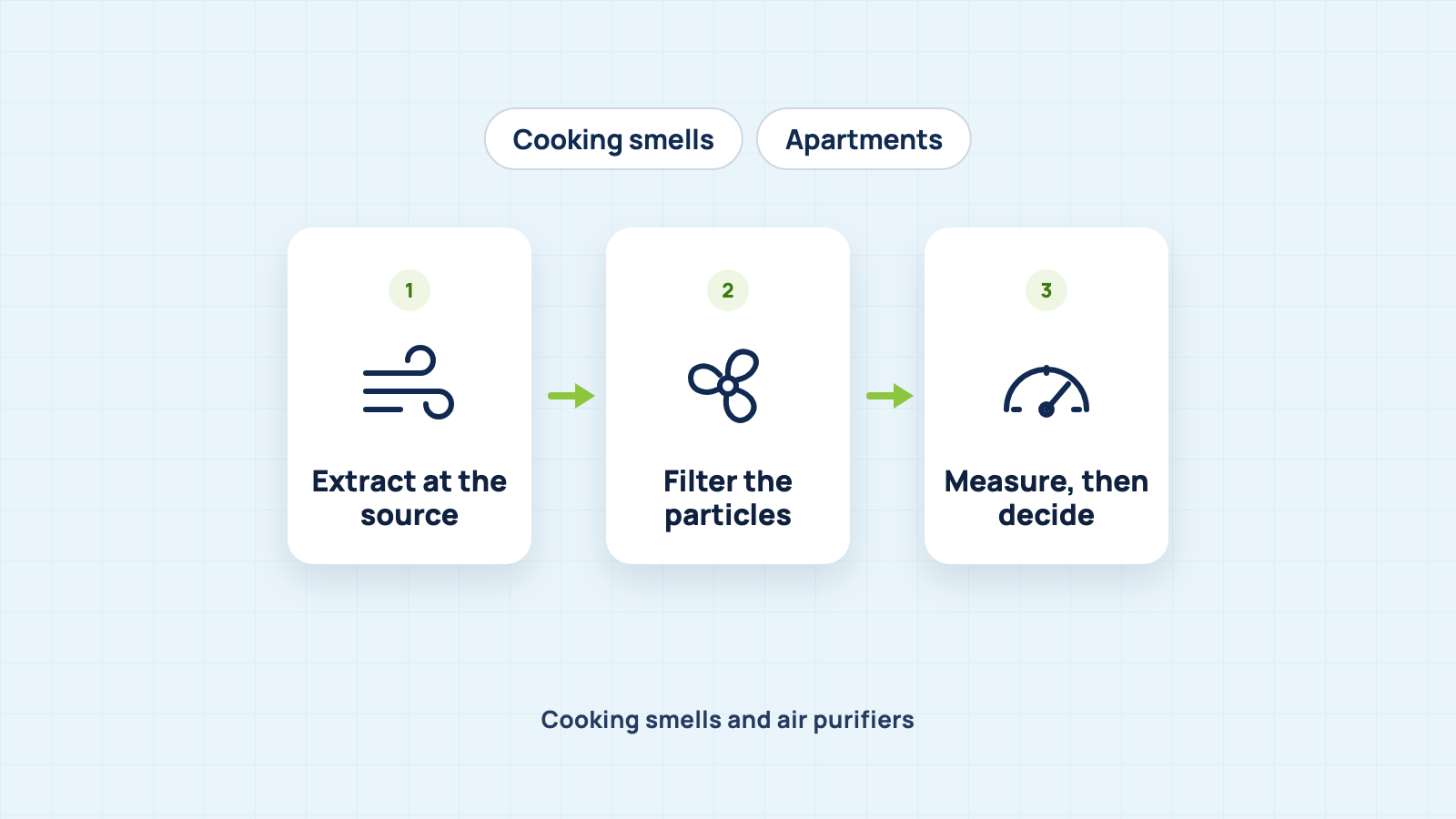
Partly. A HEPA purifier removes cooking smoke and grease particles, but much of a smell is carried by gases, which HEPA does not capture. Only a filter with a substantial amount of sorbent, usually activated carbon, reduces some odour gases, and thin carbon layers can saturate quickly. What works best is removing fumes at the source: a cooker hood that vents outdoors, run during and after cooking. A purifier is a useful extra, not a replacement.
What does cooking release into the air?
Cooking releases three different things, and each needs a different fix: particles, gases that carry the smell, and moisture. On a gas hob, the flame adds combustion gases of its own.
- Particles. Visible cooking fumes are mostly particles smaller than a micron, and cooking particles fall mainly in the ultrafine and PM2.5 size ranges, which a review of cooking studies describes as largely respirable (Abdullahi et al.). A single cooking event can push short-term PM2.5 above 300 µg/m³ (Lawrence Berkeley National Laboratory, LBNL).
- Odour gases. Cooking also gives off organic compounds as gases and vapours, and the US EPA says air cleaners designed only for particles cannot control gaseous pollutants, including those behind chemical odours. Health Canada notes that cooking can generate indoor air pollutants whether you cook on an electric or a gas stove.
- Moisture. Boiling raises humidity (Health Canada), and the EPA notes that gas stoves produce water vapour that increases humidity unless vented outside.
- Combustion gases on gas hobs. A gas burner almost always produces significant nitrogen dioxide, a respiratory irritant, and under some conditions carbon monoxide and formaldehyde. Electric burners produce no carbon monoxide and only small amounts of nitrogen dioxide (LBNL).
How you cook matters most for particles. In one study reviewed by Abdullahi et al., measured 20 cm from the cooker, deep-frying produced PM2.5 of 190 µg/m³ against 72 µg/m³ for steaming; cooking with oil produced more particles than cooking with water, and emissions rose with cooking temperature.
Can an air purifier remove cooking smells?
Only partly. A HEPA filter is a particle filter, defined by how efficiently it removes very fine particles. It captures the cooking smoke and grease particles that pass through it, but the US EPA is direct about gases: “Air-cleaning devices designed only to remove particles are incapable of controlling gases and some odors.”
Gases need a sorbent, usually activated carbon, and the amount is what counts. The EPA says carbon filters “can be effective when there is a large amount of material used in the filter (the thicker the better)”. Its technical summary adds that every sorbent has a limited capacity, that thin layers “can become quickly saturated” and can then release what they trapped, and that the carbon-impregnated combination filters available for portable units, typically 3 mm to 5 cm thick, “usually have limited effectiveness in removing odors”. A properly designed gas filter, it says, is too big for a typical portable air cleaner.
Carbon also adsorbs more readily at lower temperature and humidity, which counts against it in a hot, steamy kitchen, and it is “not especially effective” against formaldehyde or nitrogen oxide (EPA). Other technologies do not fill the gap: the EPA says plasma, photocatalytic oxidation and UV light have not been shown to remove gases effectively in home air cleaners, ionisers do not remove odours, and ozone generators should not be used in occupied spaces, where ozone can mask a smell without removing it. Our guide to PCO, catalytic and ozone fridge purifiers explains how these technologies differ.
Why does CADR not tell you how well a purifier removes smells?
Because CADR (clean air delivery rate) is a particle rating. AHAM’s test scores a purifier on smoke, dust and pollen particles from 0.1 to 11 µm, and AHAM itself places the reduction of gases and odours “outside the scope” of the standard. The EPA notes that there are no widely used rating systems for portable air cleaners designed to remove gases, so a high CADR on the box says nothing about cooking smells.
The rating is also usually measured at the highest fan speed. At the quieter settings people actually use, the EPA says the clean air delivery “could be considerably lower”.
Ducted or recirculating cooker hood: what is the difference?
A ducted hood carries fumes, moisture and combustion gases out of the home; a recirculating (ductless) hood passes them through grease and charcoal filters and blows the air back into the kitchen. The difference matters most for gases and steam. The California Air Resources Board (CARB) says the filters in ductless hoods “trap much of the grease” but do not effectively remove the pollutants and moisture produced by cooking or by gas burners, and LBNL knew of no home product that claims to remove carbon monoxide or water vapour.
Recirculating hoods are not useless. In a 2024 LBNL test, two filtered recirculating hoods substantially reduced particles of all sizes from both gas and induction cooking, and one also lowered some VOCs. LBNL scientist Brett Singer’s advice for a hood that only recirculates is to use another exhaust fan at the same time, for example a nearby bathroom fan, or to open windows (in the UAE, only when the outdoor air allows; see below).
In Dubai, the Building Code expects domestic hoods to discharge outdoors through a sealed metal duct, but allows a ductless hood where it is installed to the maker’s instructions and the home has mechanical ventilation (clause H.4.12.14 for apartment buildings and K.10.1.8.4 for villas). So a recirculating hood is not necessarily non-compliant; the hood’s manual or your building’s management can tell you which type you have.
How you use the hood changes how much it catches. An LBNL study of seven new hoods measured capture from under 15% to over 98%, depending on the hood, its fan speed and the burner; back burners were captured better than front burners, and quiet hoods meeting the US Energy Star criteria captured under 30% from the front burners and the oven.
- Use it every time, during and after cooking. That is LBNL’s advice, and one of its scientists suggests the high setting while cooking and for 15 minutes afterwards. People cannot sense most pollutants, so do not wait for smoke.
- Cook on the back burners. Capture is better there (LBNL), and Health Canada gives the same advice.
- Use the high setting for frying and searing. Health Canada recommends the range hood, preferably on high, to lower humidity and reduce particles and gases.
Extraction, ventilation or filtration: which does what?
Each approach handles a different part of the problem. The EPA’s order is source control and ventilation first, with filtration as a supplement: “Filtration does not replace the need to control pollutants and ventilate.” Dubai Municipality’s indoor air quality guideline uses the same order.
| Approach | Particles (smoke, grease) | Odour gases | Moisture | Combustion gases (NO₂, CO) |
|---|---|---|---|---|
| Ducted hood (removes only what it captures) | Removed outdoors; capture varies widely (LBNL) | Removed outdoors with the air | Removed outdoors | Removed outdoors; the EPA advises an outdoor-vented fan over gas stoves |
| Recirculating hood | Can reduce them substantially (2024 LBNL test) | One of two hoods tested lowered some VOCs (LBNL 2024) | Not removed effectively (CARB) | Not removed effectively (CARB); no known product claims CO removal (LBNL) |
| Ventilation (fresh-air supply, extract fan, a window when outdoor air is clean) | Diluted | Diluted | Extract fan removes it | Diluted |
| Portable purifier with HEPA only | Captured in the air that passes through it | Not controlled (EPA) | Not removed | Not removed |
| Portable purifier with HEPA and carbon | Captured in the air that passes through it | Some; limited with thin carbon (EPA) | Not removed | CO is not readily captured by carbon (EPA) |
Smell, smoke or something else? A quick guide
Start from what you notice:
| Problem | Likely source | What helps | What does not |
|---|---|---|---|
| Food smell lingers for hours | Odour gases from oil, meat and spices that the hood did not capture | A ducted hood on high during and after cooking; back burners; ventilation when outdoor air is clean | A HEPA-only purifier; sprays and scent devices that mask the smell |
| Haze or smoke when frying or searing | Cooking particles, mostly PM2.5 and smaller | Hood on high; a HEPA purifier sized for the whole open-plan space | Opening a window on a dusty day |
| Purifier turns red while cooking | Its sensor detecting cooking particles or gases | Hood on; purifier on a higher speed until the reading settles | Treating green as proof that every pollutant has gone |
| Condensation or damp after cooking | Water vapour from boiling and gas burners | Ducted extraction; see indoor humidity in UAE homes | A purifier or a recirculating hood |
| Worry about carbon monoxide from a gas hob | Burning gas; carbon monoxide has no smell | A certified CO alarm, an outdoor-vented hood and a serviced cooker | A purifier or a general air quality monitor |
| A musty smell, not a food smell | Moisture and mould, sometimes in or around the AC | Find the moisture source; see why an AC smells musty | An air purifier: the EPA says it does not address the cause of musty odours |
Should you open a window while cooking in a UAE apartment?
Sometimes, but not by default. The EPA’s moisture advice is to use exhaust fans or open windows whenever cooking, and its monitor guidance suggests turning on the hood or opening a window or door when a particle monitor rises during cooking. In the UAE, though, outdoor air is often dusty or polluted, and the Dubai Building Code says windows may be opened but “shall not be relied upon” for ventilation.
Open a window when the outdoor air is cleaner than the air inside, and keep it shut on dusty or high-AQI days. Our guide to when to open a window in the Gulf and our Dubai AQI guide explain how to check, and the AQI guide suggests skipping frying on high-pollution days.
Why does an air purifier turn red when you cook?
Because a built-in sensor detects cooking particles or gases. Some purifiers include pollutant sensors (EPA); the MedicAir Pro Mini, for example, lists a laser particulate sensor plus humidity, temperature and TVOC sensors.
The colour tells you less than it seems. The EPA says built-in purifier sensors have not been studied over time and “may provide useful indicators of relative pollutant concentrations”, which is not the same as a measurement, and neither MedicAir document we checked explains what each colour means. A particle sensor counts particles, so a return to green shows that particles have fallen; it does not show that odour gases, nitrogen dioxide or carbon monoxide have gone. Our guide to why monitors give different readings explains sensor limits in more detail.
A short red spike is also not the same as breaching a health guideline. The WHO’s PM2.5 guideline is 15 µg/m³ as a 24-hour average and 5 µg/m³ as an annual average, and the EPA urges caution in comparing minute-by-minute sensor readings directly with standards based on 24-hour averages. Frequent spikes still count towards the daily average, which is why extraction at the source matters (the same effect with incense is covered in our bakhoor guide).
Cooking on gas: carbon monoxide, nitrogen dioxide and alarms
Carbon monoxide (CO) and carbon dioxide (CO₂) are different gases. CO₂ indoors comes mainly from people breathing and is used as a sign of how much fresh air a room gets (Health Canada). CO is a poisonous gas from burning fuel, including gas cookers, and it has no colour or smell, so you cannot tell it is there (NHS, CDC).
A purifier is not protection against it. The EPA notes that carbon monoxide “is not readily captured by adsorption or chemisorption”, which is how carbon filters work, and that alerts from consumer air quality monitors “are not designed to warn of the potential for immediate danger” in the way CO alarms are. A monitor that measures only particles will not detect CO at all.
- Vent the hob outdoors. The EPA advises installing and using an exhaust fan vented outdoors over gas stoves.
- Fit a certified CO alarm. The CDC advises battery-operated or battery back-up CO detectors near every sleeping area, and the EPA says CO alarms should be certified to UL 2034.
- Look after the cooker. The NHS advises having gas appliances serviced and not using oversized pots that cover more than one gas ring.
Gas burners also produce nitrogen dioxide (NO₂). The WHO’s one-hour guideline for NO₂ is 200 µg/m³, and its indoor air guidance notes that people using gas cookers in poorly ventilated spaces can see peaks above 500 µg/m³. An LBNL model of Southern California homes cooking with gas without using a venting hood estimated that 62% of occupants are routinely exposed above acute NO₂ standards, and that regular use of even moderately effective venting hoods would greatly reduce that. Induction removes the flame from the equation: in an LBNL test, cooking with induction produced no discernible nitrogen oxides.
How do you choose a purifier for an open-plan kitchen?
With the hood doing its job, a purifier is a useful second step for particles that escape into an open-plan living area. When comparing models, check:
- A HEPA filter. It handles the smoke and grease particles. Check which grade the maker states and whether it was tested.
- Enough carbon, documented. Ask for the carbon weight or depth and any gas-removal test. If the maker publishes neither, assume odour removal is limited.
- Sized for the whole connected space. With an open floor plan, the EPA says to consider the entire space the purifier will serve, or to use several units. AHAM’s rule of thumb is a smoke CADR in cubic feet per minute of at least two-thirds of the floor area in square feet, and larger for ceilings above 8 ft (2.4 m).
- Quiet enough at the speed you will use. A purifier filters less air at a lower speed, and its clean air delivery at quiet settings may be considerably lower than the figure on the box (EPA).
- Run during and after cooking. Cooking is an intermittent source, so the EPA says a purifier needs to run during and after it, with its intake placed near the source.
- Placed sensibly. Neither MedicAir document we checked sets limits for heat, steam or grease, so keep a purifier beside the kitchen area, not over the hob, with its inlets clear (over 20 cm from walls in the Pro Mini manual).
- Filters replaced on time. Sorbent filters have a finite capacity and must be replaced regularly (EPA).
- No ozone and no scent. Avoid units that intentionally produce ozone, and devices that only mask the smell (EPA, Dubai Municipality).
About MedicAir, which HawaQ works with: the Pro Mini and Pro Max combine a HEPA filter (H14, as stated by MedicAir) with activated carbon, which the Pro Mini manual says “can subsequently reduce odours”. The MedicAir documents we checked give no carbon weight or depth and no gas or odour removal test, and an independent report on the Pro Max, as summarised on our MedicAir comparison, described its carbon stage as too thin for gas capture. We therefore size MedicAir purifiers for particles in the room and do not present them as the answer to cooking smells.
HawaQ is the indoor air quality division of PRO TECHnology, which distributes MedicAir purifiers in the GCC, so we have a commercial link to the product named here. We measure first and recommend equipment only where the readings call for it.
Three illustrative UAE apartment examples
These are illustrative situations, not HawaQ case studies or measurements.
- A studio with an open kitchen and a recirculating hood. The smell reaches the sofa and the bed. Check whether the hood can be switched to vent, run it on high during and after cooking, use the bathroom extract fan at the same time, and add a HEPA purifier in the living area for the particles. Expect less smell, not none.
- A family apartment that fries daily on a gas hob. Cook on the back burners with the hood on high, fit a certified CO alarm near the bedrooms, and if the hood recirculates, ask the building’s management whether ducted extraction is available. A purifier in the living area helps with particles, not with nitrogen dioxide or carbon monoxide.
- A villa with a ducted hood where the smell still lingers. Check that the hood covers the front burners and is used during and after cooking, because a hood that captures little from the front burners lets the plume escape. If the smell persists, measure: logging PM2.5 and TVOC around mealtimes shows whether fumes are escaping the hood.
When is it worth measuring?
When the smell or haze persists despite a working hood, when someone at home has asthma or is sensitive, or when you want to know whether the hood actually captures the fumes. A HawaQ home air quality check-up logs particles, TVOC, CO₂, temperature and humidity in key rooms agreed with you, so cooking peaks can be seen against the rest of the day, and a ventilation and filtration assessment looks at airflow, air changes and filtration. HawaQ measures and advises; the hood or ductwork itself is a job for your building management or a kitchen contractor. For restaurant and café kitchens, see our restaurants and cafés page.
Frequently asked questions
Does a HEPA filter remove cooking smells?
Not on its own. HEPA captures particles such as cooking smoke and grease droplets, but much of a smell is carried by gases, and the US EPA says particle-only air cleaners cannot control gases and some odours. Odour gases need a substantial carbon or other sorbent filter, and even then removal is limited.
Are recirculating cooker hoods allowed in Dubai?
In some cases. The Dubai Building Code expects domestic hoods to discharge outdoors, but allows a ductless hood where it is installed to the maker’s instructions and the home has mechanical ventilation. A recirculating hood traps grease and can cut particles, but it does not remove moisture or combustion gases effectively.
How long should I run the cooker hood after cooking?
Researchers at Lawrence Berkeley National Laboratory advise using kitchen ventilation during and after every cooking event, and one of them suggests the high setting while cooking and for 15 minutes afterwards. We found no official run-on time, so keep it on at least until the haze and steam have cleared.
Is a red purifier light during cooking a health risk?
Not by itself. It shows that the purifier’s sensor sees a spike of particles or gases. Health guidelines such as the WHO PM2.5 value are averaged over 24 hours, and the US EPA urges caution in comparing minute-by-minute sensor readings with 24-hour standards. Frequent spikes still add up, so use the hood every time you cook.
Will an air purifier protect me from carbon monoxide from a gas hob?
No. Carbon monoxide is not readily captured by carbon filters, and the US EPA says consumer air quality monitors are not designed to warn of immediate danger. Use a certified carbon monoxide alarm near sleeping areas, a hood vented outdoors and a regularly serviced cooker.
Do ozone machines or air fresheners get rid of cooking smells?
No. The US EPA says ozone generators should not be used in occupied spaces and, at safe levels, do not remove many odour-causing chemicals. Dubai Municipality warns that scenting devices can make people believe odour-causing pollutants have gone when they have only been masked.
Sources
- US EPA. Guide to Air Cleaners in the Home, 2nd edition, 2018. epa.gov
- US EPA. Residential Air Cleaners: A Technical Summary, 3rd edition, EPA 402-F-09-002, 2018 (pp. 6, 11, 19, 26, 29 to 37). epa.gov
- AHAM. ANSI/AHAM AC-1: understanding its scope and the related AHAM certification programme, 2014. ahamverifide.org
- AHAM Verifide. Air filtration standards (CADR and the two-thirds rule). ahamverifide.org
- US EPA. Ozone generators that are sold as air cleaners. epa.gov
- US EPA. Carbon monoxide’s impact on indoor air quality. epa.gov
- US EPA. Low-cost air pollution monitors and indoor air quality. epa.gov
- US EPA. How air sensors can help you, EPA-452/F-26-010 (short readings versus 24-hour standards). epa.gov
- US EPA. A Brief Guide to Mold, Moisture and Your Home, EPA 402-K-02-003. epa.gov
- California Air Resources Board. Air cleaning devices for the home (updated July 2014), ductless range hoods. ww2.arb.ca.gov
- Stratton JC, Singer BC. Addressing Kitchen Contaminants for Healthy, Low-Energy Homes. LBNL-6547E, 2014. eta-publications.lbl.gov
- Delp WW, Singer BC. Performance assessment of U.S. residential cooking exhaust hoods. Environ Sci Technol 2012;46(11):6167-73. pubmed.ncbi.nlm.nih.gov
- Li J, Zhao H, Russell ML et al. Air pollutant exposure concentrations from cooking a meal with a gas or induction cooktop and the effectiveness of two recirculating range hoods with filters. Indoor Environments 2024 (LBNL). bies.lbl.gov
- LBNL. Range hood advice from indoor air quality researcher Brett Singer, 2018. indoor.lbl.gov
- LBNL. Cooking air quality tips (Iain Walker), 2021. homes.lbl.gov
- Logue JM, Klepeis NE, Lobscheid AB, Singer BC. Pollutant exposures from natural gas cooking burners: a simulation-based assessment for Southern California. Environ Health Perspect 2014;122(1):43-50. pubmed.ncbi.nlm.nih.gov
- Abdullahi KL, Delgado-Saborit JM, Harrison RM. Emissions and indoor concentrations of particulate matter and its specific chemical components from cooking: a review. Atmospheric Environment 2013;71:260-294 (accepted manuscript). hdl.handle.net
- Health Canada. Improve indoor air quality in your home (cooking; air cleaning). canada.ca
- Health Canada. Carbon dioxide in your home. canada.ca
- CDC. Carbon monoxide poisoning basics. cdc.gov
- NHS. Carbon monoxide poisoning. nhs.uk
- WHO. WHO global air quality guidelines, executive summary, 2021 (Tables 0.1 and 0.2). iris.who.int
- WHO Regional Office for Europe. WHO guidelines for indoor air quality: selected pollutants, 2010 (nitrogen dioxide). iris.who.int
- Dubai Municipality. Dubai Building Code, 2021 edition: H.4.11, H.4.12.14, K.10.1.8.4. dmpmedia.dm.gov.ae
- Dubai Municipality. Technical Guidelines for Indoor Air Quality for Healthy Life, DM-HSD-GU119-IAQ, Version 4, December 2024 (Appendix 6). dmpmedia.dm.gov.ae
- MedicAir. Pro Mini user manual, IFU_EM_REV1.1, April 2022 (hosted by PRO TECHnology). protechnology.ae
- MedicAir. Pro Max specification sheet (hosted by PRO TECHnology). protechnology.ae
Sources read on 2 November 2026. The examples are illustrative. Product details are as published by the manufacturer on that date; this guide is general information, not medical advice.