
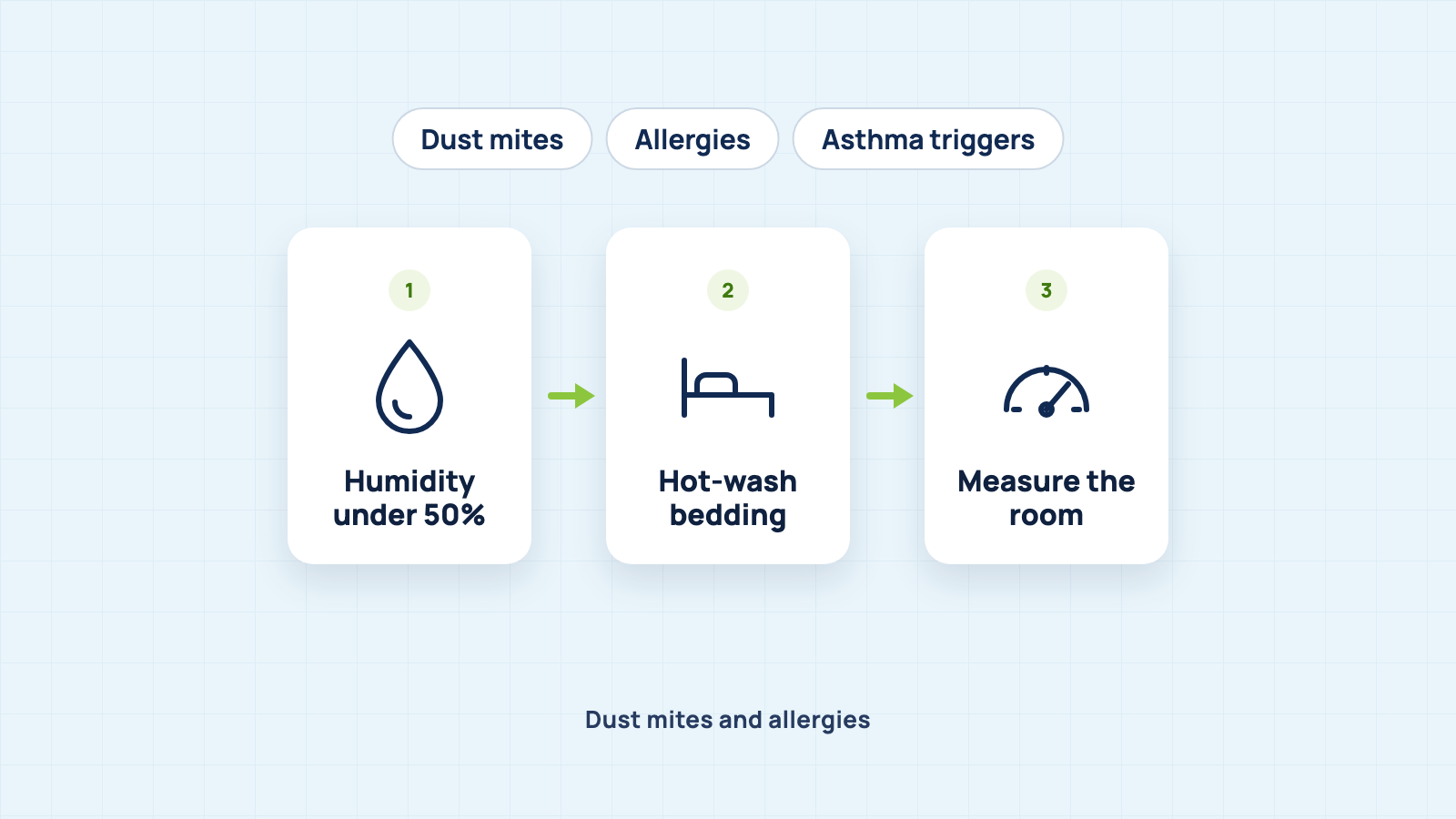
Dust mites live in bedding, upholstered furniture and carpets and grow best in humid air, so the bedroom matters most. Keep it below 50% humidity where feasible, hot-wash bedding weekly and vacuum with a HEPA filter. Single measures rarely ease asthma on their own; combined steps aimed at the allergens a person actually reacts to have better evidence. A HEPA purifier can catch airborne pet allergen, but not mite allergen settled in bedding.
What are dust mites, and why do they matter in UAE homes?
Dust mites are tiny creatures, too small to see, that feed on skin flakes and live in mattresses, pillows, carpets and upholstered furniture. Their droppings and body parts can trigger allergy and asthma symptoms, and they thrive where it is warm and humid, which makes the bedroom of a closed, air-conditioned UAE home the place to focus.
Those facts come from the US EPA and the AAAAI (American Academy of Allergy, Asthma and Immunology), which calls cutting mite levels in the bedroom essential because so much time is spent there.
A dust mite allergy usually causes sneezing, a stuffy or runny nose and itching in the nose, eyes or throat (AAAAI), and the NHS lists house dust mites among the causes of allergic rhinitis. In allergic asthma, allergens can also trigger flare-ups. A cold looks similar, so see a doctor rather than guess.
What humidity do dust mites need, and how do you measure it?
Keep the bedroom below 50% relative humidity if you can, and below 60% in any case. Dubai Municipality’s technical guideline on indoor air quality (GU119, version 4) says: “Keep relative humidity below 60% (50%, if feasible, to control dust mites)”. The AAAAI suggests 40 to 50%, and the US EPA, in its advice on mould, ideally 30 to 50%.
In a US study in a humid temperate climate (Arlian and colleagues, 2001), 23 homes kept below 51% through two humid summers, most with a high-efficiency dehumidifier and air conditioning, saw live mites fall from about 400 to 8 per gram of dust after 17 months. Air conditioning did not always do it: 24 homes with it (5 also with a dehumidifier) did not stay below 51% and kept seasonal peaks, and by the end the dry homes had more than ten times less mite allergen than the humid ones. The study measured dust, not symptoms, and a temperate climate is not Dubai’s.
To check your bedroom, read a hygrometer at breathing height, away from the AC outlet, windows and sun, at bedtime and on waking for at least a week (see testing the air at home). Above 60%, deal with the moisture first: see ideal indoor humidity in UAE homes and why an AC can leave a room humid. Between 50 and 60%, the room is within Dubai Municipality’s 60% guideline but above its dust mite target.
Which other indoor triggers cause allergy and asthma symptoms?
Besides dust mites, the US EPA lists mould, pets, cockroaches and other pests, secondhand smoke, nitrogen dioxide from fuel-burning appliances, outdoor air pollution, chemical irritants and wood smoke as asthma triggers. In UAE homes, add bakhoor and incense smoke and fine dust from sandstorms. Which ones matter differs from person to person.
Two UAE studies show how much this varies. Among 327 adult patients with respiratory, skin or eye conditions of suspected allergic origin, tested at an Al Ain hospital from 1996 to 1998, skin prick tests were positive most often to pollens such as mesquite (45.5%), against 9.5% for dust mite; at a children’s allergy clinic in Abu Dhabi in 2008 to 2010, 81.7% of 82 children with asthma were sensitised to dust mites. Both groups were hospital or clinic patients, so neither figure is a UAE-wide rate.
| Trigger | Where it comes from | What helps | What does not |
|---|---|---|---|
| Dust mites | Mattresses, pillows, carpets, upholstered furniture, soft toys | Weekly hot wash, humidity below 50%, HEPA vacuuming, fewer soft furnishings | A purifier or mite-proof covers alone |
| Mould (mold) | Damp walls, wardrobes, wet areas, AC drip trays and ducts | Fix the water, clean, keep humidity low; see why mould keeps coming back | A purifier, which does not address the cause (EPA) |
| Pets | Skin flakes, saliva and urine of furry pets | Pets out of the bedroom, a HEPA purifier | “Hypoallergenic” breeds: the AAAAI says there are none |
| Cockroaches and other pests | Kitchens, food left out, leaks, cracks | Clear food away, airtight storage, sealed cracks, fixed leaks | Relying on pesticides: the EPA says they can harm people too and advises lower-risk methods |
| Tobacco smoke | Smoking indoors or in the car | A smoke-free home and car | Smoking just outside a door or window |
| Bakhoor and incense | Smoke and fine particles, worst in small closed rooms | Burn less and ventilate while it burns; see our bakhoor guide | Air fresheners to mask it, which the EPA lists as irritants |
| Sandstorm dust | Fine dust through gaps and fresh-air intakes | Windows shut on dusty days, a HEPA purifier, better HVAC filters; see our sandstorm guide | A wall-mounted split AC, whose filter mainly keeps the unit clean (EPA) |
In an Omani survey of 2,441 schoolchildren aged 10, parents of 38% of those with asthma said bakhoor worsened their wheeze, though bakhoor use was not linked with having asthma. The EPA adds fumes from gas cooking, cleaning products, paints and air fresheners (see air quality in a new or renovated home).
What actually reduces dust mite allergen, and does it ease symptoms?
Between them, the US EPA, the NHS and the AAAAI recommend weekly hot-washing, allergen-proof covers, low humidity, HEPA vacuuming and fewer soft furnishings. But lower allergen does not always mean fewer symptoms: single measures have mostly failed to improve asthma in trials, so combine them and aim them at the allergens a person reacts to.
- Hot-wash bedding weekly. At 60 °C or above (NHS); the AAAAI gives 130 °F (about 54 °C) and a hot dryer.
- Encase the mattress and pillows. Allergen-proof zippered covers, as part of a wider plan, not on their own.
- Keep bedroom humidity below 50% where feasible. Check it with a hygrometer.
- Vacuum weekly with a HEPA-filter vacuum. The person with allergies or asthma should leave the room (US EPA). Dust with a damp cloth.
- Cut the soft furnishings. Take up wall-to-wall carpet where you can, use washable rugs (AAAAI) and choose washable soft toys (US EPA).
The evidence on symptoms is weak. A Cochrane review of 55 trials in 3,121 people with mite-sensitive asthma found no benefit from chemical and physical mite control and concluded these measures “cannot be recommended”, though since 2021 Cochrane has flagged it as predating its current standards and says it should not be used for clinical decisions. Two 2003 trials found the same for covers used alone: no better peak flow or cut in inhaled steroids in 1,122 adults with asthma, and no symptom relief in 279 people with mite-allergic rhinitis, although their mattresses held less mite allergen.
Combined, targeted plans have better evidence. The 2018 review behind the US asthma guidelines found that single measures generally did not help, while multicomponent programmes improved some outcomes. The US guideline (NHLBI, 2020) therefore conditionally recommends a multicomponent plan only for people with asthma whose symptoms are linked to an indoor allergen confirmed by history or allergy testing, and mite-proof covers only within such a plan. In the US Inner-City Asthma Study (937 children with allergic asthma), a one-year home programme tailored to each child’s allergies and exposures meant fewer days with symptoms than in the control group (3.39 against 4.20 days in every two weeks), and the gain lasted into the following year.
Do air purifiers help with allergies, and which one is best?
A HEPA purifier can help a little, mainly with allergens that stay in the air. The US EPA says studies of portable HEPA air cleaners have found improvements in some allergy or asthma symptoms, though not always major ones. It does little for dust mites, whose allergen settles quickly onto surfaces.
The EPA explains why: mite and cockroach allergen rides on large particles that settle rather rapidly, so air filters are not likely to remove them effectively, while a significant fraction of cat and dog allergen travels on small particles that stay airborne longer. The US asthma guideline names pet dander and mould as the main targets of purifiers and dust mites as a secondary one, and rates purifiers as making no difference to asthma outcomes (low to moderate certainty).
There is no single best purifier for allergies, and the EPA does not recommend brands. What matters:
- A HEPA filter for particles, with activated carbon if odours matter too.
- Sized to the room. Match the clean air delivery rate (CADR) or the maker’s maximum room size to the room, and size up for ceilings above about 2.4 m (EPA).
- Quiet enough to run all night. If noise would stop you running it, the EPA suggests a low published noise rating.
- In the bedroom. Filtered air near sleeping allergic or asthmatic people appears more effective than living-room filtration (EPA).
- Filters replaced on schedule. A dirty, overloaded filter will not work well.
Where our readings show particles worth filtering, HawaQ recommends MedicAir. MedicAir purifiers combine a HEPA filter with activated carbon. Size them room by room: a Pro Mini for a bedroom, a Pro for a living area. HEPA grades and airflow figures are MedicAir’s own specifications. PRO TECHnology’s MedicAir guide for villas and apartments and our Pro Mini, Pro and Pro Max comparison help you choose. No purifier removes allergen settled in bedding, stops mould growing or lowers CO₂.
HawaQ is a PRO TECHnology Group company. PRO TECHnology distributes Stadler Form in the UAE and MedicAir in the GCC, so we have a commercial link to the products we name. We measure first and recommend a product only where the readings call for one.
When is a dehumidifier worth it, and which size?
Only when your own readings call for one. If the bedroom stays above about 50 to 60% for days with the AC used normally, a dehumidifier sized to the room can bring it down towards the 50% that Dubai Municipality suggests for dust mites. If readings already sit below 50%, it adds little.
Size it to the space. Stadler Form Lukas removes up to 20 litres a day and is rated for rooms up to 70 m², which suits a bedroom or a smaller apartment.
For villas and large apartments near the sea, Lukas Pro is the dehumidifier HawaQ recommends most often. In more than 50 waterfront homes on Palm Jumeirah, Dubai Marina, JBR and La Mer, HawaQ logged humidity room by room for a month before recommending anything, then specified Lukas Pro where the data showed it was needed. Stadler Form Lukas Pro removes up to 50 litres a day and is rated for rooms up to 175 m². That is a rated maximum: Stadler Form says it is reached only from about 22 °C and 70% humidity, so a cooled room will see less. It drains continuously through the included hose, has a digital hygrostat and an H11 particle filter, and carries a 5-year Pro Series warranty.
Aim for about 50% and check it with your own hygrometer. A dehumidifier does not fix a leak, clean mould that is already growing or wash allergen out of bedding.
How does HawaQ check a home for allergy triggers?
HawaQ measures the home, not the person. A two-week home check-up places professional monitors in the rooms you use most, logs humidity, temperature, PM2.5, PM10, TVOC and CO₂, inspects the HVAC system and ends with a written report and recommendations. We do not diagnose allergies or asthma; a doctor does.
- Bedroom humidity above 50 to 60%: conditions mites and mould favour; fix this first.
- PM2.5 and PM10 peaks: dust getting in, or smoke from cooking, candles or bakhoor.
- TVOC peaks: cleaning products, air fresheners, perfumes, paint or new furniture.
- CO₂ building up overnight: too little fresh air; see stuffy bedroom and CO₂.
Where there is a musty smell or visible mould, a mould investigation adds moisture mapping, an AC check and, where needed, air or surface samples analysed by a laboratory. For data all year round, see indoor air quality monitoring.
Monitors measure particles and gases, not what a person is allergic to. A doctor or allergist can test that with a skin prick test or a blood test (NHS), and the US guideline suggests testing before taking on burdensome measures. See a doctor if symptoms disturb your sleep or daily life, or if asthma is getting worse.
Frequently asked questions
Can dust mites live in air-conditioned homes?
Yes, if the air stays humid. In a US study, homes with air conditioning that did not stay below 51% humidity kept seasonal peaks of mites and allergen, while homes held below 51% had more than ten times less allergen than the humid homes after 17 months. A cool room is not always a dry one, so check the bedroom with a hygrometer.
Is 60% humidity too high for dust mites?
For dust mites, yes. Dubai Municipality’s indoor air quality guideline sets 60% as the upper limit but says 50%, if feasible, to control dust mites, and the AAAAI suggests 40 to 50%. In a US study, homes kept below 51% through two humid summers cut live mites from about 400 to 8 per gram of dust.
Do air purifiers remove dust mites?
Not well. Mite allergen is carried on larger particles that settle onto surfaces quickly, so the US EPA says air filters are unlikely to remove it effectively and that allergen control needs routine cleaning and dust control. A HEPA purifier is more useful for allergens that stay airborne, such as a significant share of cat and dog allergen, and for fine dust and smoke.
How often should I wash bedding for a dust mite allergy?
Every week. The US EPA and the AAAAI both advise a weekly hot wash; the NHS says to wash bedding at 60 °C and above, and the AAAAI suggests a hot dryer afterwards. Duvets and pillows that cannot be washed often can go in allergen-proof covers. Combine washing with the other steps in this guide.
Can a dehumidifier help allergies?
It can help indirectly, by lowering the humidity that dust mites and mould need. In a US study, homes kept below 51% had far less mite allergen, though symptoms were not measured. If bedroom readings stay above 50 to 60% for days, a dehumidifier sized to the room is worth considering. Below 50%, it adds little, and it never removes allergen already in bedding or fixes a leak.
Does HawaQ test homes for allergens?
HawaQ measures the conditions that let allergens build up and does not test what a person is allergic to. A two-week home check-up logs humidity, temperature, PM2.5, PM10, TVOC and CO₂ in your key rooms and includes an HVAC inspection; a mould investigation adds moisture readings and laboratory samples where needed. For allergy tests, see a doctor or allergist.
Sources
- Dubai Municipality. Technical Guidelines for Indoor Air Quality for Healthy Life, DM-HSD-GU119-IAQ, Version 4 (December 2024), Appendix 10-1-2 (p41). dmpmedia.dm.gov.ae
- Arlian LG, Neal JS, Morgan MS, et al. Reducing relative humidity is a practical way to control dust mites and their allergens in homes in temperate climates. J Allergy Clin Immunol 2001;107(1):99-104. pubmed.ncbi.nlm.nih.gov
- US EPA. Asthma Triggers: Gain Control (updated 6 July 2026). epa.gov
- US EPA. Guide to Air Cleaners in the Home, 2nd edition, 2018. epa.gov
- US EPA. Residential Air Cleaners: A Technical Summary, 3rd edition, 2018 (pp. 10, 19, 43). epa.gov
- US EPA. Sources of Indoor Particulate Matter (PM) (updated 10 March 2026). epa.gov
- Gøtzsche PC, Johansen HK. House dust mite control measures for asthma. Cochrane Database Syst Rev 2008;(2):CD001187 (search updated July 2011; editorial note added July 2021). pmc.ncbi.nlm.nih.gov
- Leas BF, D’Anci KE, Apter AJ, et al. Effectiveness of indoor allergen reduction in asthma management: a systematic review. J Allergy Clin Immunol 2018;141(5):1854-1869. pubmed.ncbi.nlm.nih.gov
- NHLBI Expert Panel Working Group (Cloutier MM, et al.). 2020 Focused Updates to the Asthma Management Guidelines. J Allergy Clin Immunol 2020;146(6):1217-1270, Recommendations 5 to 8 and Table IIIA. pmc.ncbi.nlm.nih.gov
- Morgan WJ, Crain EF, Gruchalla RS, et al. Results of a home-based environmental intervention among urban children with asthma. N Engl J Med 2004;351(11):1068-80. pubmed.ncbi.nlm.nih.gov
- Woodcock A, Forster L, Matthews E, et al. Control of exposure to mite allergen and allergen-impermeable bed covers for adults with asthma. N Engl J Med 2003;349(3):225-36. pubmed.ncbi.nlm.nih.gov
- Terreehorst I, Hak E, Oosting AJ, et al. Evaluation of impermeable covers for bedding in patients with allergic rhinitis. N Engl J Med 2003;349(3):237-46. pubmed.ncbi.nlm.nih.gov
- NHS. Allergic rhinitis (reviewed 8 January 2026). nhs.uk
- NHS. Allergies (reviewed 5 March 2026). nhs.uk
- AAAAI. Indoor Allergens (16 July 2026). aaaai.org
- AAAAI. Humidifiers and Indoor Allergies (16 July 2026). aaaai.org
- Bener A, Safa W, Abdulhalik S, Lestringant GG. An analysis of skin prick test reactions in asthmatics in a hot climate and desert environment. Allerg Immunol (Paris) 2002;34(8):281-6. pubmed.ncbi.nlm.nih.gov
- Adham TM, Tawfik SA. Dermatophagoides in childhood asthma. Saudi Med J 2012;33(3):292-7. pubmed.ncbi.nlm.nih.gov
- Al-Rawas OA, Al-Maniri AA, Al-Riyami BM. Home exposure to Arabian incense (bakhour) and asthma symptoms in children: a community survey in two regions in Oman. BMC Pulm Med 2009;9:23. pubmed.ncbi.nlm.nih.gov
Sources read on 27 October 2026; the Dubai Municipality guideline was checked against the copy verified on 23 October 2026. Study results are as reported in each paper’s abstract or full text. Product figures are as published by the manufacturer on 27 October 2026. HawaQ did not take its own measurements for this article, which is general information, not medical advice.