
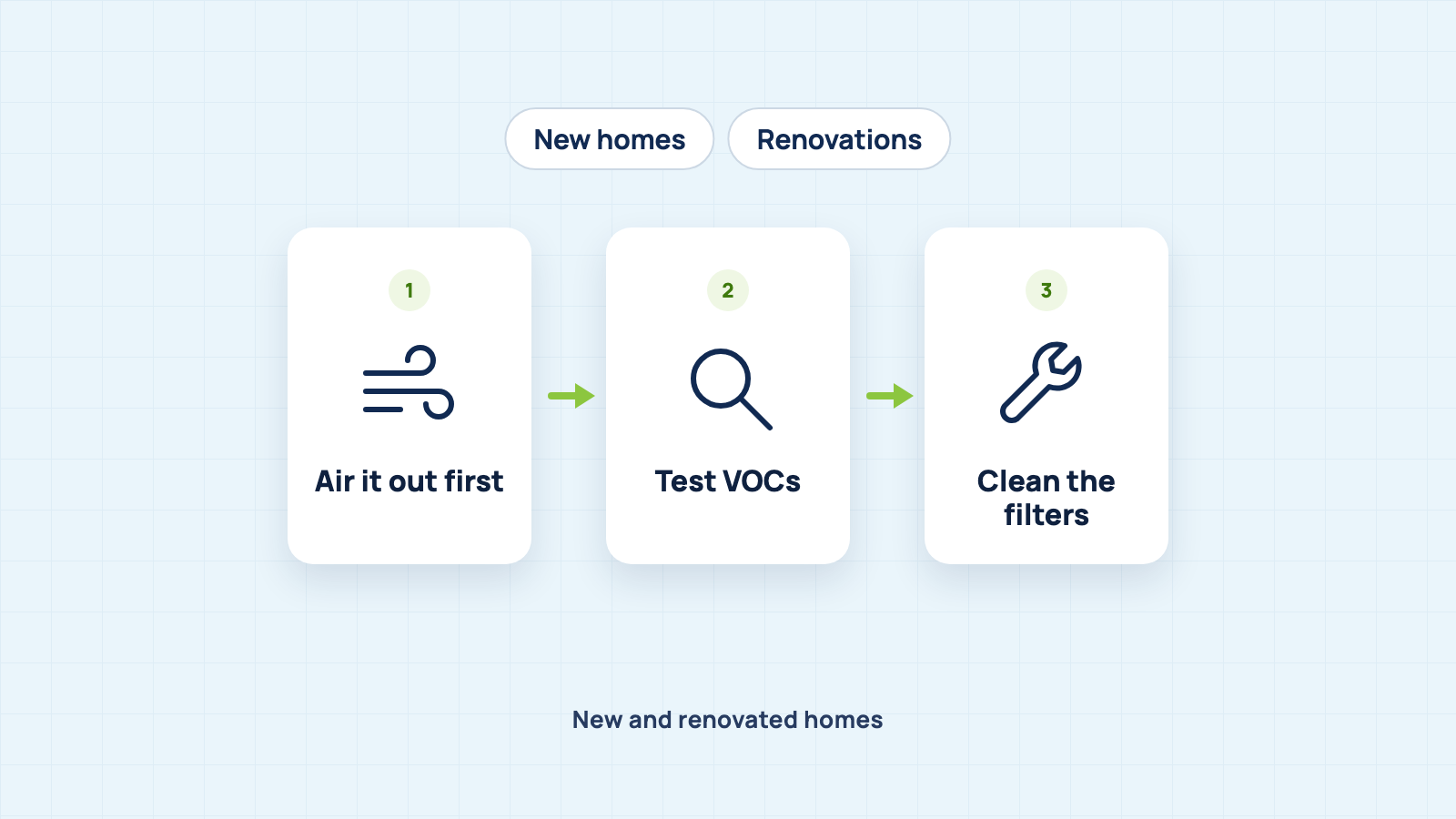
New paints, adhesives, flooring and pressed-wood furniture release VOCs, including formaldehyde, and building work leaves fine dust. Emissions are generally highest when products are new, and heat, humidity and little fresh air can raise levels. Before moving in, finish the works, clean the AC filters, air the home out, then measure with the AC running normally. In Dubai, the Building Code requires a pre-occupancy air test for the apartment buildings it covers, but not for villas or townhouses.
What makes the air in a new or renovated home different?
New materials keep releasing gases after they are installed. Paints, varnishes, adhesives, sealants, new flooring and pressed-wood furniture such as MDF and particleboard give off volatile organic compounds (VOCs), including formaldehyde, while cutting and sanding leave fine dust. Emissions are typically highest when the work is finished, then fall as products age.
Three conditions can raise levels, the US EPA explains: too little outdoor air to dilute and remove emissions, heat, which speeds up formaldehyde release, and humidity. A home left closed over summer, with the AC off or set high until move-in, combines little fresh air with heat.
| Source | What it releases | How long it tends to last | What reduces it |
|---|---|---|---|
| Paint and wallpaper | VOCs; some formaldehyde | Formaldehyde sometimes detectable 1 to 3 months after application | Low-VOC paint; ventilation during and after painting |
| Wood floor finishes | Formaldehyde, high from some finishes | Falls after the first 24 hours | Finishes that are not formaldehyde-based; keeping out as the maker advises |
| Pressed-wood furniture and cabinets (MDF, particleboard, plywood) | Formaldehyde from the resins | Falls with age; CPSC notes a decrease 6 to 10 months after initial testing, not an end point | Laminated or coated surfaces and edges; certified low-emission panels |
| Adhesives, sealants and new flooring | VOCs; some formaldehyde | Highest when new; no figure in our sources | Low-emission labels; ventilation |
| Building and renovation dust | Particles (PM2.5 and PM10) | Until cleaned out of rooms, AC filters and ducts | Containment; a sealed HEPA vacuum; new or cleaned filters |
Is a new-paint or new-furniture smell harmful?
Not necessarily: a smell tells you something is being released, not which chemical, how much, or whether it matters; CPSC notes that smelling formaldehyde does not always mean levels are of concern. Some VOCs irritate the eyes, nose and throat, and so can formaldehyde, so a smell that lasts is worth measuring.
The US EPA lists possible VOC effects from eye, nose and throat irritation and headaches to liver, kidney and nervous system damage, depending on level and exposure time, but says little is known about effects at the levels usually found in homes.
WHO’s indoor guideline for formaldehyde is 0.1 mg/m³ (about 0.08 ppm) over any 30 minutes, set to prevent sensory irritation and, WHO says, long-term effects including cancer. You may smell it below that level, which WHO does not consider an adverse health effect.
Some people are very sensitive to formaldehyde at levels where others notice nothing (CPSC). If watery eyes, a runny nose or headaches ease when you leave home, see a doctor and mention the new furniture or work; see also sick building syndrome symptoms. Do not mask the smell: EPA lists air fresheners as VOC sources, and Dubai Municipality’s guideline lists incense burning as a source of polycyclic aromatic hydrocarbons, so bakhoor adds pollutants.
Is an air test required before you move in?
In Dubai, the Building Code requires an indoor air quality test before occupancy for buildings other than villas and townhouses, with a report submitted to the Authority. So a new apartment tower permitted under the Code needs a test report showing compliance before occupancy. Villas and townhouses of up to three storeys fall under the Code’s standalone Part K, which has no such test: if you want one, you arrange it.
The test covers formaldehyde (below 0.08 ppm; no sampling time printed), total VOCs (TVOC, below 300 µg/m³) and suspended particles under 10 µm (below 150 µg/m³), the last two as 8-hour time-weighted averages. It must be carried out by specialised companies or laboratories accredited by the Authority, with instruments holding ISO/IEC 17025 calibration certificates.
It has limits. The Code applies to building designs permitted after it came into force under Decree No. 45 of 2021, so an older tower may predate it. It sets no number of homes to sample and cannot reflect furniture added after handover. Ask the developer or building management for any test report.
Villas and townhouses keep the Code’s material rules without the test: certified paints, coatings, adhesives and sealants within Dubai Central Laboratory VOC limits, certified carpets and ISO 16890-1 filters. The Code applies in Dubai only; for other emirates, see indoor air quality requirements in the UAE and Saudi Arabia.
Snagging or an air quality check: what is the difference?
Snagging and air testing are different jobs. Snagging, in the Cambridge Dictionary’s definition, is dealing with minor faults in a newly built home. An air quality check measures what you breathe, such as VOCs, formaldehyde and particles, over hours or days against limits with set averaging times. A snag list records faults; it says nothing about the air unless air was measured.
Book the air check after the snag repairs and final clean: touch-up paint and fresh sealant are new sources. If a snagging report includes air results, check the pollutants, method, duration and limits used. HawaQ does not carry out snagging inspections; we measure the air.
What should you do before moving in?
Start once the works, snag repairs and final clean are done. Then clean the filters, air the home out, keep it cool and moderately dry, and let new furniture air out before you measure or move in. These steps follow US EPA and CPSC advice.
- Clean the filters. Replace or clean every AC filter used during the works, clean the grilles, have the ducts checked for dust and clean with a sealed HEPA-rated vacuum (EPA). If the AC smells musty, see our guide to an AC that smells musty.
- Air it out first. Bring in as much outdoor air as you can before moving in, on days when the outdoor air quality is good; in a tower, ask building management whether your unit’s fresh-air supply is running.
- Keep it cool. Heat speeds up formaldehyde release, so keep the AC at a normal setting rather than letting a closed home heat up; EPA also advises against “baking out” VOCs in an occupied home.
- Keep humidity moderate. CPSC suggests 40 to 50% to reduce formaldehyde exposure, and EPA names air conditioning and dehumidifiers as ways to control it; see ideal indoor humidity in UAE homes.
- Unpack new furniture early. Ventilate well after bringing it in, as EPA advises, and bring rugs, curtains and mattresses in after the dusty work. If a bedroom feels stuffy at night, see stuffy bedrooms and CO₂.
- Choose low-emission products. For remaining work, ask for paints, adhesives and sealants certified by Dubai Central Laboratory or another approved laboratory, which the Dubai Building Code requires in the buildings it covers; for pressed wood, ask for laminated or coated surfaces and edges (CPSC) and TSCA Title VI or CARB Phase 2 labels (EPA).
How do you test VOCs and formaldehyde in a home?
Test once the home is finished and cleaned, with the AC running as it will when you live there. Sensors show trends and which rooms lag; laboratory sampling identifies and quantifies specific chemicals. Compare each result with a limit of the same averaging time: a one-minute reading is not an 8-hour average.
Not every home needs a test: EPA’s renovation guidance calls VOC testing unnecessary in most circumstances. Test when a smell lasts after airing out, someone at home is sensitive or unwell, there is a lot of new joinery, or you want reassurance in a new villa, which has no Building Code test.
Sensors screen. Two low-cost formaldehyde sensor models, tested as groups in a 2025 laboratory study, could not reliably detect below about 0.014 and 0.022 ppm and reacted to some other gases, so they cannot confirm a level below 0.01 ppm. A TVOC reading is a total and names no chemicals; see why monitors give different readings. Laboratories confirm; trained professionals can control for home closure, temperature, humidity and sampling details (CPSC).
| Pollutant | Dubai Building Code test (binding; not villas or townhouses) | Dubai Municipality guideline, existing buildings | WHO guideline |
|---|---|---|---|
| Formaldehyde | Below 0.08 ppm (no sampling time printed) | 0.01 ppm over 8 hours; 0.08 ppm (0.1 mg/m³) over 30 minutes | 0.1 mg/m³ over any 30 minutes (2010) |
| TVOC | Below 300 µg/m³, 8-hour average | 600 µg/m³, 8 hours | None |
| Particles under 10 µm (PM10) | Below 150 µg/m³, 8-hour average | 150 µg/m³, 24 hours | 45 µg/m³, 24 hours (2021) |
| Fine particles (PM2.5) | Not tested | 35 µg/m³, 24 hours | 15 µg/m³, 24 hours (2021) |
WHO’s 24-hour particle levels are 99th percentiles (3 to 4 days a year above them), and guideline values are guidance, not law. A useful report lists rooms, dates, duration, AC and window settings, the method for each result and the limit used. For monitor placement, see how to test air quality at home; for workplaces, air quality after an office fit-out.
How do you protect the air while renovating a home you live in?
Seal the work area off from the rooms you use, stop the AC drawing air from it, and ventilate during and after painting. Dubai Municipality’s guideline asks for renovated spaces in occupied buildings to be isolated from occupied zones, and US EPA guidance sets out the practical steps below.
- Separate the work. Seal plastic sheeting over the doorway and, where you can, exhaust the room to outdoors so air flows in, not out.
- Protect the AC. Cover duct openings and return grilles in the work area so the AC cannot pull air from it, fit MERV 8 or higher filters if a ducted system must run, and replace the filters afterwards.
- Time the messy work. Do polluting work when few people are home, keep lids on paint, and ventilate with plenty of outdoor air during and after painting (Dubai Municipality).
- Contain the dust. No dry sanding without containment; cover sofas, beds and carpets with plastic; clean with a sealed HEPA-rated vacuum before the room is used again.
- Plan around vulnerable people. EPA lists vacating the home, when feasible, among extra protections, and asks contractors to identify occupants with special needs, such as children and older people.
If damp patches or mould (mold) appear after a renovation, see mould that keeps coming back; if dust allergies are the worry, see dust mites and allergies in UAE homes.
Can an air purifier clear new-home smells?
Partly, and only in the room where it runs. HEPA filters capture particles such as renovation dust, not gases. Activated carbon can take up some VOCs and odours, but the US EPA says it needs a large amount of material to be effective and is not especially effective against formaldehyde. Ventilation and removing the source come first.
MedicAir purifiers combine a HEPA filter with activated carbon. Size them room by room: a Pro Mini for a bedroom, a Pro for a living area. HEPA grades and airflow figures are MedicAir’s own specifications. Use one alongside ventilation, not instead of it (EPA). Where we recommend one, we size it to the room and measure again afterwards. See MedicAir purifiers for villas and apartments.
Do not use an ozone generator to freshen a new home: CPSC notes that indoor ozone increases formaldehyde formation, and EPA says ozone generators sold as air cleaners should not be used in occupied spaces.
HawaQ is a PRO TECHnology Group company. PRO TECHnology distributes Stadler Form in the UAE and MedicAir in the GCC, so we have a commercial link to the products we name. We measure first and recommend a product only where the readings call for one.
Where can you get a new home’s air tested?
HawaQ assesses villas and apartments before and after move-in. Our two-week home check-up covers new furniture and renovation concerns: professional monitors log nine parameters minute by minute in the rooms you use most, alongside an HVAC inspection, and you get a written report with prioritised fixes.
Before move-in, our pre-occupancy assessment and our VOC and formaldehyde assessment measure the home; after a renovation, they measure what is left in the air. Results are compared with WHO guideline values and, in Dubai, Dubai Municipality values. It is a diagnostic assessment, not the Dubai Building Code’s formal test. See indoor air quality testing.
Frequently asked questions
How long does new paint smell last?
It depends on the product, how much was used, ventilation and temperature. CPSC reports that formaldehyde from paint and wallpaper is sometimes still detectable 1 to 3 months after application, and EPA notes that raised VOC levels can persist long after the work ends. Ventilate during and after painting, keep the home cool, and measure if the smell lasts.
Should I test air quality before moving into a new villa?
It is worth considering. In Dubai, the Building Code’s pre-occupancy air test applies to buildings other than villas and townhouses, so the Code requires no air test for a villa. Test after the snag repairs and final clean, with the AC running normally, especially if there is a lot of new joinery or someone in the family is sensitive to smells or chemicals.
Is formaldehyde from new furniture dangerous?
At high levels it can be. The US EPA says formaldehyde can irritate the skin, eyes, nose and throat, and that high levels may cause some cancers. CPSC says low-level exposure causes no adverse effects for most people, though some people are very sensitive. Emissions from pressed wood fall as it ages, and ventilation helps. See a doctor about any symptoms.
Does snagging include an air quality test?
They are different jobs. Snagging deals with minor faults in a newly built home; an air test measures VOCs, formaldehyde and particles over hours or days against limits with set averaging times. If your snagging report includes air results, check what was measured, how, for how long and against which limit. HawaQ does not do snagging; we measure the air.
How do I get rid of VOCs in a new home?
Remove or seal the sources you can, bring in plenty of outdoor air, keep the home cool and humidity moderate, and clean out building dust and dirty AC filters. Safely dispose of leftover paint and solvent containers, because EPA notes gases can leak even from closed ones. A purifier with activated carbon can help in one room, but it does not replace ventilation.
Can I test formaldehyde myself?
You can screen for it. Low-cost sensors show trends, but in a 2025 laboratory study two models, tested as groups, could not reliably detect levels below about 0.014 and 0.022 ppm and reacted to some other gases. CPSC, writing for US homes, describes passive badges you hang for one to seven days and post to a laboratory, and notes that trained professionals can control for home closure, temperature and humidity.
Sources
- Dubai Municipality. Dubai Building Code, 2021 edition: Part A (A.5.1, Table A.2), Part H (H.4.10.3 and Table H.4, H 24) and Part K: Villas (K.4, K 26; K.10.1.6.3, K 148). dmpmedia.dm.gov.ae
- Government of Dubai. Decree No. (45) of 2021 Concerning the Dubai Building Code, Articles 3 and 5 (English translation). dlp.dubai.gov.ae
- Dubai Municipality. Technical Guidelines for Indoor Air Quality for Healthy Life, DM-HSD-GU119-IAQ, Version 4 (11 December 2024): clauses 8-2-1 (p14), 9-2 (p25) and 9-3 (p27), Table 2 (p33), Appendices 10-1-2 (p39) and 10-1-5 (pp. 44 to 45). dmpmedia.dm.gov.ae
- WHO Regional Office for Europe. WHO guidelines for indoor air quality: selected pollutants, 2010 (formaldehyde, pp. xviii to xix and Table A). iris.who.int
- World Health Organization. WHO global air quality guidelines, 2021 (Table 0.1, p. xvii; indoor settings, p. xx). iris.who.int
- US EPA. Volatile Organic Compounds’ Impact on Indoor Air Quality (updated 23 June 2026). epa.gov
- US EPA. Facts About Formaldehyde (updated 30 March 2026). epa.gov
- US EPA. Protect Against Exposures to Formaldehyde (updated 1 April 2026). epa.gov
- US EPA. Introduction to Indoor Air Quality (updated 19 March 2026). epa.gov
- US Consumer Product Safety Commission. An Update on Formaldehyde, Publication 725 (2016 revision), pp. 2 to 9. cpsc.gov
- US EPA. Energy Savings Plus Health: Indoor Air Quality Guidelines for Single-Family Building Upgrades, EPA 402K21001 (2021): Priority Issues 3.0 and 19.0. epa.gov
- US EPA. Guide to Air Cleaners in the Home, 2nd edition (2018), pp. 3 to 4. epa.gov
- US EPA. Residential Air Cleaners: A Technical Summary, 3rd edition, EPA 402-F-09-002 (2018), pp. 19 and 29. epa.gov
- Pei Z, Kelly KE. Laboratory cross-sensitivity evaluation of low-cost electrochemical formaldehyde sensors. Sensors 2025;25(10):3096. pmc.ncbi.nlm.nih.gov
- Cambridge Dictionary. Snagging (Cambridge Advanced Learner’s Dictionary). dictionary.cambridge.org
Sources read on 27 October 2026; the Dubai and WHO documents were checked against copies verified on 23 October 2026. This guide explains public standards in plain language. It is not legal or medical advice; check the current version of each document for compliance decisions.