
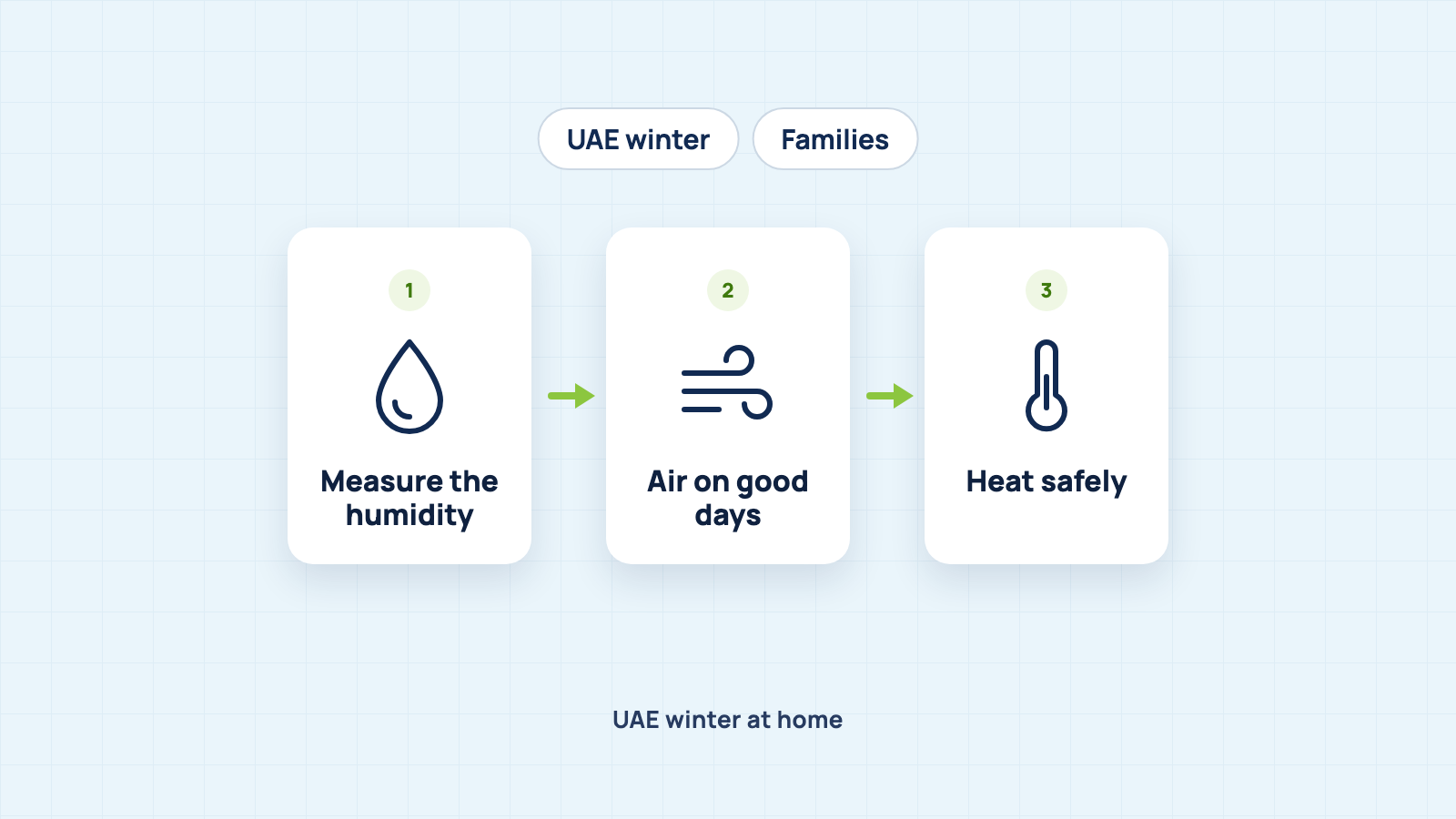
UAE winter changes indoor air in three ways. On the Abu Dhabi coast, NCM data show it is the most humid time of year, so condensation, musty rooms and mould become more likely, especially after rain and on foggy nights. Dust is usually lower than in summer, but Shamal winds still bring dusty days. Cooler evenings bring heaters, and with them fire and carbon monoxide risks. Measure humidity before you buy anything: keep it below 60%, ideally between 30 and 50%, open the windows on good-air days, and run heaters only while an adult is awake in the room, switching them off before anyone sleeps.
What does UAE winter do to the air inside your home?
Most UAE homes are built for the summer: sealed, air-conditioned and closed to the outside. Winter changes the outdoor air those homes sit in. The table sums up what each change does indoors and what helps.
| Winter change | What happens indoors | What helps |
|---|---|---|
| Humid nights and fog | Condensation on windows and cold surfaces, musty wardrobes, mould in corners and around AC vents | Keep humidity below 60%; a dehumidifier in rooms that stay damp |
| Rain | Leaks around windows and roofs, wet floors and furniture, mould a few days later | Air the room, dry everything within 24 to 48 hours, check the AC |
| Shamal and dusty days | Fine dust on surfaces and in the air, worse for children with asthma | Keep windows shut on bad-air days; a HEPA air purifier |
| Cooler evenings | Heaters in bedrooms and living rooms, sometimes charcoal or incense burners | Electric heaters only, 1 m clear around them, never charcoal indoors |
| School holidays and flu season | Children home for the winter break; coughs and colds go round | Fresh air on good days, flu vaccination, a purifier in shared rooms |
Is the UAE humid in winter?
Yes. The National Center of Meteorology (NCM) gives the UAE’s average winter relative humidity as 55 to 64%, and describes December as a shift toward “cooler and more humid conditions”, with maximum humidity often between 79% and 90%. At NCM’s Abu Dhabi Corniche station, mean humidity from 2003 to 2025 was 65% in December and 66% in January and February, and the daily minimum stayed between 48% and 51%, higher than in any other month (July’s mean daily minimum is 39%). On the Abu Dhabi coast, winter is the dampest season, not the driest.
Fog is the visible sign. NCM explains that fog forms when the air is stable, humidity is high and winds are light, mostly in the early morning, as moist air moves in from the Arabian Gulf. December has seen up to 20 foggy days in a single month (2014), and NCM’s January summary notes that fog is more frequent inland than on the coast.
Indoors, the trouble starts where humid air meets a cold surface. The US Environmental Protection Agency (EPA) explains that warm, humid air condenses on cold surfaces, and air-conditioned walls, window frames, wardrobe backs and AC vents are exactly that. Damp surfaces are where mould grows, and the World Health Organization (WHO) found that people in damp or mouldy homes are at higher risk of respiratory symptoms, respiratory infections and worse asthma.
What to do. Put a digital hygrometer in the rooms you worry about and read it morning and evening for a week. Dubai Municipality and the US EPA give the same target: keep indoor humidity below 60%, ideally between 30 and 50%. Our guide to indoor humidity in UAE homes explains how to read the numbers, and why an AC can leave a room humid.
The Dubai Health Authority (DHA) advises using a dehumidifier to keep living spaces dry; use one where a room stays above 60%. For villa living areas and large apartments, Stadler Form Lukas Pro is the dehumidifier HawaQ recommends most often for homes near the sea: Stadler Form Lukas Pro removes up to 50 litres a day and is rated for rooms up to 175 m². That is a rated maximum: Stadler Form says it is reached only from about 22 °C and 70% humidity, so a cooled room will see less. It drains continuously through the included hose, has a digital hygrostat and an H11 particle filter, and carries a 5-year Pro Series warranty. For a bedroom or a smaller apartment, Stadler Form Lukas or Albert is usually enough. We measured first in our Al Reem Island villa case study and in more than 50 waterfront homes in Dubai.
What should you do after rain?
Rain is rare but it matters. At NCM’s Abu Dhabi Corniche station almost all of the year’s rain falls between December and April, and NCM notes that winter rain is occasional but can be intense. The DHA warns that damp from heavy rain and floods encourages mould in buildings, which worsens asthma and allergies.
- Air it out. After flooding, the DHA advises opening doors and windows for at least 30 minutes to air the home out.
- Dry it fast. The US EPA advises drying water-damaged areas and items within 24 to 48 hours, before mould takes hold. Run a dehumidifier and fans with the door closed.
- Find the leak. Dubai Municipality tells owners to inspect plumbing, roofs and windows for leaks. A stain that returns after every rain is a building repair, not a cleaning job.
- Check the AC. The DHA advises having the ventilation and air-conditioning system checked and cleaned after flooding.
- Keep children out of rainwater. The DHA advises stopping children from playing in pooled rainwater.
Stadler Form’s guide to why indoor humidity rises after rain covers drying in more detail. If mould is already visible, read why mould keeps coming back before you paint over it, or book mould testing.
Dusty days and fresh air: when to open the windows
Winter is usually the cleaner season for dust, not the dusty one. A study of Abu Dhabi air found particle pollution (PM10 and PM2.5) high from April to September and low from October to March, usually at its lowest by December. Dusty days still happen: NCM notes that the north-westerly Shamal blows sand and dust over inland areas in January, and passing low-pressure systems stir up dust in February.
That makes winter a good time to let fresh air in, on the right days. The Emirati Air Quality Index guideline counts infants and children as sensitive groups. Abu Dhabi’s official air quality site describes a “Good” day as an excellent time to open the windows, and on “Unhealthy” days says circulating outdoor air is not recommended, particularly where sensitive people are present; from “Moderate” upward it advises keeping an air purifier running when they are at home. Check the index before you open up; our guide to what a high Dubai AQI means indoors explains the bands, and why houses get so dusty covers sealing and cleaning.
For a family or living room, MedicAir Pro is a good fit. MedicAir Pro combines a pre-filter, a HEPA filter (H13 by MedicAir’s specification), activated carbon and an enclosed UV-C chamber. MedicAir rates it at up to 605 m³/h at its highest setting and 180 m³/h at 28 dB on low, which suits a living room, majlis or family room; an open-plan space may need a Pro Max, and a Pro Mini suits a single bedroom. Our MedicAir Pro Mini, Pro and Pro Max comparison sizes them room by room, and PRO TECHnology’s guide to air purifiers for villas and apartments works through the sums. A purifier cleans the air in the room but brings in no fresh air, so it does not lower carbon dioxide; see why a closed bedroom gets stuffy.
Heaters and children: keeping warm safely
NCM puts average winter minimums at 14 to 16 °C, and temperatures drop most at night and in the early morning, so many homes bring out a heater. Electric heaters are the safer choice indoors, though they still cause fires if misused. Charcoal, firewood and gas burned in a closed room are not.
Dubai Police issued a carbon monoxide warning after two domestic workers died when charcoal was left burning overnight to heat their room, and advised toxic-gas detectors and never using essence or coal burners in closed places. Abu Dhabi Police and Abu Dhabi Civil Defence warned against sleeping near fire sources and said heaters should not be used for cooking, drying clothes or burning incense. The US Centers for Disease Control and Prevention (CDC) adds that people who are asleep can die of carbon monoxide poisoning before they have any symptoms, says never to burn charcoal indoors, and advises a carbon monoxide alarm near every bedroom. Our bakhoor and indoor air guide covers incense smoke.
- 1 m clear. The US National Fire Protection Association (NFPA) says to keep anything that can burn at least 1 m from a heater, and to keep a 1 m “kid-free zone” around it.
- Straight into the wall. Plug an electric heater directly into a wall socket, never an extension cord (NFPA).
- Pick one that switches off if knocked over. NFPA advises choosing a heater with an automatic shut-off for that, and keeping children away from it.
- Off when you leave or sleep. Turn portable heaters off when you leave the room or go to bed (NFPA).
- Never charcoal indoors. Not in a bedroom, a majlis or a closed tent, and not to dry clothes or burn incense on a heater.
For a living room, TV room or home office, Stadler Form Erik adds warmth and atmosphere without a flame. Stadler Form Erik is a 3-in-1 fan heater, flame-effect fireplace and aroma diffuser. The flames are LED light on a fine, cool water mist, so nothing burns and there is no soot, and the flame effect and fragrance also run with the heating off. It has two heat settings up to 1,500 W, a digital thermostat (18, 20 or 22 °C), an infrared remote, and Stadler Form recommends it for rooms up to about 20 m². Erik won a Red Dot in the Red Dot Award: Product Design 2026. Stadler Form is a Swiss design brand founded in 1998, and Erik suits the rooms where the family sits together in the evening. Its manual says to use the heater only under supervision: switch the heating off before you sleep or go out, keep it 50 cm from walls and furniture, keep curtains or anything flammable 1 m from the air outlet, and plug it straight into a wall socket. Keep young children away from it. That makes it a heater for a living room where an adult is present, never for a child’s bedroom, overnight or unattended use. Stadler Form’s Erik guide covers settings and running costs, and its room heater guide compares fan, ceramic and oil heaters for UAE homes.
Erik’s aroma tray takes a few drops of essential oil in water, and nothing is burned. Fragrance is still something to use lightly with children: the American Lung Association says some essential oils can trigger asthma symptoms and that a room with a diffuser should be well ventilated, and US Poison Control (poison.org) advises keeping essential oils locked away from children. Around a baby, or anyone with asthma, run the flame effect without oil.
Does your baby need a humidifier in the UAE winter?
Often not, at least near the coast, and only if you measure a dry room. Many parenting sites say UAE winter air is dry, but the NCM figures above show that on the Abu Dhabi coast winter is the most humid part of the year. The American Academy of Pediatrics (AAP) explains that cold, dry winter air thickens nasal mucus and that moist air can ease a stuffy nose; that advice is written for heated homes in cold climates, where indoor air really is dry.
The US EPA says not to humidify above 50% relative humidity, because higher humidity encourages dust mites and mould. So put a hygrometer in the nursery first. The thresholds below are HawaQ’s rule of thumb, built on the EPA’s 30 to 50% range:
| Hygrometer reading | What it means | What to do |
|---|---|---|
| Below 30% | Dry air, for example in a room heated for hours | A cool-mist humidifier, set to stay below 50% |
| 30 to 50% | The range the EPA recommends | Nothing to add |
| 50 to 60% | Humid enough | Do not humidify; air the room on good-air days |
| Above 60% | Too humid; mould and dust mites thrive | Dry the room: ventilation and a dehumidifier |
If you do need one, the AAP says cool-mist humidifiers are safer for young children than warm-mist humidifiers or steam vaporizers because they cannot burn, and that the water should be changed every day so mould and bacteria do not grow in the machine. Clean it as the maker says, and keep it out of the baby’s reach. Our guide to dust mites and allergies explains why a nursery that is kept too humid can make allergies worse.
Flu season, school holidays and fresh air
Winter is the season for coughs and colds. The Ministry of Health and Prevention (MoHAP) runs its national flu and seasonal respiratory disease campaign from 15 September 2026 to March 2027, recommends flu vaccination from six months of age, and lists children under five among the priority groups. It says the vaccine takes about two weeks to work, so it is best given before the seasonal peak. A DHA data study of 2017 to 2019, reported by The National in 2020, found that almost half of recorded flu cases were in children under 10, and that infections peaked in November and December.
The same national campaign lists good ventilation in indoor spaces alongside handwashing and vaccination. In its COVID-19 ventilation guidance, the WHO says better indoor ventilation lowers the risk of the virus spreading indoors and that, when it is very hot or cold outside, you can open windows for a few minutes every hour. The CDC says cleaner indoor air lowers the amount of germs in the air and the chance of respiratory illness, and lists portable HEPA air cleaners among the steps. With children home for the winter break, that means short window openings on good-air days and a HEPA purifier running in the room where everyone gathers.
A winter checklist for UAE families
- Buy a hygrometer. One for each bedroom you worry about. Aim for below 60%, ideally 30 to 50%.
- Check wardrobes and window frames. Musty smells, condensation and grey or black spots are the early signs of winter damp.
- Dehumidify rooms that stay above 60%. Doors closed, drain hose to a floor drain for rooms you do not visit daily.
- After rain, dry within 24 to 48 hours. Air the room for at least 30 minutes, find the leak, check the AC.
- Open the windows on good-air days. Check the air quality index first; keep them shut on dusty or unhealthy days.
- Run a HEPA purifier where the family gathers. Size it to the room’s volume, not just its floor area.
- Use electric heaters only. 1 m clear, plugged into the wall, and only while an adult is awake in the room.
- Fit a carbon monoxide alarm near bedrooms if anything in the home burns fuel.
- Go easy on fragrance around babies and anyone with asthma.
- Book flu vaccinations early. From six months of age, before the seasonal peak.
When is it worth measuring?
A hygrometer answers the humidity question for most rooms. It is worth calling in a professional when mould keeps coming back, when a child’s asthma or allergies get worse at home, or when you are about to buy several dehumidifiers or purifiers for a villa and want them in the right rooms. HawaQ’s indoor air quality monitoring logs humidity, temperature, particles, carbon dioxide and VOCs over days, and air quality testing gives a snapshot. We measure first and recommend equipment only where the readings call for it.
HawaQ is a PRO TECHnology Group company. PRO TECHnology distributes Stadler Form in the UAE and MedicAir in the GCC, so we have a commercial link to the products named here. We measure first and recommend equipment only where the readings call for it.
Frequently asked questions
Is it humid in the UAE in winter?
Yes. The National Center of Meteorology gives average winter humidity of 55 to 64%, and its Abu Dhabi Corniche station averaged 65% in December and 66% in January and February between 2003 and 2025, the highest of the year at that station. Indoors, that shows up as condensation, musty rooms and mould.
Why is there so much fog in the UAE in winter?
Fog forms when the air is stable, humidity is high and winds are light, mostly in the early morning, as moist air moves in from the Arabian Gulf. The National Center of Meteorology says fog becomes more frequent in December, and its January summary notes it is more common inland than on the coast.
Does my baby need a humidifier in the UAE winter?
Often not near the coast: NCM data for the Abu Dhabi coast show winter is the most humid time of year. Measure the nursery with a hygrometer first. HawaQ’s rule of thumb: only if it reads below 30% is a cool-mist humidifier worth using, set to stay below 50%, with the water changed every day.
Is it safe to use a heater in a child’s room?
Use only an electric heater, and only while an adult is awake in the room. The US NFPA advises keeping children and anything that can burn 1 m away, plugging it straight into a wall socket, choosing one that switches off if knocked over, and turning it off before the child sleeps. Never burn charcoal, wood or incense in a closed room, because carbon monoxide can kill a sleeping person before any symptoms appear.
Should I open the windows in winter in the UAE?
Yes on good-air days, when Abu Dhabi’s official air quality site calls it an excellent time to open windows. Keep them shut on dusty or unhealthy days, especially with children at home, and run an air purifier instead.
How do I stop mould after rain?
Air the room for at least 30 minutes, dry wet areas and items within 24 to 48 hours, fix the leak, and keep humidity below 60% with a dehumidifier if needed. Mould that is already visible needs cleaning or specialist removal, not paint.
Sources
- National Center of Meteorology via WAM. Winter season starts in UAE with cooler weather, 22 December 2025 (winter averages; fog conditions). wam.ae
- National Center of Meteorology via WAM. UAE records cooler temperatures, higher humidity in December, 3 December 2025. wam.ae
- National Center of Meteorology. Climate Yearly Report, Abu Dhabi Corniche station, 2003 to 2025 (humidity and rainfall by month). mobile.ncm.gov.ae
- Aletihad. UAE climate in January: cold, windy and foggy weather forecast (NCM monthly summary), 2 January 2024. en.aletihad.ae
- Aletihad. NCM highlights February weather trends, 2 February 2025. en.aletihad.ae
- Dubai Health Authority. Your Health Guide during Weather Challenges, May 2024. dha.gov.ae
- Dubai Municipality. Technical Guideline for Mold Remediation and Control, Version 1, 2025. dmpmedia.dm.gov.ae
- US EPA. A Brief Guide to Mold, Moisture, and Your Home. epa.gov
- US EPA. Mold Course, Chapter 2. epa.gov
- WHO Regional Office for Europe. WHO guidelines for indoor air quality: dampness and mould, 2009. iris.who.int
- Abuelgasim A, Farahat A. Investigations on PM10, PM2.5, and their ratio over the Emirate of Abu Dhabi, United Arab Emirates. Earth Systems and Environment 2020;4:763-775. link.springer.com
- Guideline for calculating the Emirati Air Quality Index (EAQI), 2023 (hosted on the NCM air quality portal). airquality.ncm.gov.ae
- Environment Agency Abu Dhabi. Abu Dhabi air quality (health advice by AQI band). adairquality.ae
- Khaleej Times. Dubai Police warn about carbon monoxide poisoning. khaleejtimes.com
- Aletihad. Abu Dhabi Police warn against risks when using charcoal and heating devices, December 2025. en.aletihad.ae
- US CDC. Carbon monoxide poisoning basics. cdc.gov
- NFPA. Heating safety tips. content.nfpa.org
- NFPA. Portable electric space heater safety tips. content.nfpa.org
- American Academy of Pediatrics (HealthyChildren.org). Cough and cold survival kit. healthychildren.org
- American Academy of Pediatrics (HealthyChildren.org). My baby has a stuffy nose: how can I help them sleep safely? healthychildren.org
- US EPA. Use and care of home humidifiers. epa.gov
- MoHAP via WAM. Ministry of Health and Prevention launches awareness campaign on influenza and seasonal respiratory diseases, 15 September 2026. wam.ae
- MoHAP via WAM. Ministry of Health to launch influenza, seasonal respiratory diseases campaign Tuesday. wam.ae
- The National. Half of UAE flu cases in under-10s (DHA study, 2017 to 2019). thenationalnews.com
- WHO. Ventilation and air conditioning (questions and answers), 2021. who.int
- US CDC. Taking steps for cleaner air for respiratory virus prevention. cdc.gov
- American Lung Association. Essential Oils: More Harmful Than Helpful? lung.org
- Poison Control (US). Essential oils. poison.org
Sources read on 15 November 2026. Climate figures are NCM’s published averages; outdoor humidity is not indoor humidity, so measure your own rooms. Product details are as published by the manufacturers on that date. This guide is general information, not medical advice.